
Gastroprotective Effect of the Aqueous Fraction of Tamarindus indica L. Leaves Against Aspirin-Induced Gastric Injury in Mice

Article Sidebar
-
Tamarindus indica L, Aqueous fraction, Gastroprotective, Aspirin, Gastric mucosa
Abstract
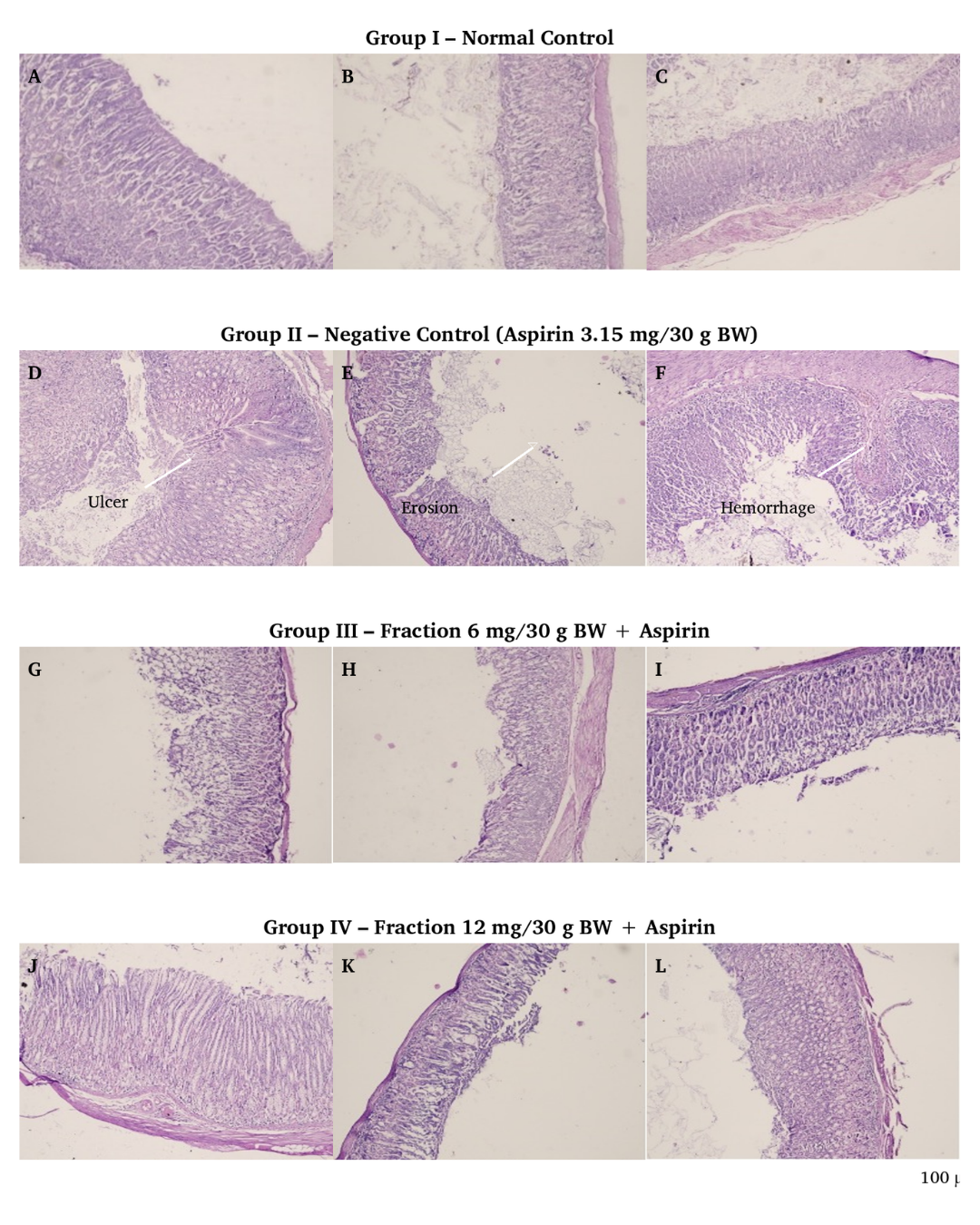
Tamarindus indica L. leaves contain bioactive compounds, particularly tannins and saponins, which may contribute to gastric mucosal protection. This study aimed to evaluate the gastroprotective effect of the aqueous fraction of T. indica leaves in aspirin-induced gastric injury in mice. Twelve mice were randomly divided into four groups (n = 3): normal control, negative control, and two treatment groups receiving the aqueous fraction at doses of 6 mg/30 g and 12 mg/30 g body weight prior to aspirin induction. Gastroprotective activity was assessed through macroscopic observation and histopathological examination of gastric tissues. Aspirin administration caused gastric mucosal injury characterized by erosion, ulceration, and hemorrhage. Treatment with the aqueous fraction reduced gastric damage and improved epithelial integrity. The dose of 12 mg/30 g body weight showed the most pronounced protective effect. These findings suggest that the aqueous fraction of T. indica leaves has potential gastroprotective activity.
Full text article
References
Alharbi, M. M., Qureshi, S., Raza, M., Ahmed, M. M., Afzal, M., & Shah, A. H. (1994). Evaluation of Caralluma tuberculata pretreatment for the protection of rat gastric mucosa against toxic damage. Toxicology and Applied Pharmacology, 128(1), 1–8. https://doi.org/10.1006/taap.1994.1173
Ameh, G. I., & Eze, C. S. (2010). Phytochemical constituents of some Nigerian plants. Journal of Biological Research and Biotechnology, 8(1), 614–617. https://doi.org/10.4314/br.v8i1.62544
Azwanida, N. N. (2015). A review on the extraction methods used in medicinal plants: Principles, strengths, and limitations. Medicinal & Aromatic Plants, 4, Article 196. https://doi.org/10.4172/2167-0412.1000196
Bancroft, J. D., & Gamble, M. (2008). Theory and practice of histological techniques (6th ed.). Elsevier.
Beck, P. L., Xavier, R., Lu, N., Nanda, N. N., Dinauer, M., Podolsky, D. K., & Seed, B. (2000). Mechanisms of NSAID-induced gastrointestinal injury defined using mutant mice. Gastroenterology, 119(3), 699–705. https://doi.org/10.1053/gast.2000.16497
Bhadoriya, S. S., Ganeshpurkar, A., Narwaria, J., Rai, G., & Jain, A. P. (2011). Tamarindus indica: Extent of explored potential. Pharmacognosy Reviews, 5(9), 73–81. https://doi.org/10.4103/0973-7847.79102
Borrelli, F., & Izzo, A. A. (2000). The plant kingdom as a source of anti-ulcer remedies. Phytotherapy Research, 14(8), 581–591. https://doi.org/10.1002/1099-1573(200012)14:8<581::AID-PTR776>3.0.CO;2-S
Chanudom, L., & Tangpong, J. (2015). Anti-inflammatory property of Syzygium cumini (L.) Skeels on indomethacin-induced acute gastric ulceration. Gastroenterology Research and Practice, 2015, Article 343642. https://doi.org/10.1155/2015/343642
Devi, R. S., Narayan, S., Vani, G., & Devi, C. S. S. (2007). Gastroprotective effect of Terminalia arjuna bark on diclofenac sodium-induced gastric ulcer. Chemico-Biological Interactions, 167(1), 71–83. https://doi.org/10.1016/j.cbi.2007.01.011
Karmana, I. W. (2024). Kandungan fitokimia daun asam jawa dan potensinya sebagai bioagen antibakteri untuk pengobatan alami. Biocaster: Jurnal Kajian Biologi, 4(2), 89–95. https://doi.org/10.36312/biocaster.v4i2.274
Kmiec, Z. (2016). J. A. Kiernan: Histological and histochemical methods: Theory and practice. Folia Histochemica et Cytobiologica, 54(1), 58–59. https://doi.org/10.5603/FHC.a2016.0007
Kumar, S., Suman, Sharma, S., & Kalra, P. (2011). Antiulcer effect of the methanolic extract of Tamarindus indica seeds in different experimental models. Journal of Pharmacy and Bioallied Sciences, 3(2), 236–241. https://doi.org/10.4103/0975-7406.80778
Kvietys, P. R., Yaqinuddin, A., & Al Kattan, W. (2014). Gastrointestinal mucosal defense system. Morgan & Claypool Life Sciences.
Laine, L., Takeuchi, K., & Tarnawski, A. (2008). Gastric mucosal defense and cytoprotection: Bench to bedside. Gastroenterology, 135(1), 41–60. https://doi.org/10.1053/j.gastro.2008.05.030
Oates, P. J., & Hakkinen, J. P. (1988). Studies on the mechanism of ethanol-induced gastric damage in rats. Gastroenterology, 94(1), 10–21. https://doi.org/10.1016/0016-5085(88)90604-X
Pal, G. K. (2021). Textbook of medical physiology (4th ed.). Elsevier.
Rahimah, S., Awaluddin, A., & Wahyuddin, N. (2022). Pengaruh fraksi daun asam jawa (Tamarindus indica L.) terhadap fungsi hati dan ginjal tikus diinduksi parasetamol. Jurnal Kefarmasian Indonesia, 12(2), 155–162. https://doi.org/10.22435/jki.v0i0.5955
Raja, N. L., Jegan, N., & Wesley, J. (2008). Antiulcerogenic activity of alcoholic extract of the leaves of Tamarindus indica (L.) on experimental ulcer models. Pharmacologyonline, 3, 85–92.
Santoso, J. (2017). Efektivitas infusa akar manis sebagai anti tukak lambung tikus yang diinduksi asetosal. Jurnal Kebidanan dan Kesehatan Tradisional, 2(1), 51–59. https://doi.org/10.37341/jkkt.v2i1.21
Satapathy, T., Sen, K., Sahu, S., Pradhan, B., Gupta, A., Khan, M. A., Kumar, D., Satapathy, A., & Yadav, N. (2024). Experimental animal models for gastric ulcer/peptic ulcer: An overview. Journal of Drug Delivery and Therapeutics, 14(1), 182–192. https://doi.org/10.22270/jddt.v14i1.6258
Senguttuvan, J., Paulsamy, S., & Karthika, K. (2014). Phytochemical analysis and evaluation of leaf and root parts of the medicinal herb Hypochaeris radicata L. for in vitro antioxidant activities. Asian Pacific Journal of Tropical Biomedicine, 4(Suppl. 1), S359–S367. https://doi.org/10.12980/APJTB.4.2014C1030
Shackelford, C., Long, G., Wolf, J., Okerberg, C., & Herbert, R. (2002). Qualitative and quantitative analysis of nonneoplastic lesions in toxicology studies. Toxicologic Pathology, 30(1), 93–96. https://doi.org/10.1080/01926230252824761
Singh, S., Khajuria, A., Taneja, S. C., Khajuria, R. K., Singh, J., Johri, R. K., & Qazi, G. N. (2008). The gastric ulcer protective effect of boswellic acids, a leukotriene inhibitor from Boswellia serrata, in rats. Phytomedicine, 15(6–7), 408–415. https://doi.org/10.1016/j.phymed.2008.02.017
Szabo, S., & Hollander, D. (1989). Pathways of gastrointestinal protection and repair: Mechanisms of action of sucralfate. The American Journal of Medicine, 86(6A), 23–31. https://doi.org/10.1016/0002-9343(89)90153-8
Takeuchi, K. (2012). Pathogenesis of NSAID-induced gastric damage: Importance of cyclooxygenase inhibition and gastric hypermotility. World Journal of Gastroenterology, 18(18), 2147–2160. https://doi.org/10.3748/wjg.v18.i18.2147
Takeuchi, K., & Amagase, K. (2018). Roles of cyclooxygenase, prostaglandin E2 and EP receptors in mucosal protection and ulcer healing in the gastrointestinal tract. Current Pharmaceutical Design, 24(18), 2002–2011. https://doi.org/10.2174/1381612824666180629111227
Tiwari, P., Kumar, B., Kaur, M., Kaur, G., & Kaur, H. (2011). Phytochemical screening and extraction: A review. Internationale Pharmaceutica Sciencia, 1(1), 98–106.
Zakaria, M. N. M., Islam, M. W., Radhakrishnan, R., Liu, X. M., Ismail, A., Kamil, M., Chan, K., & Al-Attas, A. (2002). Anti-gastric ulcer and cytoprotective properties of Caralluma arabica. Pharmaceutical Biology, 40(3), 225–230. https://doi.org/10.1076/PHBI.40.3.225.5830
Authors

This work is licensed under a Creative Commons Attribution-NonCommercial-ShareAlike 4.0 International License. Copyright @2017. This is an open-access article distributed under the terms of the Creative Commons Attribution-NonCommercial-ShareAlike 4.0 International License (http://creativecommons.org/licenses/by-nc-sa/4.0/) which permits unrestricted non-commercial used, distribution and reproduction in any medium