
Molecular Docking of Active Compound of Okra (Abelmoschus esculentus L.) on α-Glucosidase as Antidibetic Mellitus Drug Candidate

Article Sidebar
-
α-glucosidase, Diabetes, Docking, Flavonoids, Okra
Abstract
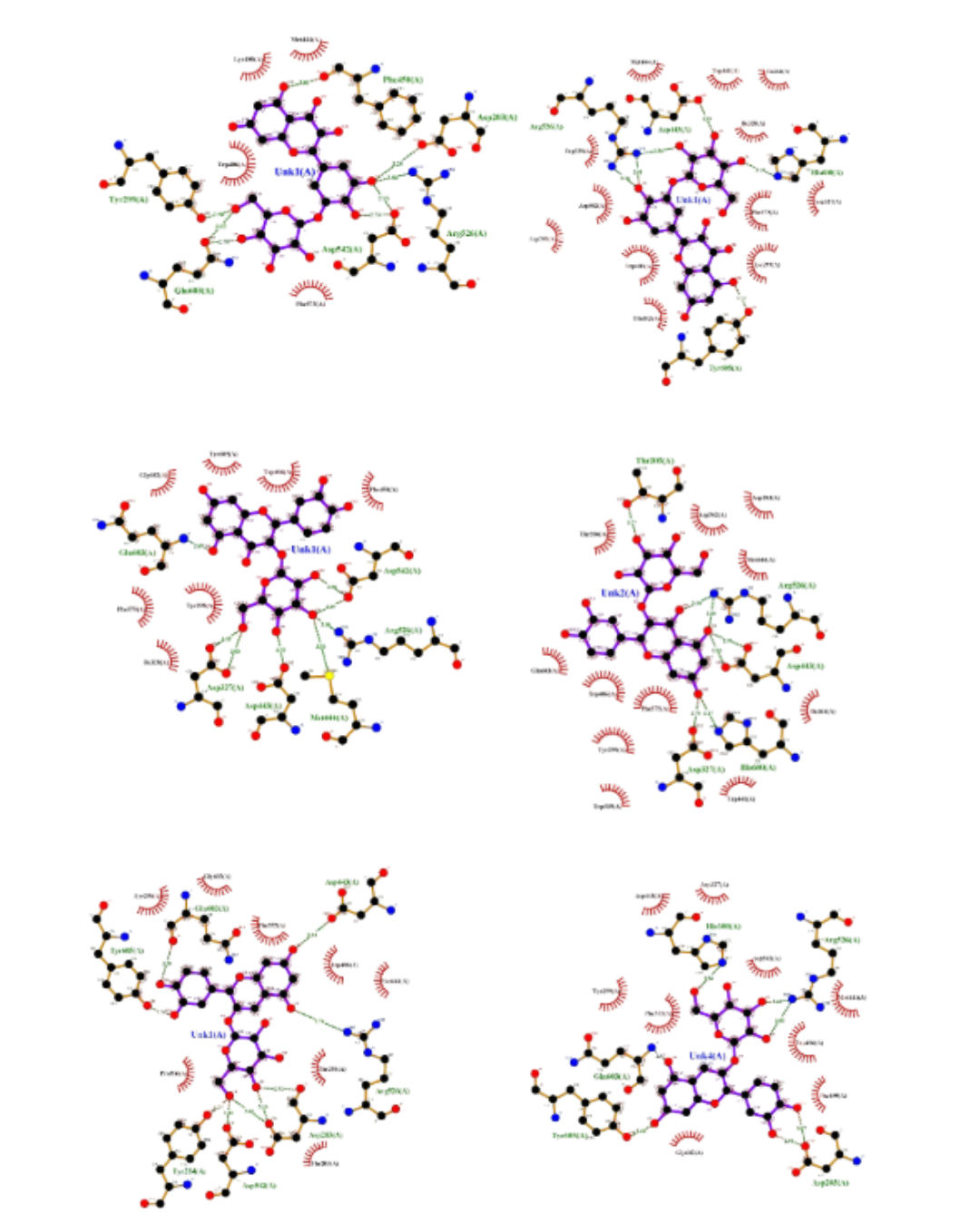
Diabetes mellitus (DM) is a leading cause of death among degenerative diseases, primarily due to impaired insulin function that disrupts carbohydrate metabolism. One therapeutic strategy involves α-glucosidase inhibitors that delay glucose absorption. Abelmoschus esculentus (okra) is rich in phenolic and flavonoid compounds with antihyperglycemic and antioxidant activity, suggesting potential as α-glucosidase inhibitors. This study evaluated the inhibitory potential of okra-derived compounds against α-glucosidase using in silico molecular docking with PLANTS and YASARA Structure. The analysis included physicochemical screening, ligand–receptor preparation, and docking simulations, assessing docking score, Gibbs free energy (ΔG), and dissociation constant (Kd). Cannabiscitrin, a flavonoid from okra, demonstrated the strongest binding affinity, outperforming the reference drug acarbose in all parameters. These findings suggest its potential as an alternative antidiabetic agent.
Full text article
References
Abdel-Razek, M. A. M., Abdelwahab, M. F., Abdelmohsen, U. R., & Hamed, A. N. E. (2023). A review: Pharmacological activity and phytochemical profile of Abelmoschus esculentus (2010–2022). RSC Advances, 13(22), 15280–15294. https://doi.org/10.1039/D3RA
Antar, S., Ashour, N., Sharaky, M., Khattab, M., Ashour, N., Zaid, R., Roh, E., Elkamhawy, A., & Al-Karmalawy, A. (2023). Diabetes mellitus: Classification, mediators, and complications; A gate to identify potential targets for the development of new effective treatments. Biomedicine & Pharmacotherapy, 168, 115734. https://doi.org/10.1016/j.biopha.2023.115734
Bahari, F. A., Rusly, N. N., Mohd Rais, N. H., & Hassan, H. A. (2024). Potential of okra (Abelmoschus esculentus) in managing diabetes: A review of phytochemical and pharmacological evidence. Frontiers in Pharmacology, 14, 1254789. https://doi.org/10.3389/fphar.2024.1254789
Chedik, L., Mias-Lucquin, D., Bruyere, A., & Fardel, O. (2017). In silico prediction for intestinal absorption and brain penetration of chemical pesticides in humans. International Journal of Environmental Research and Public Health, 14(7), 708. https://doi.org/10.3390/ijerph14070708
Daina, A., Michielin, O., & Zoete, V. (2017). SwissADME: A free web tool to evaluate pharmacokinetics, drug-likeness, and medicinal chemistry friendliness of small molecules. Scientific Reports, 7, 42717. https://doi.org/10.1038/srep42717
Emilda. (2018). Efek senyawa bioaktif kayu manis (Cinnamomum burmanii NEES EX.BL.) terhadap diabetes melitus: Kajian pustaka. Jurnal Fitofarmaka Indonesia, 5(1), 246–252. https://doi.org/10.33096/jffi.v5i1.316
Friedman, R. (2022). Computational studies of protein–drug binding affinity changes upon mutations in the drug target. WIREs Computational Molecular Science, 12, e1563. https://doi.org/10.1002/wcms.1563
Gomes, M. F. P., de Moura, E. O. C., Cardoso, N. M., da Silva, G. A., dos Santos, A. C. C., de Souza, F. S., Estadella, D., Lambertucci, R. H., Lago, J. H. G., & Medeiros, A. (2023). Supplementation with okra combined or not with exercise training is able to protect the heart of animals with metabolic syndrome. Scientific Reports, 13, 1468. https://doi.org/10.1038/s41598-023-28072-7
Institute for Health Metrics and Evaluation. (2021). Burden of disease. https://vizhub.healthdata.org/gbd-compare/
Kashtoh, H., & Baek, K. H. (2022). Recent updates on phytoconstituent alpha-glucosidase inhibitors: An approach towards the treatment of type 2 diabetes. Plants, 11(20), 2722. https://doi.org/10.3390/plants11202722
Korb, O., Stützle, T., & Exner, T. E. (2009). Empirical scoring functions for advanced protein-ligand docking with PLANTS. Journal of Chemical Information and Modeling, 49(1), 84–96. https:// doi.org/10.1021/ci800298z
Laskowski, R. A., & Swindells, M. B. (2011). LigPlot+: Multiple ligand–protein interaction diagrams for drug discovery. Journal of Chemical Information and Modeling, 51(10), 2778–2786. https://doi.org/10.1021/ci200227u
Liao, H., Dong, W., Shi, X., Liu, H., & Yuan, K. (2012). Analysis and comparison of the active components and antioxidant activities of extracts from Abelmoschus esculentus L. Pharmacognosy Magazine, 8(30), 156–161. https://doi.org/10.4103/0973-1296.96570
Lipinski, C. A., Lombardo, F., Dominy, B. W., & Feeney, P. J. (1997). Experimental and computational approaches to estimate solubility and permeability in drug discovery and development settings. Advanced Drug Delivery Reviews, 23(1–3), 3–25. https://doi.org/10.1016/S0169-409X(96)00423-1
Lipinski, C. A., Lombardo, F., Dominy, B. W., & Feeney, P. J. (2001). Experimental and computational approaches to estimate solubility and permeability in drug discovery and development settings. Advanced Drug Delivery Reviews, 46(1–3), 3–26. https://doi.org/10.1016/S0169-409X(00)00129-0
Maffettone, A., Rinaldi, M., & Fontanella, A. (2018). Postprandial hyperglycemia: A new frontier in diabetes management? Italian Journal of Medicine, 12(2), 108–115. https://doi.org/10.4081/itjm.2018.961
Megawati, E., Ekyastuti, W., & Herawatiningsih, R. (2020). Keanekaragaman jenis tumbuhan berkhasiat obat di Hutan Kampus Universitas Tanjungpura Pontianak. Jurnal Hutan Lestari, 8(4), 825–839.
Ministry of Health, Republic of Indonesia. (2007). Report on the results of the national basic health research (Riskesdas) 2007. National Institute of Health Research and Development. https://repository.badankebijakan.kemkes.go.id/id/eprint/4386/1/Report%20on%20Result%20of%20National%20Basic%20Health%20Research%202007.pdf
Ministry of Health, Republic of Indonesia. (2013). National report on basic health research (Riskesdas) 2013. https://repository.badankebijakan.kemkes.go.id/id/eprint/4467/1/Laporan_riskesdas_2013_final.pdf
Ministry of Health, Republic of Indonesia. (2019). National report on basic health research (Riskesdas) 2018. https://repository.badankebijakan.kemkes.go.id/id/eprint/3514/1/Laporan%20Riskesdas%202018%20Nasional.pdf
Nhlapho, S., Nyathi, M. H., Ngwenya, B. L., Dube, T., Telukdarie, A., Munien, I., Vermeulen, A., & Chude-Okonkwo, U. A. (2024). Druggability of pharmaceutical compounds using Lipinski rules with machine learning. Sciences of Pharmacy, 3(4), 177–192. https://doi.org/10.58920/sciphar0304264
Pilot, P. (2016). BIOVIA Discovery Studio Modelling Environment (Release). Dassault Systèmes.
Popoviciu, M. S., Kaka, N., Sethi, Y., Patel, N., Chopra, H., & Cavalu, S. (2023). Type 1 diabetes mellitus and autoimmune diseases: A critical review of the association and the application of personalized medicine. Journal of Personalized Medicine, 13(3), 422. https://doi.org/10.3390/jpm13030422
Pratama, M., & Suhartono, E. (2018). Understanding the interaction between glutathione and acetaminophen: A docking study approach. Dentino: Jurnal Kedokteran Gigi, 3(2), 215–219. https://doi.org/10.20527/dentino.v3i2.6027
Rajalakshmi, R., Lalitha, P., Sharma, S. C., Rajiv, A., Chithambharan, A., & Ponnusamy, A. (2021). In silico studies: Physicochemical properties, drug score, toxicity predictions and molecular docking of organosulphur compounds against diabetes mellitus. Journal of Molecular Recognition, 34(11), e2925. https://doi.org/10.1002/jmr.2925
Rollando, R., Aktivitas, P. S., & Senyawa, P. M. (2018). 2-iminoethyl 2-(2-(1-hydroxypentan-2-yl) phenyl)acetate hasil isolasi fungi endofit genus Fusarium sp. pada enzim β-ketoasil-ACP kasa synthase dan enzim asam mikolat siklopropana synthase. Pharmaceutical Journal of Indonesia, 3(2), 45–51. https://doi.org/10.21776/ubpji.2017.003.02.2
Sabitha, V., Panneerselvam, K., Ramachandran, S., & Naveen, K. R. (2012). In vitro α-glucosidase and α-amylase enzyme inhibitory effects in aqueous extracts of Abelmoschus esculentus (L.) Moench. Asian Pacific Journal of Tropical Biomedicine, 2(1), S162–S164. https://doi.org/10.1016/S2221-1691(12)60150-6
Saputri, K. E., Fakhmi, N., Kusumaningtyas, E., Priyatama, D., & Santoso, B. (2016). Docking molecular potensi inhbisi anti diabetes mellitus tipe 2 turunan zerumbon sebagai inhibitor aldose reduktase dengan Autodock-Vina. Chimica et Natura Acta, 4(1), 16–20. https://doi.org/10.24198/cna.v4.n1.10443
Siddique, M. H., Ashraf, A., Hayat, S., Aslam, B., Fakhar-e-Alam, M., Muzammil, S., Atif, M., Shahi, M., Shafeeq, S., Afzal, M., Ahmad, S., & others. (2022). Antidiabetic and antioxidant potentials of Abelmoschus esculentus: In vitro combined with molecular docking approach. Journal of Saudi Chemical Society, 26, 101418. https://doi.org/10.1016/j.jscs.2021.101418
Silva, E. L., Lobo, J. F., Vinther, J. M., Borges, R. M., & Staerk, D. (2016). High-resolution α-glucosidase inhibition profiling combined with HPLC-HRMS-SPE-NMR for identification of antidiabetic compounds in Eremanthus crotonoides (Asteraceae). Molecules, 21(6), 782. https://doi.org/10.3390/molecules21060782
Sim, L., Quezada-Calvillo, R., Sterchi, E. E., Nichols, B. L., & Rose, D. R. (2008). Human intestinal maltase-glucoamylase: Crystal structure of the N-terminal catalytic subunit and basis of inhibition and substrate specificity. Journal of Molecular Biology, 375(3), 782–792. https://doi.org/10.1016/j.jmb.2007.10.069
Syahputra, G., Ambarsari, L., & Sumaryada, T. (2014). Simulasi docking kurkumin enol, bisdemetoksikurkumin dan analognya sebagai inhibitor enzim 12-lipoksigenase. Jurnal Biofisika, 10(1), 55–67. https://doi.org/10.13140/RG.2.2.30614.55363
Widyasari, E. M., Sriyani, M. E., Daruwati, I., Halimah, I., & Nuraeni, W. (2019). Karakteristik fisiko-kimia senyawa bertanda 99mTc-kuersetin. Indonesian Journal of Nuclear Science and Technology, 20(1), 9–18. https://doi.org/10.17146/jstni.2019.1.1.4108
Zakir, M., Ahuja, N., Surksha, M. A., Sachdev, R., Kalariya, Y., Nasir, M., Kashif, M., Shahzeen, F., Tayyab, A., Khan, M. S. M., Junejo, M., Kumar, M., Varrassi, G., Kumar, S., Khatri, M., & Mohamad, T. (2023). Cardiovascular complications of diabetes: From microvascular to macrovascular pathways. Cureus, 15(9), e45835.
Authors

This work is licensed under a Creative Commons Attribution-NonCommercial-ShareAlike 4.0 International License. Copyright @2017. This is an open-access article distributed under the terms of the Creative Commons Attribution-NonCommercial-ShareAlike 4.0 International License (http://creativecommons.org/licenses/by-nc-sa/4.0/) which permits unrestricted non-commercial used, distribution and reproduction in any medium