
Aqueous Extract of Gembili (Dioscorea esculenta) Tubers Exceeds Its Ethanol Fractions in Phenolic Content and Antioxidant Capacity

Article Sidebar
-
Ethanol precipitation, Folin–Ciocalteu, Inulin, Radical scavenging
Abstract
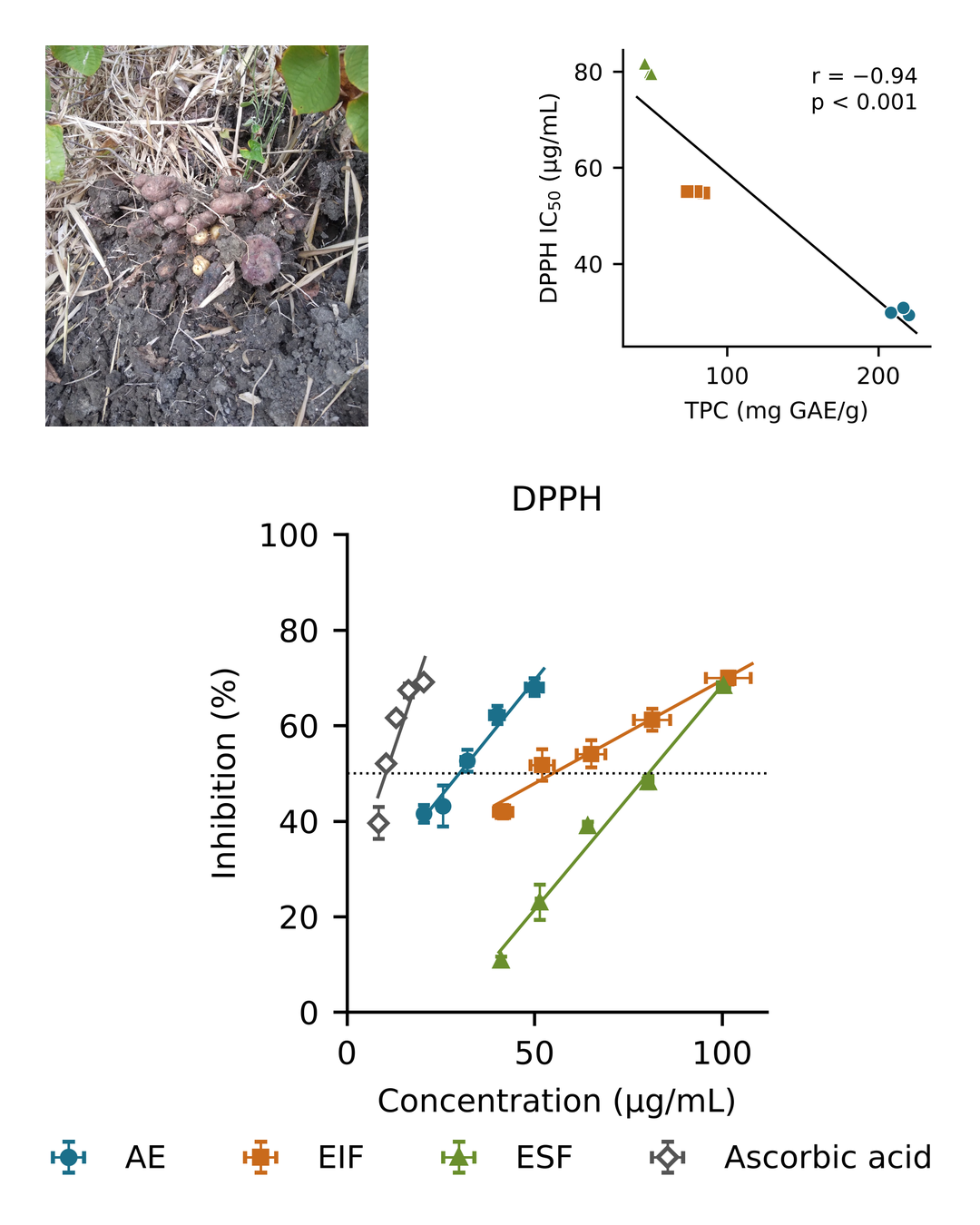
Gembili (Dioscorea esculenta) tubers are used in Indonesia mainly as a source of inulin, recovered from hot-water extracts by ethanol precipitation, but how antioxidants partition during this step is unknown. A hot-water extract (AE) was compared with its ethanol-insoluble (EIF) and ethanol-soluble (ESF) fractions for total phenolic (TPC) and flavonoid (TFC) contents and for 2,2-diphenyl-1-picrylhydrazyl (DPPH), 2,2′-azinobis(3-ethylbenzothiazoline-6-sulfonic acid) (ABTS), and ferric reducing antioxidant power (FRAP) activities. AE had the highest TPC (214.9 ± 6.1 mg gallic acid equivalents/g) and TFC (159.7 ± 6.5 mg quercetin equivalents/g), the lowest IC50 values (DPPH 30.0 ± 0.8; ABTS 28.5 ± 1.9 µg/mL), and the highest FRAP (269 ± 42 mg ascorbic acid equivalents/g). EIF exceeded ESF in all assays except FRAP (p < 0.001), and antioxidant capacity followed TPC across nine determinations (DPPH IC50, r = −0.94). The inulin-rich precipitate therefore retains part of the antioxidant capacity of the tuber.
Full text article
References
Adomėnienė, A., & Venskutonis, P. R. (2022). Dioscorea spp.: Comprehensive review of antioxidant properties and their relation to phytochemicals and health benefits. Molecules, 27(8), 2530. https://doi.org/10.3390/molecules27082530 DOI: https://doi.org/10.3390/molecules27082530
Amarasekara, R., & Wickramarachchi, S. R. (2021). Antioxidant activity of phenolic compounds in Dioscorea alata L. (raja ala) tuber cooking water. Acta Chemica Iasi, 29(2), 183–200. https://doi.org/10.47743/achi-2021-2-0013 DOI: https://doi.org/10.47743/achi-2021-2-0013
Bai, Y., Fan, B., Liu, J., Wang, F., & Zhang, M. (2026). Processing shapes architecture, cultivar dictates chemistry: A structural and functional paradigm for yam polysaccharides. Foods, 15(5), 921. https://doi.org/10.3390/foods15050921 DOI: https://doi.org/10.3390/foods15050921
Benzie, I. F. F., & Strain, J. J. (1996). The ferric reducing ability of plasma (FRAP) as a measure of “antioxidant power”: The FRAP assay. Analytical Biochemistry, 239(1), 70–76. https://doi.org/10.1006/abio.1996.0292 DOI: https://doi.org/10.1006/abio.1996.0292
Brand-Williams, W., Cuvelier, M. E., & Berset, C. (1995). Use of a free radical method to evaluate antioxidant activity. LWT – Food Science and Technology, 28(1), 25–30. https://doi.org/10.1016/S0023-6438(95)80008-5 DOI: https://doi.org/10.1016/S0023-6438(95)80008-5
Fernandes, P. A. R., & Coimbra, M. A. (2023). The antioxidant activity of polysaccharides: A structure–function relationship overview. Carbohydrate Polymers, 314, 120965. https://doi.org/10.1016/j.carbpol.2023.120965 DOI: https://doi.org/10.1016/j.carbpol.2023.120965
Ghozaly, M. R., Elya, B., Hanafi, M., & Setiawan, H. (2026). Ultrasound-assisted extraction enhances phenolic, flavonoid, and antioxidant profiles of Spatholobus littoralis roots. Jurnal Jamu Indonesia, 11(3), 211–216. https://doi.org/10.29244/jji.v11i3.501 DOI: https://doi.org/10.29244/jji.v11i3.501
Hilman, A., Harmayani, E., & Cahyanto, M. N. (2021). The potential of gembili (Dioscorea esculenta L.) and dahlia (Dahlia spp. L.) from Indonesia as prebiotic compound. IOP Conference Series: Earth and Environmental Science, 782(3), 032109. https://doi.org/10.1088/1755-1315/782/3/032109 DOI: https://doi.org/10.1088/1755-1315/782/3/032109
Jiang, S., Xie, H., Zuo, Y., Sun, J., Wu, D., & Shu, X. (2024). Structural and functional properties of polysaccharides extracted from three Dioscorea species. International Journal of Biological Macromolecules, 281(Pt 4), 136469. https://doi.org/10.1016/j.ijbiomac.2024.136469 DOI: https://doi.org/10.1016/j.ijbiomac.2024.136469
Kiss, A., Papp, V. A., Pál, A., Prokisch, J., Mirani, S., Toth, B. E., & Alshaal, T. (2025). Comparative study on antioxidant capacity of diverse food matrices: Applicability, suitability and inter-correlation of multiple assays to assess polyphenol and antioxidant status. Antioxidants, 14(3), 317. https://doi.org/10.3390/antiox14030317 DOI: https://doi.org/10.3390/antiox14030317
Lawag, I. L., Nolden, E. S., Schaper, A. A. M., Lim, L. Y., & Locher, C. (2023). A modified Folin–Ciocalteu assay for the determination of total phenolics content in honey. Applied Sciences, 13(4), 2135. https://doi.org/10.3390/app13042135 DOI: https://doi.org/10.3390/app13042135
Munteanu, I. G., & Apetrei, C. (2021). Analytical methods used in determining antioxidant activity: A review. International Journal of Molecular Sciences, 22(7), 3380. https://doi.org/10.3390/ijms22073380 DOI: https://doi.org/10.3390/ijms22073380
Muñoz-Bernal, Ó. A., Torres-Aguirre, G. A., Núñez-Gastélum, J. A., de la Rosa, L. A., Rodrigo-García, J., Ayala-Zavala, J. F., & Álvarez-Parrilla, E. (2017). Nuevo acercamiento a la interacción del reactivo de Folin–Ciocalteu con azúcares durante la cuantificación de polifenoles totales [A new approach to the interaction of the Folin–Ciocalteu reagent with sugars during the quantification of total polyphenols]. TIP Revista Especializada en Ciencias Químico-Biológicas, 20(2), 23–28. https://doi.org/10.1016/j.recqb.2017.04.003 DOI: https://doi.org/10.1016/j.recqb.2017.04.003
Murtado, A. D., Yani, A. V., & Idealistuti, I. (2025). Analysis of antioxidant activity and natural prebiotic in gembili tubers (Dioscorea esculenta). Journal of Global Sustainable Agriculture, 5(3), 368–373. https://doi.org/10.32502/jgsa.v5i3.1367 DOI: https://doi.org/10.32502/jgsa.v5i3.1367
Padhan, B., Nayak, J. K., & Panda, D. (2020). Natural antioxidant potential of selected underutilized wild yams (Dioscorea spp.) for health benefit. Journal of Food Science and Technology, 57(6), 2370–2376. https://doi.org/10.1007/s13197-020-04470-x DOI: https://doi.org/10.1007/s13197-020-04470-x
Peng, K., Li, Y., Sun, Y., Xu, W., Wang, H., Zhang, R., & Yi, Y. (2023). Lotus root polysaccharide–phenol complexes: Interaction, structure, antioxidant, and anti-inflammatory activities. Foods, 12(3), 577. https://doi.org/10.3390/foods12030577 DOI: https://doi.org/10.3390/foods12030577
Pérez, M., Dominguez-López, I., & Lamuela-Raventós, R. M. (2023). The chemistry behind the Folin–Ciocalteu method for the estimation of (poly)phenol content in food: Total phenolic intake in a Mediterranean dietary pattern. Journal of Agricultural and Food Chemistry, 71(46), 17543–17553. https://doi.org/10.1021/acs.jafc.3c04022 DOI: https://doi.org/10.1021/acs.jafc.3c04022
Pico, J., Pismag, R. Y., Laudouze, M., & Martinez, M. M. (2020). Systematic evaluation of the Folin–Ciocalteu and Fast Blue BB reactions during the analysis of total phenolics in legumes, nuts and plant seeds. Food & Function, 11(11), 9868–9880. https://doi.org/10.1039/d0fo01857k DOI: https://doi.org/10.1039/D0FO01857K
Platzer, M., Kiese, S., Herfellner, T., Schweiggert-Weisz, U., & Eisner, P. (2021). How does the phenol structure influence the results of the Folin–Ciocalteu assay? Antioxidants, 10(5), 811. https://doi.org/10.3390/antiox10050811 DOI: https://doi.org/10.3390/antiox10050811
Putri, W. D. R., Riyanto, E. I., Heliana, A., Wellang, A., & Zubaidah, E. (2021). Optimization of microwave-assisted extraction (MAE) time and material to solvent ratio of gembili (Dioscorea esculenta) water-soluble polysaccharides (WSP). Industria: Jurnal Teknologi dan Manajemen Agroindustri, 10(1), 78–98. https://doi.org/10.21776/ub.industria.2021.010.01.9 DOI: https://doi.org/10.21776/ub.industria.2021.010.01.9
Re, R., Pellegrini, N., Proteggente, A., Pannala, A., Yang, M., & Rice-Evans, C. (1999). Antioxidant activity applying an improved ABTS radical cation decolorization assay. Free Radical Biology and Medicine, 26(9–10), 1231–1237. https://doi.org/10.1016/S0891-5849(98)00315-3 DOI: https://doi.org/10.1016/S0891-5849(98)00315-3
Rumpf, J., Burger, R., & Schulze, M. (2023). Statistical evaluation of DPPH, ABTS, FRAP, and Folin–Ciocalteu assays to assess the antioxidant capacity of lignins. International Journal of Biological Macromolecules, 233, 123470. https://doi.org/10.1016/j.ijbiomac.2023.123470 DOI: https://doi.org/10.1016/j.ijbiomac.2023.123470
Shraim, A. M., Ahmed, T. A., Rahman, M. M., & Hijji, Y. M. (2021). Determination of total flavonoid content by aluminum chloride assay: A critical evaluation. LWT, 150, 111932. https://doi.org/10.1016/j.lwt.2021.111932 DOI: https://doi.org/10.1016/j.lwt.2021.111932
Sies, H., Berndt, C., & Jones, D. P. (2017). Oxidative stress. Annual Review of Biochemistry, 86, 715–748. https://doi.org/10.1146/annurev-biochem-061516-045037 DOI: https://doi.org/10.1146/annurev-biochem-061516-045037
Singleton, V. L., Orthofer, R., & Lamuela-Raventós, R. M. (1999). Analysis of total phenols and other oxidation substrates and antioxidants by means of Folin–Ciocalteu reagent. Methods in Enzymology, 299, 152–178. https://doi.org/10.1016/S0076-6879(99)99017-1 DOI: https://doi.org/10.1016/S0076-6879(99)99017-1
Tamaroh, S., & Sudrajat, A. (2021). Antioxidative characteristics and sensory acceptability of bread substituted with purple yam (Dioscorea alata L.). International Journal of Food Science, 2021, 5586316. https://doi.org/10.1155/2021/5586316 DOI: https://doi.org/10.1155/2021/5586316
Tatara, K., & Sato, K. (2025). Chronic intake of Dioscorea esculenta suppresses testicular atrophy, enhances the ability of protection from inflammation in type 2 diabetes rats. The Journal of Steroid Biochemistry and Molecular Biology, 250, 106730. https://doi.org/10.1016/j.jsbmb.2025.106730 DOI: https://doi.org/10.1016/j.jsbmb.2025.106730
Winarti, S., Harmayani, E., Marsono, Y., & Pranoto, Y. (2013). Pengaruh foaming pada pengeringan inulin umbi gembili (Dioscorea esculenta) terhadap karakteristik fisiko-kimia dan aktivitas prebiotik [Effect of foaming on the drying of gembili (Dioscorea esculenta) tuber inulin on its physicochemical characteristics and prebiotic activity]. Agritech, 33(4), 424–432. https://journal.ugm.ac.id/agritech/article/view/9538
Wołosiak, R., Drużyńska, B., Derewiaka, D., Piecyk, M., Majewska, E., Ciecierska, M., Worobiej, E., & Pakosz, P. (2021). Verification of the conditions for determination of antioxidant activity by ABTS and DPPH assays—A practical approach. Molecules, 27(1), 50. https://doi.org/10.3390/molecules27010050 DOI: https://doi.org/10.3390/molecules27010050
Xue, H., Du, X., Fang, S., Gao, H., Xie, K., Wang, Y., & Tan, J. (2024). The interaction of polyphenols–polysaccharides and their applications: A review. International Journal of Biological Macromolecules, 278(Pt 1), 134594. https://doi.org/10.1016/j.ijbiomac.2024.134594 DOI: https://doi.org/10.1016/j.ijbiomac.2024.134594
Yang, L., Wang, W., Liu, Z., Zhai, Y., Wang, Z., Li, Y., Zhang, Z., Hou, B., Zhang, B., & Zhou, J. (2025). Widely targeted metabolomics reveals the bioactive metabolites and antioxidant activities of Chinese yam (Dioscorea opposita Thunb.) peel. Biomedical Chromatography, 39(5), e70085. https://doi.org/10.1002/bmc.70085 DOI: https://doi.org/10.1002/bmc.70085
Zubaidah, E., & Akhadiana, W. (2013). Comparative study of inulin extracts from dahlia, yam, and gembili tubers as prebiotic. Food and Nutrition Sciences, 4(11A), 8–12. https://doi.org/10.4236/fns.2013.411A002 DOI: https://doi.org/10.4236/fns.2013.411A002
Authors
Copyright (c) 2026 Ika Puspitaningrum, Lia Kusmita

This work is licensed under a Creative Commons Attribution-NonCommercial-ShareAlike 4.0 International License.
This work is licensed under a Creative Commons Attribution-NonCommercial-ShareAlike 4.0 International License. Copyright is retained by the authors.