
Optimization of a Three-Extract Polyherbal Antioxidant Formulation Using Simplex Lattice Design

Article Sidebar
-
Antioxidant activity, Caesalpinia sappan, Mixture design, Polyherbal formulation, Simplex lattice design
Abstract
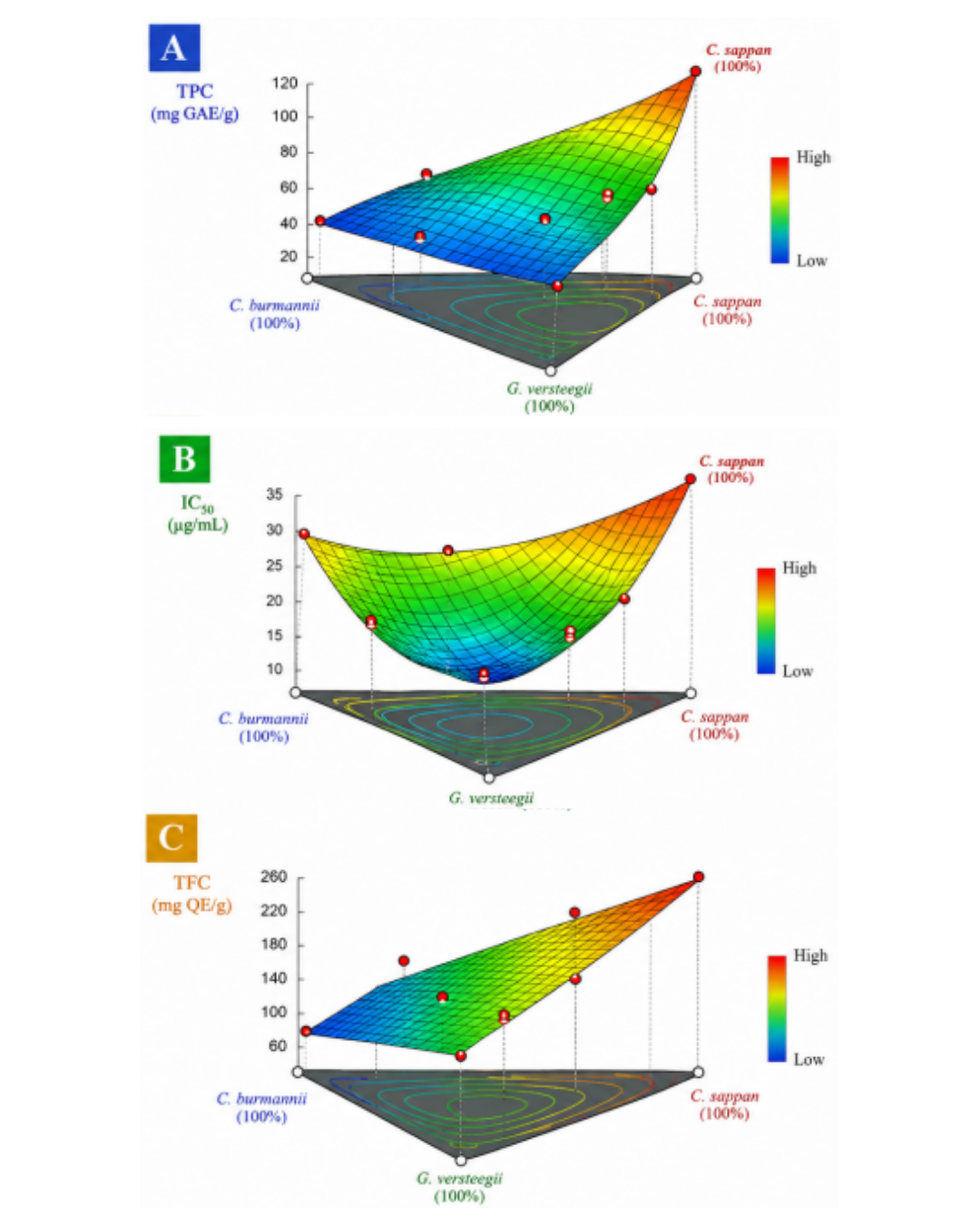
Polyherbal formulations have attracted increasing interest because combining plant extracts may improve phytochemical composition and antioxidant performance. This study aimed to optimize the proportions of ethanolic extracts of Cinnamomum burmannii bark, Gyrinops versteegii leaves, and Caesalpinia sappan wood using a simplex lattice design. Ten formulations were generated and evaluated for total phenolic content (TPC), total flavonoid content (TFC), total tannin content (TTC), and DPPH radical-scavenging activity (IC₅₀). The optimized formulation contained 10.00% C. burmannii, 21.51% G. versteegii, and 68.49% C. sappan, with experimental values of 79.27 mg GAE/g TPC, 197.64 mg QE/g TFC, 102.08 mg TAE/g TTC, and an IC₅₀ of 24.78 µg/mL. Experimental verification closely agreed with model predictions, with an average relative deviation of 2.95%. These findings demonstrate that simplex lattice design is an effective approach for optimizing polyherbal antioxidant formulations based on integrated phytochemical characteristics and antioxidant activity.
Full text article
References
Akmal, T., Julianti, A. I., & Syamsudin, S. S. (2023). Polyherbal formulation optimization from Clitoria ternatea, Rosmarinus officinalis, and Aquilaria malaccensis using simplex lattice design. International Journal of Applied Pharmaceutics, 15(Special Issue 2), 79–84. https://doi.org/10.22159/ijap.2023.v15s2.15
Amelia, P., Citraningsih, K., Dewi, A. K., Anggia, V., & Anggraeni, Y. (2025). Determination of total phenolic content and antioxidant activity of epigallocatechin gallate-rich fraction from tea leaves (Camellia sinensis L.). Jurnal Sains Farmasi & Klinis, 12(1), 36–40. https://doi.org/10.25077/jsfk.12.1.36-40.2025
Asevedo, E. A., Ramos Santiago, L., Kim, H. J., Syahputra, R. A., Park, M. N., Ribeiro, R. I. M. A., & Kim, B. (2025). Unlocking the therapeutic mechanism of Caesalpinia sappan: A comprehensive review of its antioxidant and anti-cancer properties, ethnopharmacology, and phytochemistry. Frontiers in Pharmacology, 15, Article 1514573. https://doi.org/10.3389/fphar.2024.1514573
Bahtiarsyah, A. A., Hidayati, L., Wijayanti, N., & Nuringtyas, T. R. (2023). Synergistic activity of Cinnamomum burmannii (Nees & T. Nees) Blume and Aquilaria malaccensis Lamk. extracts for antidiabetic study. The Indonesian Biomedical Journal, 15(2), 132–140. https://doi.org/10.18585/inabj.v15i2.2132
Baliyan, S., Mukherjee, R., Priyadarshini, A., Vibhuti, A., Gupta, A., Pandey, R. P., & Chang, C.-M. (2022). Determination of antioxidants by DPPH radical scavenging activity and quantitative phytochemical analysis of Ficus religiosa. Molecules, 27(4), Article 1326. https://doi.org/10.3390/molecules27041326
Budiastuti, Andini, Y. W., Cahyasari, I. A., Primaharinastiti, R., & Sukardiman. (2020). Standardization of Cinnamomum burmannii Nees ex Bl. bark from five areas of Indonesia. Pharmacognosy Journal, 12(3), 578–588. https://doi.org/10.5530/pj.2020.12.87
Fadzil, M. A. M., Abu Seman, N., & Abd Rashed, A. (2024). The potential therapeutic use of agarwood for diabetes: A scoping review. Pharmaceuticals, 17(11), Article 1548. https://doi.org/10.3390/ph17111548
Haile, M., & Kang, W. H. (2019). Antioxidant activity, total polyphenol, flavonoid, and tannin contents of fermented green coffee beans with selected yeasts. Fermentation, 5(1), Article 29. https://doi.org/10.3390/fermentation5010029
Hashim, Y. Z. H.-Y., Phirdaous, A., & Azura, A. (2014). Screening of anticancer activity from agarwood essential oil. Pharmacognosy Research, 6(3), 191–194. https://doi.org/10.4103/0974-8490.132593
Kementerian Kesehatan Republik Indonesia. (2022). Farmakope herbal Indonesia. Kementerian Kesehatan Republik Indonesia.
Kupina, S., Fields, C., Roman, M. C., & Brunelle, S. L. (2019). Determination of total phenolic content using the Folin–Ciocalteu assay: Single-laboratory validation, First Action 2017.13. Journal of AOAC International, 102(1), 320–321. https://doi.org/10.1093/jaoac/102.1.320
Lestari, S., Nasution, R., Ginting, C. N., & Lister, I. N. E. (2022). Determination of total flavonoid level and antioxidant activity of the ethyl acetate fraction of mangkokan leaf extract (Nothopanax scutellarium [Burm. f.] Merr.). Open Access Macedonian Journal of Medical Sciences, 10, 1001–1005. https://doi.org/10.3889/oamjms.2022.8131
Marangyana, I. G. B. I., Ugrasena, P. Y., & Monika, N. L. G. M. (2022). Analisis multi linear regression (MLR) pada fingerprint kromatografi andrografolid untuk memprediksi efek antikanker. Jurnal Mandala Pharmacon Indonesia, 8(1), 67–80. https://doi.org/10.35311/jmpi.v8i1.169
Matić, P., Sabljić, M., & Jakobek, L. (2017). Validation of spectrophotometric methods for the determination of total polyphenol and total flavonoid content. Journal of AOAC International, 100(6), 1795–1803. https://doi.org/10.5740/jaoacint.17-0066
Nikolaidis, M. G., Kerksick, C. M., Lamprecht, M., & McAnulty, S. R. (2012). Does vitamin C and E supplementation impair the favorable adaptations of regular exercise? Oxidative Medicine and Cellular Longevity, 2012, Article 707941. https://doi.org/10.1155/2012/707941
Olszowy-Tomczyk, M. (2020). Synergistic, antagonistic and additive antioxidant effects in the binary mixtures. Phytochemistry Reviews, 19(1), 63–103. https://doi.org/10.1007/s11101-019-09658-4
Pattananandecha, T., Apichai, S., Julsrigival, J., Ogata, F., Kawasaki, N., & Saenjum, C. (2022). Antibacterial activity against foodborne pathogens and inhibitory effect on anti-inflammatory mediator production of a brazilin-enriched extract from Caesalpinia sappan Linn. Plants, 11(13), Article 1698. https://doi.org/10.3390/plants11131698
Sari, D. R. A. P., Ugrasena, P. Y., & Indraswari, P. I. I. (2025). Pengaruh perbedaan ketinggian tumbuh daun miana (Coleus scutellarioides) di daerah Bali terhadap kadar flavonoid total. Herbal Medicine Journal, 8(2), 1–10. https://doi.org/10.58996/hmj.v8i2.156
Syahputra, H. (2024). Phytochemical screening and determination of phenolic and flavonoid contents in ethanol extract of Phyllanthus emblica L. fruit. Indonesian Journal of Pharmaceutical and Clinical Research, 7(2), 70–77. https://doi.org/10.32734/idjpcr.v7i2.18235
Vij, T., Anil, P. P., Shams, R., Dash, K. K., Kalsi, R., Pandey, V. K., Harsányi, E., Kovács, B., & Shaikh, A. M. (2023). A comprehensive review on bioactive compounds found in Caesalpinia sappan. Molecules, 28(17), Article 6247. https://doi.org/10.3390/molecules28176247
Wan, Y. J., Xu, L., Song, W. T., Liu, Y. Q., Wang, L. C., Zhao, M. B., Jiang, Y., Liu, L. Y., Zeng, K. W., & Tu, P. F. (2019). The ethanolic extract of Caesalpinia sappan heartwood inhibits cerebral ischemia/reperfusion injury in a rat model through a multitargeted pharmacological mechanism. Frontiers in Pharmacology, 10, Article 29. https://doi.org/10.3389/fphar.2019.00029
Wang, S., Yu, Z., Wang, C., Wu, C., Guo, P., & Wei, J. (2018). Chemical constituents and pharmacological activity of agarwood and Aquilaria plants. Molecules, 23(2), Article 342. https://doi.org/10.3390/molecules23020342
Yamauchi, M., Kitamura, Y., Nagano, H., Kawatsu, J., & Gotoh, H. (2024). DPPH measurements and structure–activity relationship studies on the antioxidant capacity of phenols. Antioxidants, 13(3), Article 309. https://doi.org/10.3390/antiox13030309
Authors
This work is licensed under a Creative Commons Attribution-NonCommercial-ShareAlike 4.0 International License. Copyright is retained by the authors.