
Network Pharmacology and Molecular Docking Analysis of Zingiberaceae Bioactive Compounds as Candidate Adjuncts for Hypertension Therapy

Article Sidebar
-
Hypertension, Molecular docking, Network pharmacology, TNF-α, Zingiberaceae
Abstract
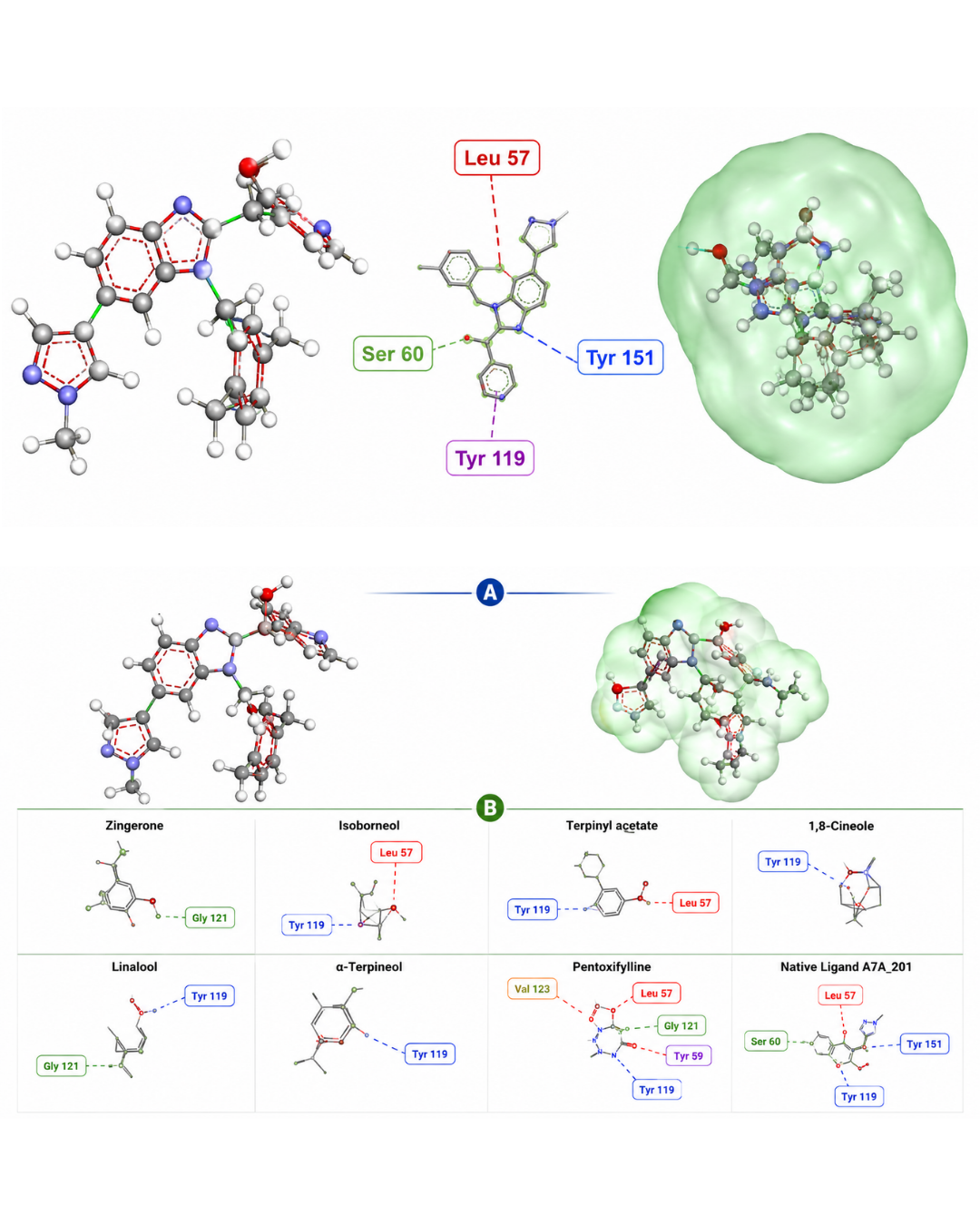
Hypertension remains a major cardiovascular risk factor, and plant-derived compounds may provide leads for adjunctive therapeutic development. This study evaluated bioactive compounds from six Zingiberaceae species using ADMET screening, network pharmacology, and molecular docking. Thirty-two compounds were screened with DeepPK using predicted human oral bioavailability (≥20%) and selected toxicity endpoints. Six compounds met the screening criteria: zingerone, isoborneol, terpinyl acetate, 1,8-cineole, linalool, and α-terpineol. SwissTargetPrediction, GeneCards, STRING, and Cytoscape analyses identified TNF as the highest-ranked hub by both degree and bottleneck metrics. Three independent native-ligand redocking runs against human TNF-α (PDB ID: 6OP0) yielded RMSD values below 2 Å. Pentoxifylline showed a Rerank Score of -43.846, whereas zingerone had the most favorable score among the selected plant compounds (-36.2546) and was predicted non-toxic for the screened endpoints. These computational findings prioritize zingerone for further experimental validation as a potential antihypertensive adjunct candidate.
Full text article
References
Aboukhater, D., Morad, B., Nasrallah, N., Nasser, S. A., Sahebkar, A., Kobeissy, F., Boudaka, A., & Eid, A. H. (2023). Inflammation and hypertension: Underlying mechanisms and emerging understandings. Journal of Cellular Physiology, 238(6), 1148–1159. https://doi.org/10.1002/jcp.31019
Angelova, M., Alov, P., Tsakovska, I., Jereva, D., Lessigiarska, I., Atanassov, K., Pajeva, I., & Pencheva, T. (2025). Pairwise performance comparison of docking scoring functions: Computational approach using InterCriteria analysis. Molecules, 30(13), 2777. https://doi.org/10.3390/molecules30132777
Buttenschoen, M., Morris, G. M., & Deane, C. M. (2024). PoseBusters: AI-based docking methods fail to generate physically valid poses or generalise to novel sequences. Chemical Science, 15(9), 3130–3139. https://doi.org/10.1039/D3SC04185A
Destryana, R. A., Estiasih, T., Sukardi, & Pranowo, D. (2024). The potential uses of galangal (Alpinia sp.) essential oils as the sources of biologically active compounds. AIMS Agriculture and Food, 9(4), 1064–1109. https://doi.org/10.3934/agrfood.2024057
Fadlan, A., & Nusantoro, Y. R. (2021). The effect of energy minimization on the molecular docking of acetone-based oxindole derivatives. JKPK (Jurnal Kimia dan Pendidikan Kimia), 6(1), 69–77. https://doi.org/10.20961/jkpk.v6i1.45467
Kumar, A. (2020). Phytochemistry, pharmacological activities and uses of traditional medicinal plant Kaempferia galanga L.—An overview. Journal of Ethnopharmacology, 253, 112667. https://doi.org/10.1016/j.jep.2020.112667
Liao, F., Yousif, M., Huang, R., Qiao, Y., & Hu, Y. (2023). Network pharmacology- and molecular docking-based analyses of the antihypertensive mechanism of Ilex kudingcha. Frontiers in Endocrinology, 14, 1216086. https://doi.org/10.3389/fendo.2023.1216086
Mao, Q. Q., Xu, X. Y., Cao, S. Y., Gan, R. Y., Corke, H., Beta, T., & Li, H. B. (2019). Bioactive compounds and bioactivities of ginger (Zingiber officinale Roscoe). Foods, 8(6), 185. https://doi.org/10.3390/foods8060185
Myung, Y., de Sá, A. G. C., & Ascher, D. B. (2024). Deep-PK: Deep learning for small molecule pharmacokinetic and toxicity prediction. Nucleic Acids Research, 52(W1), W469–W475. https://doi.org/10.1093/nar/gkae254
O'Connell, J., Porter, J., Kroeplien, B., Norman, T., Rapecki, S., Davis, R., McMillan, D., Arakaki, T., Burgin, A., Fox, D., III, Ceska, T., Lecomte, F., Maloney, A., Vugler, A., Carrington, B., Cossins, B. P., Bourne, T., & Lawson, A. (2019). Small molecules that inhibit TNF signalling by stabilising an asymmetric form of the trimer. Nature Communications, 10, 5795. https://doi.org/10.1038/s41467-019-13616-1
Oliveira, J. M. V., da Silva, A. D., Soares, A. M. D. S., & de Azevedo, W. F., Jr. (2026). Molegro Virtual Docker for docking screens. Methods in Molecular Biology, 2984, 139–152. https://doi.org/10.1007/978-1-0716-4949-7_10
Pavarino, M., Marengo, A., Cagliero, C., Bicchi, C., Rubiolo, P., & Sgorbini, B. (2023). Elettaria cardamomum (L.) Maton essential oil: An interesting source of bioactive specialized metabolites as inhibitors of acetylcholinesterase and butyrylcholinesterase. Plants, 12(19), 3463. https://doi.org/10.3390/plants12193463
Prasetyawan, S., Safitri, A., Atho'illah, M. F., & Rahayu, S. (2023). Computational evaluation of bioactive compounds in Curcuma zanthorrhiza targeting SIRT1 and NFκB. Biotechnologia, 104(2), 171–182. https://doi.org/10.5114/bta.2023.127206
Rahmat, E., Lee, J., & Kang, Y. (2021). Javanese turmeric (Curcuma xanthorrhiza Roxb.): Ethnobotany, phytochemistry, biotechnology, and pharmacological activities. Evidence-Based Complementary and Alternative Medicine, 2021, 9960813. https://doi.org/10.1155/2021/9960813
Ramos, R. H., Ferreira, C. de O. L., & Simao, A. (2024). Human protein-protein interaction networks: A topological comparison review. Heliyon, 10(5), e27278. https://doi.org/10.1016/j.heliyon.2024.e27278
Rhahmadini, Y. T., Mulatsari, E., Taqwa, I. A., Dhani, M., Mawijaya, A., Susanti, E., Simanjuntak, J. D., Mumpuni, E., & Prasetiyo, A. (2025). Molecular docking study of bioactive compounds in senggugu (Clerodendrum serratum (L.) Moon) as antidiabetics. Jurnal Kimia Riset, 10(1), 60–73. https://doi.org/10.20473/jkr.v10i1.68455
Seo, H., Haseeb, M., & Choi, S. (2026). Structural and molecular characterization of a small-molecule TNF-α-TNFR1 inhibitor modulating cell death signaling. Biochemical Pharmacology, 246, 117727. https://doi.org/10.1016/j.bcp.2026.117727
Vardhini, N. M., Punia, J., Jat, S., Pawar, S. D., Devi, N., Radhakrishnanand, P., Murty, U. S. N., Saini, A., Sethi, K. K., & Kumar, P. (2023). Purification and characterization of pure curcumin, desmethoxycurcumin, and bisdemethoxycurcumin from North-East India Lakadong turmeric (Curcuma longa). Journal of Chromatography A, 1708, 464358. https://doi.org/10.1016/j.chroma.2023.464358
World Health Organization. (2025). Global report on hypertension 2025: High stakes: Turning evidence into action. World Health Organization. https://www.who.int/publications/i/item/9789240115569
Yang, Y., Xie, Q., Zeng, J., Wu, M., Chen, D., Zhang, W., Lai, C., Shen, A., Lian, D., & Peng, J. (2026). Integrative network pharmacology and experimental study of Qingda granule in hypertension-induced endothelial dysfunction. Experimental Animals, 75(2), 131–143. https://doi.org/10.1538/expanim.25-0080
Yin, T., Zhang, H., Liu, X., Wei, D., Ren, C., Cui, L., Li, Y., Wang, L., Wang, J., Zhao, Z., Liu, D., Wang, L., & Han, X. (2024). Elucidating the anti-hypertensive mechanisms of Uncaria rhynchophylla–Alisma plantago-aquatica L.: An integrated network pharmacology, cluster analysis, and molecular docking approach. Frontiers in Chemistry, 12, 1356458. https://doi.org/10.3389/fchem.2024.1356458
Zhan, Q., Zhao, J., Liu, L., Wang, B., Hui, J., Lin, Q., Qin, Y., Xue, B., & Xu, F. (2023). Integrated network pharmacology and molecular docking analyses of the mechanisms underlying the antihypertensive effects of lotusine. European Journal of Pharmacology, 945, 175622. https://doi.org/10.1016/j.ejphar.2023.175622
Zhou, X., Afzal, S., Wohlmuth, H., Münch, G., Leach, D., Low, M., & Li, C. G. (2022). Synergistic anti-inflammatory activity of ginger and turmeric extracts in inhibiting lipopolysaccharide and interferon-γ-induced proinflammatory mediators. Molecules, 27(12), 3877. https://doi.org/10.3390/molecules27123877
Authors
This work is licensed under a Creative Commons Attribution-NonCommercial-ShareAlike 4.0 International License. Copyright is retained by the authors.