
Antibacterial Activity of Eugenia uniflora L. Leaf Extract Against Staphylococcus epidermidis: An In Vitro and In Silico Study

Article Sidebar
-
Acne, Antibacterial activity, Eugenia uniflora L., Molecular docking, Staphylococcus epidermidis
Abstract
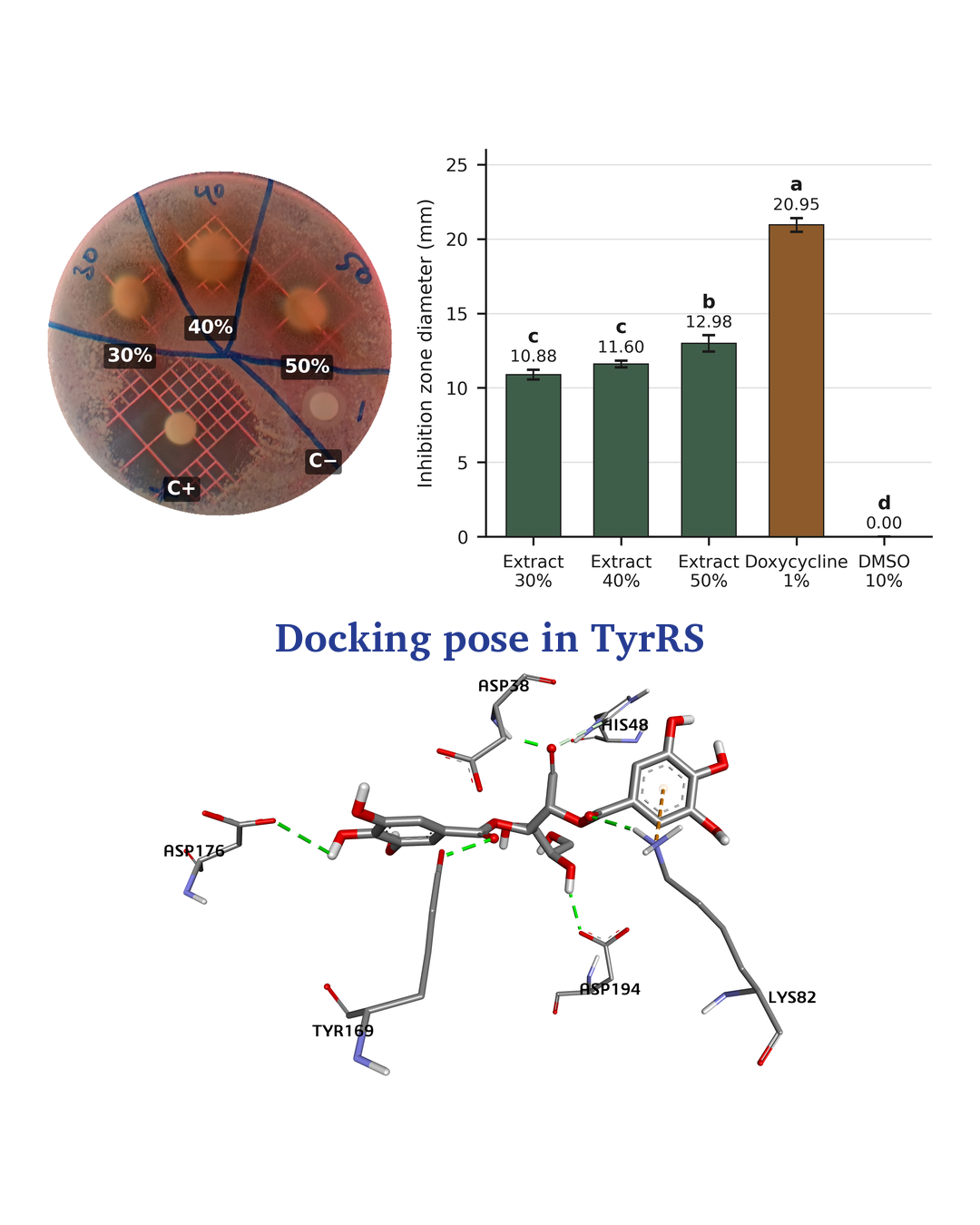
Acne is an inflammatory skin disorder commonly associated with Staphylococcus epidermidis. This study evaluated the antibacterial activity of 70% ethanolic extract of Eugenia uniflora L. leaves against S. epidermidis. The leaves were extracted by maceration using 70% ethanol and subjected to phytochemical screening. Antibacterial activity was tested using the disk diffusion method at concentrations of 30%, 40%, and 50%. In addition, molecular docking analysis was performed to investigate the potential interactions of literature-reported phytochemicals with the selected bacterial molecular target. Phytochemical screening revealed the presence of tannins, saponins, and steroids. The extract showed concentration-dependent antibacterial activity with inhibition zones of 10.88, 11.60, and 12.98 mm, respectively. Molecular docking suggested a possible interaction between 2,3-di-O-galloyl-D-glucose and tyrosyl-tRNA synthetase (TyrRS), with a binding affinity of −8.8 kcal/mol. These findings suggest that E. uniflora leaf extract has potential as a natural antibacterial agent against S. epidermidis.
Full text article
References
Adamczyk, B., Simon, J., Kitunen, V., Adamczyk, S., & Smolander, A. (2017). Tannins and their complex interaction with different organic nitrogen compounds and enzymes: Old paradigms versus recent advances. ChemistryOpen, 6(5), 610–614. https://doi.org/10.1002/open.201700113 DOI: https://doi.org/10.1002/open.201700113
Anwar, K., Lokana, F. M., & Budiarti, A. (2022). Antioxidant activity of dewandaru leaf (Eugenia uniflora L.) ethanol extract and determination of total flavonoid and phenolic content. Jurnal Ilmiah Sains, 22(2), 161–171. https://doi.org/10.35799/jis.v22i2.43913 DOI: https://doi.org/10.35799/jis.v22i2.43913
Aslan Kayıran, M., Karadağ, A. S., Al-Khuzaei, S., Chen, W., & Parish, L. C. (2020). Antibiotic resistance in acne: Mechanisms, complications and management. American Journal of Clinical Dermatology, 21(6), 813–819. https://doi.org/10.1007/s40257-020-00556-6 DOI: https://doi.org/10.1007/s40257-020-00556-6
Atkovska, K., Klingler, J., Oberwinkler, J., Keller, S., & Hub, J. S. (2018). Rationalizing steroid interactions with lipid membranes: Conformations, partitioning, and kinetics. ACS Central Science, 4(9), 1155–1165. https://doi.org/10.1021/acscentsci.8b00332 DOI: https://doi.org/10.1021/acscentsci.8b00332
Brick, P., Bhat, T. N., & Blow, D. M. (1989). Structure of tyrosyl-tRNA synthetase refined at 2.3 Å resolution. Interaction of the enzyme with the tyrosyl adenylate intermediate. Journal of Molecular Biology, 208(1), 83–98. https://doi.org/10.1016/0022-2836(89)90090-9 DOI: https://doi.org/10.1016/0022-2836(89)90090-9
Cruz, S., Vecerek, N., & Elbuluk, N. (2023). Targeting inflammation in acne: Current treatments and future prospects. American Journal of Clinical Dermatology, 24(5), 681–694. https://doi.org/10.1007/s40257-023-00789-1 DOI: https://doi.org/10.1007/s40257-023-00789-1
Davis, W. W., & Stout, T. R. (1971). Disc plate method of microbiological antibiotic assay: II. Novel procedure offering improved accuracy. Applied Microbiology, 22(4), 666–670. https://doi.org/10.1128/am.22.4.666-670.1971 DOI: https://doi.org/10.1128/am.22.4.666-670.1971
Dreno, B., Dekio, I., Baldwin, H., Demessant, A. L., Dagnelie, M.-A., Khammari, A., & Corvec, S. (2023). Acne microbiome: From phyla to phylotypes. Journal of the European Academy of Dermatology and Venereology, 38(4), 657–664. https://doi.org/10.1111/jdv.19540 DOI: https://doi.org/10.1111/jdv.19540
El-Saadony, M. T., Saad, A. M., Mohammed, D. M., Alkafaas, S. S., Abd El-Mageed, T. A., Fahmy, M. A., Ezzat Ahmed, A., Algopishi, U. B., Abu-Elsaoud, A. M., Mosa, W. F. A., AbuQamar, S. F., & El-Tarabily, K. A. (2025). Plant bioactive compounds: Extraction, biological activities, immunological, nutritional aspects, food application, and human health benefits—A comprehensive review. Frontiers in Nutrition, 12, 1659743. https://doi.org/10.3389/fnut.2025.1659743 DOI: https://doi.org/10.3389/fnut.2025.1659743
Fidelis, E. M., Savall, A. S. P., de Oliveira Pereira, F., Quines, C. B., Ávila, D. S., & Pinton, S. (2022). Pitanga (Eugenia uniflora L.) as a source of bioactive compounds for health benefits: A review. Arabian Journal of Chemistry, 15(4), 103691. https://doi.org/10.1016/j.arabjc.2022.103691 DOI: https://doi.org/10.1016/j.arabjc.2022.103691
Fortes, G. A. C., Carvalho, A. G., & Ramalho, R. R. F. (2015). Antioxidant activities of hydrolysable tannins and flavonoid glycosides isolated from Eugenia uniflora L. Records of Natural Products, 9(2), 251–256.
Fournière, M., Latire, T., Souak, D., Feuilloley, M. G. J., & Bedoux, G. (2020). Staphylococcus epidermidis and Cutibacterium acnes: Two major sentinels of skin microbiota and the influence of cosmetics. Microorganisms, 8(11), 1752. https://doi.org/10.3390/microorganisms8111752 DOI: https://doi.org/10.3390/microorganisms8111752
Garmus, T. T., Kopf, S. F. M., Paula, J. T., Aguiar, A. C., Duarte, G. H. B., Eberlin, M. N., & Cabral, F. A. (2019). Ethanolic and hydroalcoholic extracts of pitanga leaves (Eugenia uniflora L.) and their fractionation by supercritical technology. Brazilian Journal of Chemical Engineering, 36(2), 1041–1051. https://doi.org/10.1590/0104-6632.20190362s20180159 DOI: https://doi.org/10.1590/0104-6632.20190362s20180159
Hamann, T., Brüggemann, H., Feidenhansl, C., Rruci, E., Gallinger, J., Gallinat, S., & Hüpeden, J. (2025). Distinct intraspecies variation of Cutibacterium acnes and Staphylococcus epidermidis in acne vulgaris and healthy skin. Microorganisms, 13(2), 299. https://doi.org/10.3390/microorganisms13020299 DOI: https://doi.org/10.3390/microorganisms13020299
Kaz, A., Thirunavukkarasu, K., Almosd, L., Cho, E., Henkin, J., Acosta, K., Abzalimov, R., & Raskin, I. (2025). Potent surface antimicrobial activity of hydrolyzable tannins from Aleppo oak galls. Scientific Reports, 16(1), 3088. https://doi.org/10.1038/s41598-025-33013-7 DOI: https://doi.org/10.1038/s41598-025-33013-7
Khan, M. I., Ahhmed, A., Shin, J. H., Baek, J. S., Kim, M. Y., & Kim, J. D. (2018). Green Tea Seed Isolated Saponins Exerts Antibacterial Effects against Various Strains of Gram Positive and Gram Negative Bacteria, a Comprehensive Study In Vitro and In Vivo. Evidence-Based Complementary and Alternative Medicine, 2018(1), 3486106. https://doi.org/10.1155/2018/3486106 DOI: https://doi.org/10.1155/2018/3486106
Kozhantayeva, A., Tursynova, N., Kolpek, A., Aibuldinov, Y., Tursynova, A., Mashan, T., Mukazhanova, Z., Ibrayeva, M., Zeinuldina, A., Nurlybayeva, A., Iskakova, Z., & Tashenov, Y. (2024). Phytochemical profiling, antioxidant and antimicrobial potentials of ethanol and ethyl acetate extracts of Chamaenerion latifolium L. Pharmaceuticals, 17(8), 996. https://doi.org/10.3390/ph17080996 DOI: https://doi.org/10.3390/ph17080996
Layton, A. M., Thiboutot, D., & Tan, J. (2020). Reviewing the global burden of acne: How could we improve care to reduce the burden? British Journal of Dermatology, 184(2), 219–225. https://doi.org/10.1111/bjd.19477 DOI: https://doi.org/10.1111/bjd.19477
Layton, A. M., Bettoli, V., Delore, V., Puentes, E., & Tan, J. K. L. (2025). The burden of acne vulgaris on health-related quality of life and psychosocial well-being domains: A systematic review. American Journal of Clinical Dermatology, 27(1), 17–47. https://doi.org/10.1007/s40257-025-00983-3 DOI: https://doi.org/10.1007/s40257-025-00983-3
Lee, J.-E., Jayakody, J., Kim, J.-I., Jeong, J.-W., Choi, K.-M., Kim, T.-S., Seo, C., Azimi, I., Hyun, J., & Ryu, B. (2024). The influence of solvent choice on the extraction of bioactive compounds from Asteraceae: A comparative review. Foods, 13(19), 3151. https://doi.org/10.3390/foods13193151 DOI: https://doi.org/10.3390/foods13193151
Legiawati, L., Halim, P. A., Fitriani, M., Hikmahrachim, H. G., & Lim, H. W. (2023). Microbiomes in acne vulgaris and their susceptibility to antibiotics in Indonesia: A systematic review and meta-analysis. Antibiotics, 12(1), 145. https://doi.org/10.3390/antibiotics12010145 DOI: https://doi.org/10.3390/antibiotics12010145
Liu, J.-K. (2022). Natural products in cosmetics. Natural Products and Bioprospecting, 12(1), 40. https://doi.org/10.1007/s13659-022-00363-y DOI: https://doi.org/10.1007/s13659-022-00363-y
Lynn, D., Umari, T., Dellavalle, R., & Dunnick, C. (2016). The epidemiology of acne vulgaris in late adolescence. Adolescent Health, Medicine and Therapeutics, 7, 13–25. https://doi.org/10.2147/AHMT.S55832 DOI: https://doi.org/10.2147/AHMT.S55832
Pang, Y. L. J., Poruri, K., & Martinis, S. A. (2014). tRNA synthetase: tRNA aminoacylation and beyond. WIREs RNA, 5(4), 461–480. https://doi.org/10.1002/wrna.1224 DOI: https://doi.org/10.1002/wrna.1224
Rahimah, S. B., Djunaedi, D. D., Soeroto, A. Y., & Bisri, T. (2019). The phytochemical screening, total phenolic contents and antioxidant activities in vitro of white oyster mushroom (Pleurotus ostreatus) preparations. Open Access Macedonian Journal of Medical Sciences, 7(15), 2404–2412. https://doi.org/10.3889/oamjms.2019.741 DOI: https://doi.org/10.3889/oamjms.2019.741
Reynolds, R. V., Yeung, H., Cheng, C. E., Cook-Bolden, F., Desai, S. R., Druby, K. M., Freeman, E. E., Keri, J. E., Stein Gold, L. F., Tan, J. K. L., Tollefson, M. M., Weiss, J. S., Wu, P. A., Zaenglein, A. L., Han, J. M., & Barbieri, J. S. (2024). Guidelines of care for the management of acne vulgaris. Journal of the American Academy of Dermatology, 90(5), 1006.e1–1006.e30. https://doi.org/10.1016/j.jaad.2023.12.017 DOI: https://doi.org/10.1016/j.jaad.2023.12.017
Ruchiatan, K., Rizqandaru, T., Satjamanggala, P. R., Tache, N., Cahyadi, A. I., Rezano, A., Gunawan, H., Sutedja, E. K., Dwiyana, R. F., Hidayah, R. M. N., Achdiat, P. A., Sutedja, E., Suwarsa, O., & Hindritiani, R. (2023). Characteristics of biofilm-forming ability and antibiotic resistance of Cutibacterium acnes and Staphylococcus epidermidis from acne vulgaris patients. Clinical, Cosmetic and Investigational Dermatology, 16, 2457–2465. https://doi.org/10.2147/CCID.S422486 DOI: https://doi.org/10.2147/CCID.S422486
Severn, M. M., & Horswill, A. R. (2022). Staphylococcus epidermidis and its dual lifestyle in skin health and infection. Nature Reviews Microbiology, 21(2), 97–111. https://doi.org/10.1038/s41579-022-00780-3 DOI: https://doi.org/10.1038/s41579-022-00780-3
Shukla, A., Vats, S., & Shukla, R. (2015). Phytochemical screening, proximate analysis and antioxidant activity of Dracaena reflexa Lam. leaves. Indian Journal of Pharmaceutical Sciences, 77(5), 640–644. https://doi.org/10.4103/0250-474X.169035 DOI: https://doi.org/10.4103/0250-474X.169035
Sung, S. H. (2012). Antibacterial and antioxidant activities of tannins extracted from agricultural by-products. Journal of Medicinal Plants Research, 6(15), 3072–3079. https://doi.org/10.5897/JMPR11.1575 DOI: https://doi.org/10.5897/JMPR11.1575
Tan, J., Beissert, S., Cook-Bolden, F., Chavda, R., Harper, J., Hebert, A., Lain, E., Layton, A., Rocha, M., Weiss, J., & Dréno, B. (2021). Impact of facial atrophic acne scars on quality of life: A multi-country population-based survey. American Journal of Clinical Dermatology, 23(1), 115–123. https://doi.org/10.1007/s40257-021-00628-1 DOI: https://doi.org/10.1007/s40257-021-00628-1
Tenório, C. J. L., Dantas, T. D. S., Abreu, L. S., Ferreira, M. R. A., & Soares, L. A. L. (2024). Influence of major polyphenols on the anti-Candida activity of Eugenia uniflora leaves: Isolation, LC-ESI-HRMS/MS characterization and in vitro evaluation. Molecules, 29(12), 2761. https://doi.org/10.3390/molecules29122761 DOI: https://doi.org/10.3390/molecules29122761
Trentin, D. S., Silva, D. B., Amaral, M. W., Zimmer, K. R., Silva, M. V., Lopes, N. P., Giordani, R. B., & Macedo, A. J. (2013). Tannins possessing bacteriostatic effect impair Pseudomonas aeruginosa adhesion and biofilm formation. PLoS ONE, 8(6), e66257. https://doi.org/10.1371/journal.pone.0066257 DOI: https://doi.org/10.1371/journal.pone.0066257
Vasam, M., Korutla, S., & Bohara, R. A. (2023). Acne vulgaris: A review of the pathophysiology, treatment, and recent nanotechnology based advances. Biochemistry and Biophysics Reports, 36, 101578. https://doi.org/10.1016/j.bbrep.2023.101578 DOI: https://doi.org/10.1016/j.bbrep.2023.101578
Villanueva, X., Zhen, L., Ares, J. N., Vackier, T., Lange, H., Crestini, C., & Steenackers, H. P. (2023). Effect of chemical modifications of tannins on their antimicrobial and antibiofilm effect against Gram-negative and Gram-positive bacteria. Frontiers in Microbiology, 13, 987164. https://doi.org/10.3389/fmicb.2022.987164 DOI: https://doi.org/10.3389/fmicb.2022.987164
Wenas, D. M., Elya, B., Sutriyo, S., Setiawan, H., Othman, R., Nur, S., Triadisti, N., Yunita, F., & Setyaningsih, E. P. (2025). In vitro and in silico evaluation of the anti-aging potential of Eugenia uniflora UAE extracts. Molecules, 30(15), 3168. https://doi.org/10.3390/molecules30153168 DOI: https://doi.org/10.3390/molecules30153168
Xiao, Z.-P., Wei, W., Wang, P.-F., Shi, W.-K., Zhu, N., Xie, M.-Q., Sun, Y.-W., Li, L.-X., Xie, Y.-X., Zhu, L.-S., Tang, N., Ouyang, H., Li, X.-H., Wang, G.-C., & Zhu, H.-L. (2015). Synthesis and evaluation of new tyrosyl-tRNA synthetase inhibitors as antibacterial agents based on an N2-(arylacetyl)glycinanilide scaffold. European Journal of Medicinal Chemistry, 102, 631–638. https://doi.org/10.1016/j.ejmech.2015.08.025 DOI: https://doi.org/10.1016/j.ejmech.2015.08.025
Yanti, N. L. P. K. M., Dasilva, M. I., Andreani, P. R., & Suardiana, I. K. (2025). Antibacterial activity test of fennel leaves and stems (Foeniculum vulgare Mill.) against the bacteria Cutibacterium acnes and Staphylococcus epidermidis. Journal Pharmaceutical Science and Application, 7(2), 64–72. https://doi.org/10.24843/JPSA.2025.v07.i02.p02 DOI: https://doi.org/10.24843/JPSA.2025.v07.i02.p02
Zhu, Z., Zhong, X., Luo, Z., Liu, M., Zhang, H., Zheng, H., & Li, J. (2024). Global, regional, and national burdens of acne vulgaris in adolescents and young adults aged 10–24 years from 1990 to 2021: A trend analysis. British Journal of Dermatology, 192(2), 228–237. https://doi.org/10.1093/bjd/ljae352 DOI: https://doi.org/10.1093/bjd/ljae352
Authors
Copyright (c) 2026 Putu Ririn Andreani, Andriani Alfa Sartika, Ni Luh Putu Kris Monika Yanti

This work is licensed under a Creative Commons Attribution-NonCommercial-ShareAlike 4.0 International License.
This work is licensed under a Creative Commons Attribution-NonCommercial-ShareAlike 4.0 International License. Copyright is retained by the authors.