
Molecular Docking and ADMET Analysis of Bioactive Compounds from Vitex trifolia as Potential COX-2 Anti-Inflammatory Agents

Article Sidebar
-
Anti-inflammatory, COX-2, In silico, Molecular docking, Vitex trifolia
Abstract
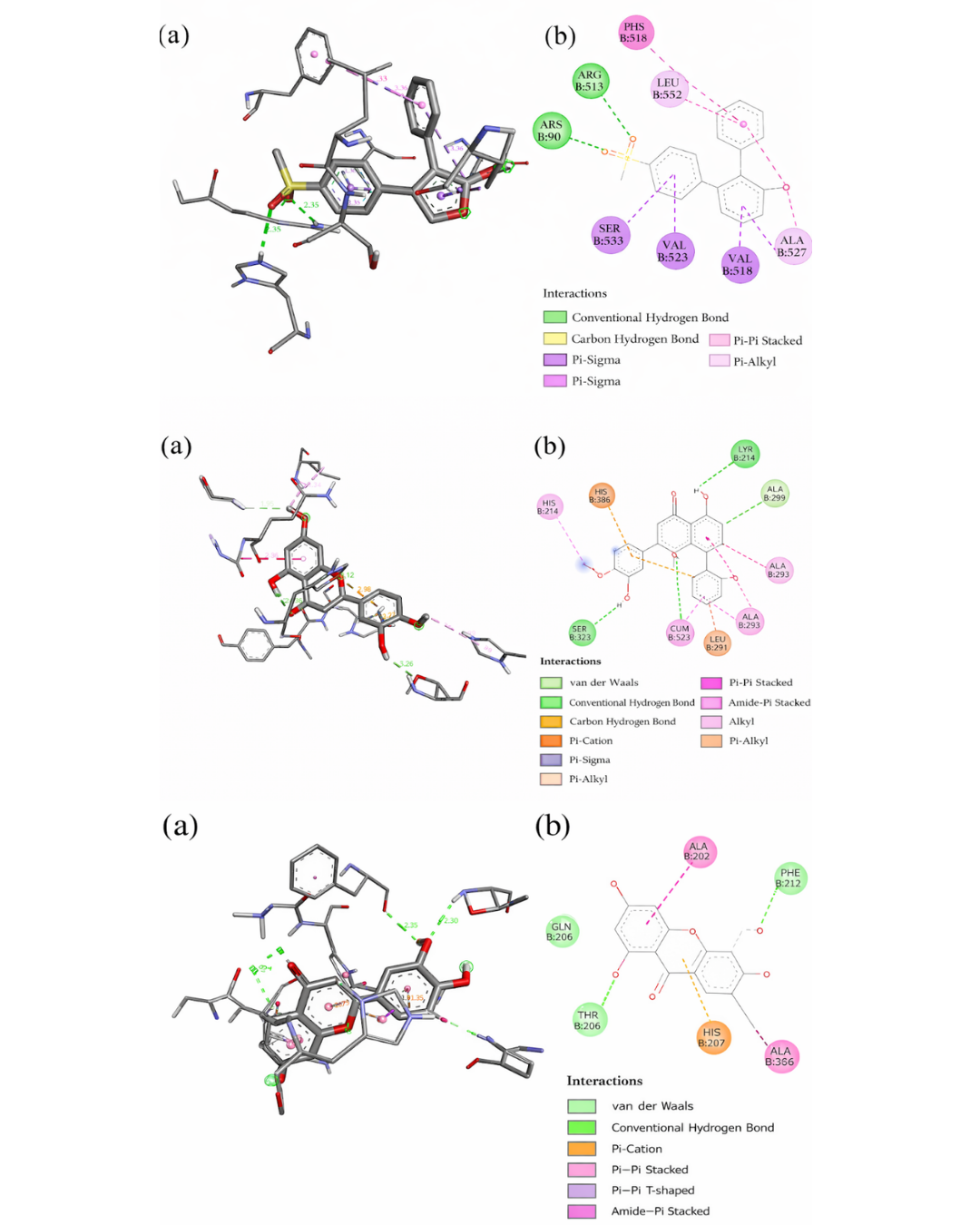
Legundi (Vitex trifolia) has been reported to exhibit anti-inflammatory activity; however, the specific bioactive compounds responsible for this effect remain unclear. This study aimed to evaluate the anti-inflammatory potential of bioactive compounds from V. trifolia against cyclooxygenase-2 (COX-2; PDB ID: 5KIR) using an in silico molecular docking approach, along with the analysis of their pharmacokinetic and toxicity profiles. The results showed that persicogenin exhibited the lowest binding affinity of −9.2 kcal/mol and formed hydrogen bonds with key amino acid residues, namely THR 212, HIS 207, and TYR 385. ADMET prediction results indicated that persicogenin met the drug-likeness criteria for an oral drug candidate, demonstrated good intestinal absorption (HIA: 92.29%), high membrane permeability (Caco-2 permeability > 0.9), low volume of distribution (VDss < 0.45), inhibitory activity against CYP2C19 and CYP3A4, and no hepatotoxic potential. These findings suggest that persicogenin may serve as an anti-inflammatory agent.
Full text article
References
Ankalikar, A., & Viswanathswamy, A. H. (2017). Effect of leaves of Vitex trifolia Linn. on different stages of inflammation. Indian Journal of Pharmaceutical Education and Research, 51(3), 461–471. https://doi.org/10.5530/ijper.51.3.74
Chen, C. Y., Peng, W. H., Tsai, K. D., & Hsu, S. L. (2007). Luteolin suppresses inflammation-associated gene expression by blocking NF-κB and AP-1 activation pathway in mouse alveolar macrophages. Life Sciences, 81(23–24), 1602–1614. https://doi.org/10.1016/j.lfs.2007.09.028
Chen, L., Deng, H., Cui, H., Fang, J., Zuo, Z., Deng, J., Li, Y., Wang, X., & Zhao, L. (2018). Inflammatory responses and inflammation-associated diseases in organs. Oncotarget, 9(6), 7204–7218. https://doi.org/10.18632/oncotarget.23208
Clària, J. (2003). Cyclooxygenase-2 biology. Current Pharmaceutical Design, 9(27), 2177–2190. https://doi.org/10.2174/1381612033454054
El-Kousy, S., Mohamed, M., & Mohamed, S. (2012). Phenolic and biological activities of Vitex trifolia aerial parts. Life Science Journal, 9(2), 671–677.
Forli, S., Huey, R., Pique, M. E., Sanner, M. F., Goodsell, D. S., & Olson, A. J. (2016). Computational protein-ligand docking and virtual drug screening with the AutoDock suite. Nature Protocols, 11(5), 905–919. https://doi.org/10.1038/nprot.2016.051
Hasan, R., Cholashotul I’anah, F., Resvita, R., & Bahi, R. R. (2022). Docking molekuler senyawa potensial daun kelor (Moringa oleifera) terhadap reseptor folat. Journal of Innovation Research and Knowledge, 2(2), 519. https://doi.org/10.53625/jirk.v2i2.2918
Hasan, R., Herowati, R., & Pamudji Widodo, G. (2023). Molecular docking and pharmacokinetic prediction of potential compounds from Luffa acutangula as antidiabetic candidates. Pharmaceutical Journal of Indonesia, 20(1), 71–76. https://doi.org/10.30595/pharmacy.v0i0.16066
Ifora, I., Putri, A., & Oktavia, S. (2022). Vitex trifolia as cyclooxygenase-2 inhibitors in anti-inflammatory drug discovery. International Journal of Pharmaceutical and Bio-Medical Science, 2(10), 400–406. https://doi.org/10.47191/ijpbms/v2-i10-03
Kemenkes RI. (2018). Laporan nasional Riset Kesehatan Dasar (Riskesdas). Badan Penelitian dan Pengembangan Kesehatan RI.
Li, W. X., Cui, C. B., Cai, B., Wang, H. Y., & Yao, X. S. (2005). Flavonoids from Vitex trifolia inhibit cell cycle progression at G2/M phase and induce apoptosis in mammalian cancer cells. Journal of Asian Natural Products Research, 7(4), 615–626. https://doi.org/10.1080/10286020310001625085
Loka, K. D. P., & Kodariah, R. (2022). Inflamasi kronis pada kolon: Tinjauan dari aspek COX-2 dan IL-10. Pratista Patologi, 7(2), 1–5.
Nusantoro, Y. R., & Fadlan, A. (2020). Analisis sifat mirip obat, prediksi ADMET, dan penambatan molekular isatinil-2-aminobenzoilhidrazon dan kompleks logam transisi Co(II), Ni(II), Cu(II), Zn(II) terhadap BCL2-XL. Akta Kimia Indonesia, 5(2), 114–126. https://doi.org/10.12962/j25493736.v5i2.7881
Pires, D. E. V., Blundell, T. L., & Ascher, D. B. (2015). pkCSM: Predicting small-molecule pharmacokinetic and toxicity properties using graph-based signatures. Journal of Medicinal Chemistry, 58(9), 4066–4072. https://doi.org/10.1021/acs.jmedchem.5b00104
Putri, F. S., Arief, M. J., & Rusli, R. (2024). Uji aktivitas antiinflamasi akut ekstrak etanol dan ekstrak air daun telang (Clitoria ternatea L.) dengan induksi karagenan. Jurnal Mandala Pharmacon Indonesia, 10(1), 151–156. https://doi.org/10.35311/jmpi.v10i1.467
Sari, I. W., Junaidin, J., & Pratiwi, D. (2020). Studi molecular docking senyawa flavonoid herba kumis kucing (Orthosiphon stamineus B.) pada reseptor α-glukosidase sebagai antidiabetes tipe 2. Jurnal Farmagazine, 7(2), 54. https://doi.org/10.47653/farm.v7i2.194
Silalahi, M., & Asra, R. (2024). Vitex trifolia (Botani, metabolit sekunder, dan bioaktivitasnya). Jurnal Pro-Life, 11(2), 96–110. https://doi.org/10.33541/pro-life.v11i2.5813
Sururi, A. M., Wati, A., & Kartika Maharani, D. (2023). Studi in silico: Potensi senyawa katekin dan turunannya dari teh hijau sebagai inhibitor HGF serta profil toksisitasnya. UNESA Journal of Chemistry, 12(2), 57–63. https://doi.org/10.26740/ujc.v12n2.p57-63
Wee, H. N., Neo, S. Y., Singh, D., Yew, H. C., Qiu, Z. Y., Tsai, X. R. C., How, S. Y., Yip, K. Y. C., Tan, C. H., & Koh, H. L. (2020). Effects of Vitex trifolia leaf extracts and phytoconstituents on cytokine production in human U937 macrophages. BMC Complementary Medicine and Therapies, 20, Article 91. https://doi.org/10.1186/s12906-020-02884-w
Weni, M., Safithri, M., & Seno, D. S. H. (2020). Molecular docking of active compounds Piper crocatum on the alpha-glucosidase enzyme as antidiabetic. Indonesian Journal of Pharmaceutical Science and Technology, 7(2), 64–72. https://doi.org/10.24198/ijpst.v7i2.21120
Authors

This work is licensed under a Creative Commons Attribution-NonCommercial-ShareAlike 4.0 International License. Copyright @2017. This is an open-access article distributed under the terms of the Creative Commons Attribution-NonCommercial-ShareAlike 4.0 International License (http://creativecommons.org/licenses/by-nc-sa/4.0/) which permits unrestricted non-commercial used, distribution and reproduction in any medium