
Ultrasound-Assisted Extraction Enhances Phenolic, Flavonoid, and Antioxidant Profiles of Spatholobus littoralis Roots

Article Sidebar
-
Antioxidant activity, Flavonoids, Phenolics, Spatholobus littoralis, Ultrasound-assisted extractio
Abstract
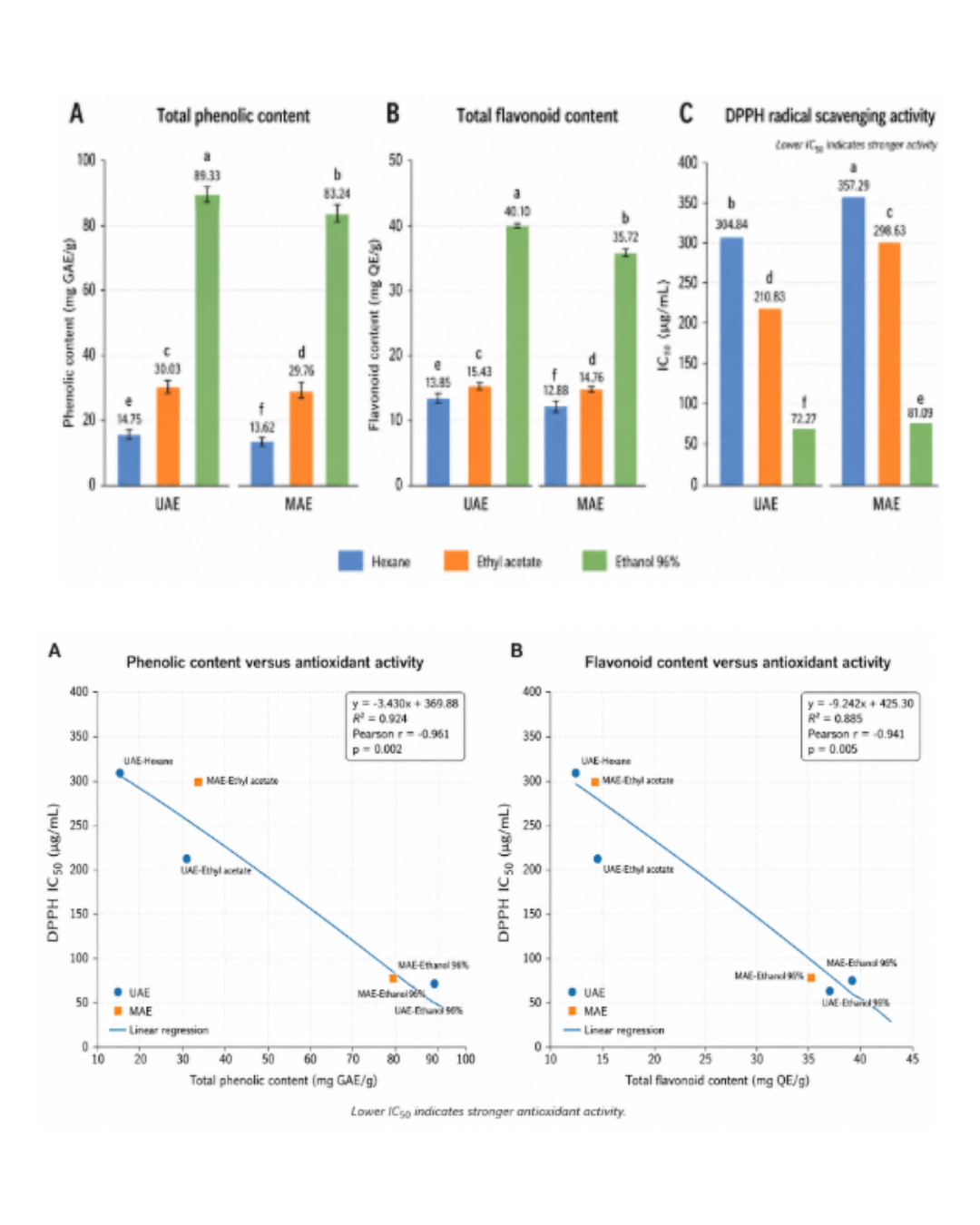
Spatholobus littoralis Hassk. roots contain antioxidant-related compounds whose recovery may be influenced by extraction method and solvent polarity. This study compared ultrasound-assisted extraction and microwave-assisted extraction using n-hexane, ethyl acetate, and 96% ethanol to evaluate their effects on total phenolic content, total flavonoid content, and DPPH radical-scavenging activity. Among the tested conditions, 96% ethanol combined with ultrasound-assisted extraction produced the highest phenolic content, flavonoid content, and antioxidant activity, with values of 89.33 mg GAE/g, 40.10 mg QE/g, and IC₅₀ 72.27 µg/mL, respectively. Strong negative correlations were observed between DPPH IC₅₀ and both total phenolic content (r = −0.961) and total flavonoid content (r = −0.941). These findings indicate that ultrasound-assisted extraction with 96% ethanol was the most effective condition for obtaining antioxidant-rich S. littoralis root extract in this study.
Full text article
References
Arsul, M. I., Syamsi, N., Putri, N., Nur, N. A. A., Muhkhriani, & Hamzah, N. (2022). Total phenolic, flavonoid, and antioxidant capacity of bajakah (Spatholobus littoralis Hassk). Current Research on Biosciences and Biotechnology, 4(1), 242–245. https://doi.org/10.5614/crbb.2022.4.1/VRJ3X4LF
Brand-Williams, W., Cuvelier, M. E., & Berset, C. (1995). Use of a free radical method to evaluate antioxidant activity. LWT—Food Science and Technology, 28(1), 25–30. https://doi.org/10.1016/S0023-6438(95)80008-5
Cai, Y., Luo, Q., Sun, M., & Corke, H. (2004). Antioxidant activity and phenolic compounds of 112 traditional Chinese medicinal plants associated with anticancer. Life Sciences, 74(17), 2157–2184. https://doi.org/10.1016/j.lfs.2003.09.047
Chang, C. C., Yang, M. H., Wen, H. M., & Chern, J. C. (2002). Estimation of total flavonoid content in propolis by two complementary colorimetric methods. Journal of Food and Drug Analysis, 10(3), 178–182.
Chemat, F., & Cravotto, G. (Eds.). (2013). Microwave-assisted extraction for bioactive compounds: Theory and practice. Springer. https://doi.org/10.1007/978-1-4614-4830-3
Chemat, F., Rombaut, N., Sicaire, A.-G., Meullemiestre, A., Fabiano-Tixier, A.-S., & Abert-Vian, M. (2017). Ultrasound assisted extraction of food and natural products: Mechanisms, techniques, combinations, protocols and applications. A review. Ultrasonics Sonochemistry, 34, 540–560. https://doi.org/10.1016/j.ultsonch.2016.06.035
Dai, J., & Mumper, R. J. (2010). Plant phenolics: Extraction, analysis, and their antioxidant and anticancer properties. Molecules, 15(10), 7313–7352. https://doi.org/10.3390/molecules15107313
Do, Q. D., Angkawijaya, A. E., Tran-Nguyen, P. L., Huynh, L. H., Soetaredjo, F. E., Ismadji, S., & Ju, Y. H. (2014). Effect of extraction solvent on total phenol content, total flavonoid content, and antioxidant activity of Limnophila aromatica. Journal of Food and Drug Analysis, 22(3), 296–302. https://doi.org/10.1016/j.jfda.2013.11.001
Halliwell, B., & Gutteridge, J. M. C. (2015). Free radicals in biology and medicine (5th ed.). Oxford University Press. https://doi.org/10.1093/acprof:oso/9780198717478.001.0001
Hasna, L. Z., Sehkhaemi, P., & Aviciena, M. A. (2021). Akar kayu bajakah dan manfaatnya untuk kesehatan. FoodTech: Jurnal Teknologi Pangan, 4(1), 32–39.
Kiromah, N. Z. W., Husein, S., & Rahayu, T. P. (2021). Uji aktivitas antioksidan ekstrak etanol daun ganitri (Elaeocarpus ganitrus Roxb.) dengan metode DPPH (2,2-difenil-1-pikrilhidazil). Pharmacon: Jurnal Farmasi Indonesia, 18(1), 60–67. https://doi.org/10.23917/pharmacon.v18i01.12161
Lopeda-Correa, M., Valdés-Duque, B. E., & Osorio-Tobón, J. F. (2022). Ultrasound-assisted extraction of phenolic compounds from Adenaria floribunda stem: Economic assessment. Foods, 11(18), Article 2904. https://doi.org/10.3390/foods11182904
Mahfudh, N., Murdi, H. B., Utami, D., Ahda, M., Nashihah, S., & Andika, A. (2024). Antioxidant activity, total phenolics, and total flavonoids content of Bajakah Tampala (Spatholobus littoralis): The indigenous herbal medicine from Kalimantan. Borneo Journal of Pharmacy, 7(3), 247–253. https://doi.org/10.33084/bjop.v7i3.6609
Molyneux, P. (2004). The use of the stable free radical DPPH for estimating antioxidant activity. Songklanakarin Journal of Science and Technology, 26(2), 211–219.
Nastiti, K., & Nugraha, D. F. (2022). Aktivitas antiinflamasi ekstrak kayu bajakah (Spatholobus littoralis Hassk). Jurnal Surya Medika, 7(2), 45–50. https://doi.org/10.33084/jsm.v7i2.3202
Nur, A. D. F., Zakiah, M., & Asseggaf, S. N. Y. R. S. (2024). Potensi antioksidan dari akar tanaman bajakah (Spatholobus littoralis Hassk) asal Kubu Raya Kalimantan Barat. Ibnu Sina: Jurnal Kedokteran dan Kesehatan—Fakultas Kedokteran Universitas Islam Sumatera Utara, 23(2), 129–137. https://doi.org/10.30743/ibnusina.v23i2.622
Pedisić, S., Čulina, P., Pavlešić, T., Vahčić, N., Elez Garofulić, I., Zorić, Z., Dragović-Uzelac, V., & Repajić, M. (2023). Efficiency of microwave and ultrasound-assisted extraction as a green tool for polyphenolic isolation from monofloral honeys. Processes, 11(11), Article 3141. https://doi.org/10.3390/pr11113141
Pisoschi, A. M., & Pop, A. (2015). The role of antioxidants in the chemistry of oxidative stress: A review. European Journal of Medicinal Chemistry, 97, 55–74. https://doi.org/10.1016/j.ejmech.2015.04.040
Prior, R. L., Wu, X., & Schaich, K. (2005). Standardized methods for the determination of antioxidant capacity and phenolics in foods and dietary supplements. Journal of Agricultural and Food Chemistry, 53(10), 4290–4302. https://doi.org/10.1021/jf0502698
Sadiq, I. Z. (2023). Free radicals and oxidative stress: Signaling mechanisms, redox basis for human diseases, and cell cycle regulation. Current Molecular Medicine, 23(1), 13–35. https://doi.org/10.2174/1566524022666211222161637
Savić Gajić, I., Savić, I., Boskov, I., Žerajić, S., Marković, I., & Gajić, D. (2019). Optimization of ultrasound-assisted extraction of phenolic compounds from black locust (Robinia pseudoacacia) flowers and comparison with conventional methods. Antioxidants, 8(8), Article 248. https://doi.org/10.3390/antiox8080248
Sianipar, R. N. R., Suryanegara, L., Fatriasari, W., Arung, E. T., Kusuma, I. W., Achmadi, S. S., Azelee, N. I. W., & Hamid, Z. A. A. (2023). The role of selected flavonoids from Bajakah Tampala (Spatholobus littoralis Hassk.) stem on cosmetic properties: A review. Saudi Pharmaceutical Journal, 31(3), 382–400. https://doi.org/10.1016/j.jsps.2023.01.006
Singleton, V. L., Orthofer, R., & Lamuela-Raventós, R. M. (1999). Analysis of total phenols and other oxidation substrates and antioxidants by means of Folin–Ciocalteu reagent. Methods in Enzymology, 299, 152–178. https://doi.org/10.1016/S0076-6879(99)99017-1
Vo, T. P., Nguyen, N. T. U., Le, V. H., Phan, T. H., Nguyen, T. H. Y., & Nguyen, D. Q. (2023). Optimizing ultrasonic-assisted and microwave-assisted extraction processes to recover phenolics and flavonoids from passion fruit peels. ACS Omega, 8(37), 33870–33882. https://doi.org/10.1021/acsomega.3c04550
Yusoff, I. M., Mat Taher, Z., Rahmat, Z., & Chua, L. S. (2022). A review of ultrasound-assisted extraction for plant bioactive compounds: Phenolics, flavonoids, thymols, saponins, and proteins. Food Research International, 157, Article 111268. https://doi.org/10.1016/j.foodres.2022.111268
Authors

This work is licensed under a Creative Commons Attribution-NonCommercial-ShareAlike 4.0 International License. Copyright @2017. This is an open-access article distributed under the terms of the Creative Commons Attribution-NonCommercial-ShareAlike 4.0 International License (http://creativecommons.org/licenses/by-nc-sa/4.0/) which permits unrestricted non-commercial used, distribution and reproduction in any medium