
Formulation and Evaluation Stick Moisturizing Combination of Aloe Vera Extract (Aloe barbadensis mill) and Chamomile (Matricaria recutita)

Article Sidebar
-
Antioxidant, Aloe Vera, Chamomile, Factorial design, Moisturizer Stick
Abstract
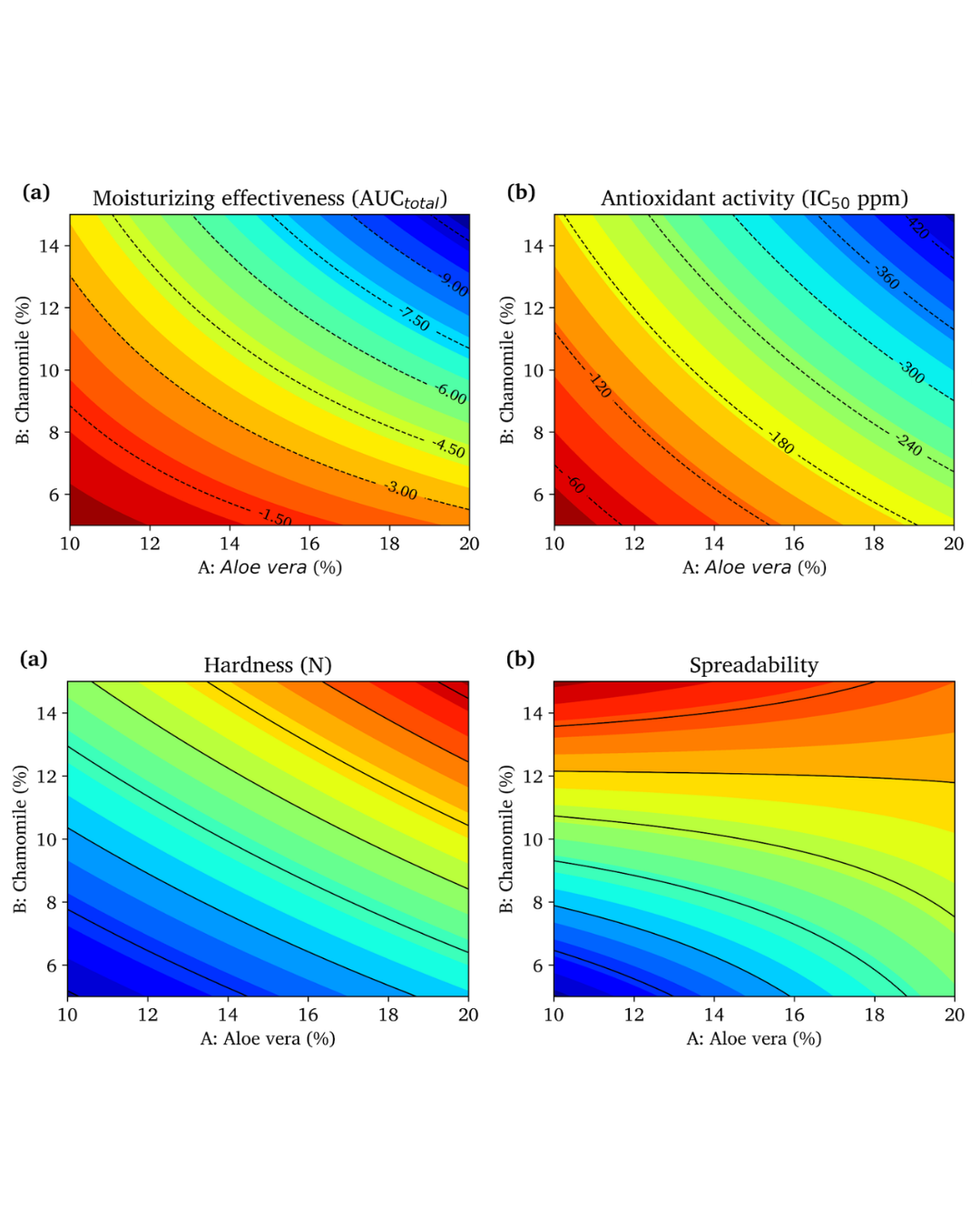
Aloe vera (Aloe barbadensis mill) and chamomile (Matricaria recutita) contain active compounds in the form of aloin and apigenin, which function as moisturizers with soothing and antioxidant effects that can neutralize free radicals that cause oxidative stress on the skin. This study aims to determine the optimal formula for a moisturizing stick that combines Aloe vera and chamomile extracts, based on physical properties, effectiveness as a moisturizer, and antioxidant activity. The dry extract was obtained by percolation with 96% ethanol and dried using a spray dryer. The dry extract will be standardized for specific and non-specific tests. The optimum moisturizing stick formula was obtained using the factorial design method. The factors used were aloe vera extract with a concentration of (-1) 10% and a concentration of (+1) 20%, as well as chamomile extract with a concentration of (-1) 5% and a concentration of (+1) 15%. Determination of the optimum formula was carried out using a factorial design method using the following responses: hardness, spreadability, moisture [AUC], and antioxidant activity (IC50). The moisturizing stick formulation uses a hot melt extrusion method. The data from the parametric experiments between batches and formulas will be analyzed using the One-Way Anova (Yate's Treatment). The results showed that increasing aloe vera extract increased the spreadability and moisture, while increasing chamomile extract increased the antioxidant activity. The interaction between the extracts had a significant effect on all parameters. The optimum formula was obtained at a concentration of 18.711% aloe vera and 8.167% chamomile, which met the quality and effectiveness criteria.
Full text article
References
Ainurofiq, A., Haya, A. F. F. D., Safitri, A. N., Solihatin, I. Z., Nusriya, S. B., & Nugroho, T. S. (2023). Characterization and application of moisturizer in skin treatment: A review. Journal of Pakistan Association of Dermatologists, 33(4), 1602-1613.
Akram, W., Ahmed, S., Rihan, M., Arora, S., Khalid, M., Ahmad, S., Ahmadf, F., Haqueg, S., & Vashishth, R. (2024). An updated comprehensive review of the therapeutic properties of Chamomile (Matricaria chamomilla L.). International Journal of Food Properties, 27(1), 133-164.
Allen, L. V. (2020). The art, science, and technology of pharmaceutical compounding (6th ed.). American Pharmacists Association.
Allen, LV & McPherson, (2023). Al-Snafi, A. E., & Hasham, L. F. (2023). Ansel’s Pharmaceutical Drug Delivery System, 12th edition, Wolters Kluwer. Philadelphia.
Al-Snafi, A. E., & Hasham, L. F. (2023). Bioactive constituents and pharmacological importance of matricaria chamomilla: A recent review. GSC Biological and Pharmaceutical Sciences, 22(2).
Abrutyn, E. (2 024). Maximizing moisturization for sustained skin health: The 4+2+1 theory. Cosmetics & Toiletries, 139(1).
Anonim. 2020, Durometer & IRHD Hardness Tester. Teclock Corporation. Japan
Antony, J. (2023). Design of experiments for engineers and scientists. Amsterdam, Ntherland: Elsevier Ltd.
Babu, S. N., & Noor, A. (2020). Bioactive constituents of the genus Aloe and their potential therapeutic and pharmacological applications: A review. Journal of Applied Pharmaceutical Science, 10(11), 133–145.
Badan Pengawas Obat dan Makanan. (2025). Peraturan Badan Pengawas Obat dan Makanan Nomor 6 Tahun 2025 tentang Pedoman Uji Stabilitas Suplemen Kesehatan. BPOM RI.
Catani, M. V., Rinaldi, F., Tullio, V., Gasperi, V., & Savini, I. (2021). Comparative analysis of phenolic composition of six commercially available chamomile (Matricaria chamomilla L.) extracts: Potential biological implications. International Journal of Molecular Sciences, 22(19), 10601.
Chelu, M., Popa, M., Ozon, E. A., Cusu, J. P., Anastasescu, M., Surdu, V. A., Moreno, J. C., & Musuc, A. M. (2023). High-content Aloe vera based hydrogels: Physicochemical and pharmaceutical properties. Polymers, 15(5), 1312.
Choi, M., Song, S. and Kang, N.G. (2020). Development of a sunscreen stick formulation which is water-resistant but easily washable. Korea Journal of Cosmetic Science, 2(1): 21-31.
Dai, Y.L., Li, Y., Wang, Q., Niu, F.J., Li, K.W., Wang, Y.Y., Wang, J., Zhou, C.Z. and Gao, L.N., 2023. Chamomile: a review of its traditional uses, chemical constituents, pharmacological activities and quality control studies. Molecules, 28(1): p.133.
Direktorat Jenderal Pengawasan Obat dan Makanan. (2000). Parameter standar umum ekstrak tumbuhan obat. Departemen Kesehatan Republik Indonesia.
Hęś, M., Dziedzic, K., Górecka, D., Jędrusek-Golińska, A., & Gujska, E. (2019). Aloe vera (L.) Webb.: Natural sources of antioxidants – A review. Plant Foods for Human Nutrition, 74(3), 255–265.
Iskandar, B., Lukman, A., Elfitri, O., Safri, S., & Surboyo, M. D. C. (2021). Formulasi dan uji aktivitas anti-aging gel lendir lidah buaya (Aloe vera Linn.). Jurnal Ilmu Kefarmasian Indonesia, 19(2), 154–165.
Jaiswal, V., Chauhan, S., & Lee, H. J. (2021). The bioactivity and phytochemicals of Pachyrhizus erosus (L.) Urb.: A multifunctional underutilized crop plant. Antioxidants, 11(1), 58.
Jumriani, J., Sinala, S., & Ibrahim, I. (2022). Formulasi sediaan balsem stik dari lada putih (Piper album). Jurnal Mandala Pharmacon Indonesia, 8(2), 141–150.
Kementerian Kesehatan RI. (2017). Farmakope herbal Indonesia edisi II. Kementerian Kesehatan RI.
Lanjewar, U., Meshram, A., & Pancham, R. (2020). Formulation and evaluation of a herbal lip balm infused with papaya and turmeric. Journal of Critical Reviews, 7(8), 3905–3914.
Manful, M. E., Ahmed, L., & Barry-Ryan, C. (2024). Cosmetic formulations from natural sources: Safety considerations and legislative frameworks in the European Union. Cosmetics, 11(3), 72.
Massoud, D., Alrashdi, B. M., Fouda, M., El-Kott, A., Soliman, S. A., & Abd-Elhafeez, H. H. (2023). Aloe vera and wound healing: A brief review. Brazilian Journal of Pharmaceutical Sciences, 58, e20837.
Masykuroh, A., & Abna, N. (2022). Uji aktivitas antioksidan nanopartikel perak (NPP) hasil biosintesis menggunakan ekstrak kulit buah jeruk kunci Citrus microcarpa Bunge. Bioma: Jurnal Biologi Makassar, 7(2), 51–64.
Michalak M, Pierzak M, Krecisz B, & Suliga E. (2021). Review Bioactive Compounds for Skin Health: A Review. Nutrients. 2021;13:203, Available at: https://doi.org/ 10.3390/nu13010203
Michalak, M. (2022). Plant-derived antioxidants: Significance in skin health and the ageing process. International Journal of Molecular Sciences, 23(2).
Mawazi SM, Ann J, Othman N, Khan J, Alolayan SO, Al thagfan SS, & Kaleemullah M. (2022). A Review of Moisturizers; History, Preparation, Characterization and Applications. Cosmetics, 9, 61. DOI: https://doi.org/10.3390/cosmetics9030061
Nakiguli, C. K., Kosgei, V. J., Cherutoi, J. K., & Odda, J. (2022). Quantification of aloin in Aloe barbadensis Miller leaf gel and latex from selected regions of Kenya. Open Access Library Journal, 9(4), 1–12.
Rodrigues &Pintado. (2024). Hesperidin from Orange Peel as a Promising Skincare Bioactive: An Overview. International Journal of Molecular Sciences, 25(3). https://doi.org/10.3390/ijms25031890
Saeed, M. K., Zahra, N., Abidi, S. H. I., & Syed, Q. (2022). Phytochemical screening and DPPH free radical scavenging activity of Aloe vera (Aloe barbadensis Miller) powder. International Journal of Food Science and Agriculture, 6(3), 301–308.
Shane, F. (2023). The essential role of moisturizer in dermatology. Scientific Journal of Dermatology and Venereology, 1(1), 19–22.
Strodhal, D. (2024). Paula's Choice Skin Care Antioxidant for Better Sun Protection. accessed on May 16, 2024. Available at : https://www.paulaschoice.com/expert-advice/skincare-advice/ingredient-spotlight/antioxidants-sunscreen
Sulistiana, S., & Darijanto, S. T. (2022). Formulasi dan evaluasi mikroemulsi gel minyak chamomile serta uji aktivitas antioksidan. Indonesian Journal of Pharmaceutical Education, 2(1), 52–66.
Susanto DWC, Yamlean PVY, & Mansauda KRL. (2024). Formulasi Dan Evaluasi Krim Kombinasi Ekstrak Kulit Semangka (Citrullus lanatus) Dan Ekstrak Kulit Pepaya (Carica papaya L.) Sebagai Pelembap, Pharmacon. 2024;13(1). Available at: https://www. DOI: 10.35799/pha.13.2024.49564
U.S. Pharmacopeia. (2024). The United States pharmacopeia, USP 47/The National formulary, NF 42. U.S. Pharmacopeial Convention, Inc.
Verma, A., Zanoletti, A., Kareem, KY., Adelodun, B., Kumar, P., Ajibade, FO., Silva, LFO., Phillips, AJ., Kartheeswaran, T., Bontempi, T., & Dwivedi, A. (2023). Skin protection from solar ultraviolet radiation using natural compounds: a review, Environmental Chemistry Letters, Available at : https://doi.org/10.1007/s10311-023-01649-4
Wirawan, S. (2023). Metodologi penelitian untuk tenaga kesehatan. Thema Publishing.Yogyakarta
Wypych, G. (2020). Handbook of antioxidants (2nd ed.). ChemTech Publishing, Toronto, Canada
Yoon, J. H., Kim, M. Y., & Cho, J. Y. (2023). Apigenin: A therapeutic agent for treatment of skin inflammatory diseases and cancer. International Journal of Molecular Sciences, 24(2), 1498.
Authors

This work is licensed under a Creative Commons Attribution-NonCommercial-ShareAlike 4.0 International License. Copyright @2017. This is an open-access article distributed under the terms of the Creative Commons Attribution-NonCommercial-ShareAlike 4.0 International License (http://creativecommons.org/licenses/by-nc-sa/4.0/) which permits unrestricted non-commercial used, distribution and reproduction in any medium