
Optimization of Green Tea Leaf Extract Serum Using Xanthan Gum and Carbopol

Article Sidebar
-
Carbopol, Green tea, Serum, Simplex lattice design, Xanthan gum
Abstract
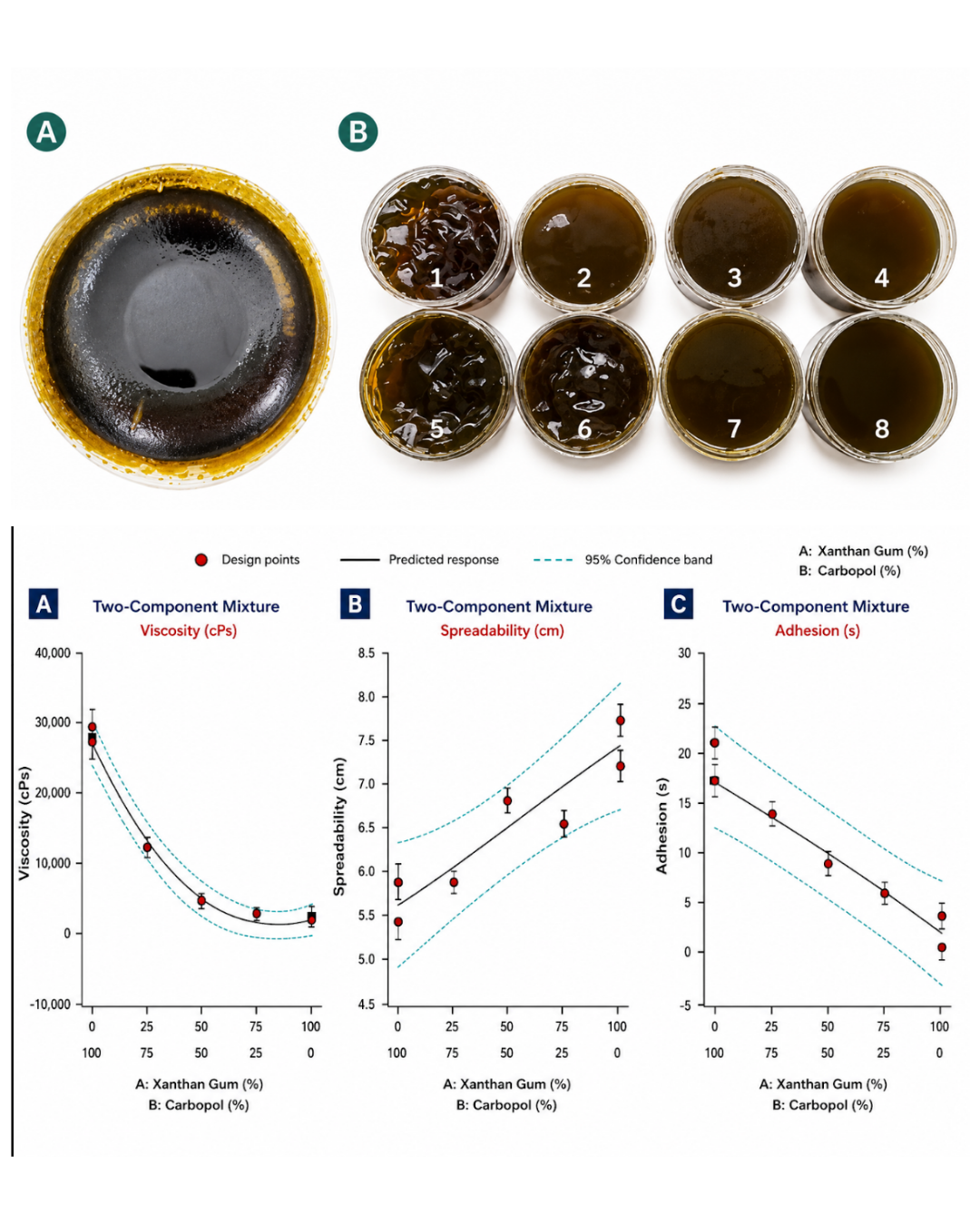
Green tea leaves (Camellia sinensis) contain polyphenolic compounds with antioxidant potential and can be developed into topical serum preparations. This study aimed to optimize the combination of xanthan gum and carbopol in a green tea leaf ethanol extract serum using the Simplex Lattice Design method. Serum formulations were prepared using different proportions of xanthan gum and carbopol, then evaluated for viscosity, spreadability, adhesiveness, pH, organoleptic properties, and physical stability using a cycling test. The optimum formulation consisted of 55% xanthan gum and 45% carbopol, with a desirability value of 1.0. Verification showed that the predicted and observed responses were not significantly different. The optimum formula met the initial physical quality requirements; however, the cycling test showed changes in viscosity, spreadability, and adhesiveness. These findings indicate that xanthan gum and carbopol can be optimized to produce green tea extract serum, although further stability improvement is required.
Full text article
References
Alara, O. R., Abdurahman, N. H., & Ukaegbu, C. I. (2021). Extraction of phenolic compounds: A review. Current Research in Food Science, 4, 200–214. https://doi.org/10.1016/j.crfs.2021.03.011
Angraini, A. W., Asri SR, M., & Ariati, W. (2024). Formulasi sediaan serum dari ekstrak etanol daun nangka (Artocarpus heterophyllus Lam.) sebagai antijerawat terhadap Propionibacterium acnes. Jurnal Ilmiah Farmasi Farmasyifa, 7(2), 132–146. https://doi.org/10.29313/jiff.v7i2.3033
Apriani, E. F., Kornelia, N., & Amriani, A. (2023). Optimizing gel formulations using carbopol 940 and sodium alginate containing Andrographis paniculata extract for burn-wound healing. Jurnal Farmasi dan Ilmu Kefarmasian Indonesia, 10(3), 300–311. https://doi.org/10.20473/jfiki.v10i32023.300-311
Baki, G. (2023). Introduction to cosmetic formulation and technology. John Wiley & Sons.
Calixto, G., Yoshii, A. C., Rocha e Silva, H., Cury, B. S. F., & Chorilli, M. (2015). Polyacrylic acid polymers hydrogels intended to topical drug delivery: Preparation and characterization. Pharmaceutical Development and Technology, 20(4), 490–496. https://doi.org/10.3109/10837450.2014.882941
Calixto, L. S., & Campos, P. M. B. G. M. (2017). Physical–mechanical characterization of cosmetic formulations and correlation between instrumental measurements and sensorial properties. International Journal of Cosmetic Science, 39(5), 527–534. https://doi.org/10.1111/ics.12406
Chang, R.-K., Raw, A., Lionberger, R., & Yu, L. (2013). Generic development of topical dermatologic products: Formulation development, process development, and testing of topical dermatologic products. The AAPS Journal, 15(1), 41–52. https://doi.org/10.1208/s12248-012-9411-0
Dahlizar, S., Nurkhasanah, N., Betha, O. S., & Anggraeni, Y. (2022). Formulasi emulgel gamma oryzanol dengan menggunakan carbopol sebagai gelling agent. Jurnal Sains Farmasi & Klinis, 9(2), 129–137. https://doi.org/10.25077/jsfk.9.2.129-137.2022
Dritsa, V., Rigas, F., Doulia, D., Avramidou, T., & Hatzianestis, I. (2009). Optimization of culture conditions for the biodegradation of lindane by the fungus Penicillium sp. Water, Air, & Soil Pollution, 204(1), 19–27. https://doi.org/10.1007/s11270-009-0024-4
Hajrin, W., Subarnas, A., & Joni, I. M. (2021). Optimization of formulation parameters for nanoemulsion delivery systems using response surface methodology. International Journal of Applied Pharmaceutics, 13(4), 145–151. https://doi.org/10.22159/ijap.2021v13i4.41527
Happe, I. N., Yustiti, A. J., Ikhsan, M. K., & Yusuf, M. (2024). Formulasi dan uji antioksidan sediaan serum ekstrak daun keji beling (Strobilanthes crispus L. Blume) dengan metode DPPH. Inhealth: Indonesian Health Journal, 3(2), 118–127.
Illah, G. S. R., Rejeki, E. S., & Pramukantoro, G. E. (2024). Uji aktivitas antioksidan kombinasi ekstrak etanol daun teh hijau (Camellia sinensis L.) dengan ekstrak etanol kulit buah naga merah (Hylocereus polyrhizus) menggunakan metode DPPH. Jurnal Farmasi dan Sains Indonesia, 7(2), 178–185. https://doi.org/10.52216/jfsi.vol7no2p178-185
Indriastuti, M., & Puspita, E. (2024). Pemilihan komposisi variasi basis formula sediaan serum ekstrak daun kelor (Moringa oleifera L.) dari tinjauan formula dan kenyamanan pemakaian. Jurnal Insan Farmasi Indonesia, 7(3), 303–312.
Kementerian Kesehatan Republik Indonesia. (2017). Farmakope herbal Indonesia (Edisi II). Kementerian Kesehatan Republik Indonesia.
Koch, W., Zagórska, J., Marzec, Z., & Kukula-Koch, W. (2019). Applications of tea (Camellia sinensis) and its active constituents in cosmetics. Molecules, 24(23), Article 4277. https://doi.org/10.3390/molecules24234277
Mitura, S., Sionkowska, A., & Jaiswal, A. (2020). Biopolymers for hydrogels in cosmetics: Review. Journal of Materials Science: Materials in Medicine, 31(6), Article 50. https://doi.org/10.1007/s10856-020-06390-w
Nurcholis, W., Safithri, M., Marliani, N., & Iqbal, M. (2023). Response surface modeling to optimize sonication extraction with the maceration method for the phenolic content and antioxidant activity of Justicia gendarussa Burm. f. Journal of Applied Pharmaceutical Science, 13(10), 181–187. https://doi.org/10.7324/JAPS.2023.148030
Nurcholis, W., Septiawati, I. Z., Najmi, L., Sutandy, F. A., Febrian, L., Fitriasari, G. C., Ramdhani, A. F., Zahra, A., Aisyah, S. I., Ambarsari, L., Hindaningrum, I. F., & Artika, I. M. (2024). Optimization of flavonoid extraction and antioxidant capacity from Acanthus ilicifolius using microwave-assisted extraction and I-optimal response surface methodology. Tropical Journal of Natural Product Research, 8(12), 9470–9475. https://doi.org/10.26538/tjnpr/v8i12.18
Pertiwi, R. D., Solachudin, F. M., & Hurit, H. E. (2025). Optimasi kombinasi setil alkohol dan lanolin pada formula balsam stik dengan metode Simplex Lattice Design. Jurnal Ilmiah Manuntung: Sains Farmasi dan Kesehatan, 11(1), 23–35. https://doi.org/10.51352/jim.v11i1.895
Politis, S. N., Colombo, P., Colombo, G., & Rekkas, D. M. (2017). Design of experiments in pharmaceutical development. Drug Development and Industrial Pharmacy, 43(6), 889–901. https://doi.org/10.1080/03639045.2017.1291672
Porcheron, A., Latreille, J., Jdid, R., Tschachler, E., & Morizot, F. (2014). Influence of skin ageing features on Chinese women’s perception of facial age and attractiveness. International Journal of Cosmetic Science, 36(4), 312–320. https://doi.org/10.1111/ics.12128
Prasanth, M. I., Sivamaruthi, B. S., Chaiyasut, C., & Tencomnao, T. (2019). A review of the role of green tea (Camellia sinensis) in antiphotoaging, stress resistance, neuroprotection, and autophagy. Nutrients, 11(2), Article 474. https://doi.org/10.3390/nu11020474
Rohmanah, A., Sari, G. K., & Hapsari, E. A. (2024). Formulasi dan uji stabilitas fisik sediaan serum ekstrak etanol 96% biji alpukat (Persea americana Mill). Pratama Medika: Jurnal Kesehatan, 3(2), 111–130. https://doi.org/10.56480/pratamamedika.v3i2.1328
Sawiji, R. T., Rumbory, S., Cahyaningrum, D. A. P. W., Dewi, N. P. F. S., Nauli, M. N., Putri, A. A. I. P. A., & Suryani, N. M. L. (2024). Pengaruh variasi konsentrasi gelling agent xanthan gum dan carbopol pada sediaan serum dengan bahan aktif retinoic acid. Acta Holistica Pharmaciana, 6(1), 1–10. https://doi.org/10.62857/ahp.v6i1.157
Septyani, V. R. D., Wicahyo, S. M., & Raharjo, D. (2024). Optimasi sediaan serum antiaging ekstrak etanol rambut baby corn (Zea mays L.). Journal of Pharmaceutical and Sciences, 7(4), 588–599. https://doi.org/10.36490/journal-jps.com.v7i4.622
Slamet, S., Anggun, B. D., & Pambudi, D. B. (2020). Uji stabilitas fisik formula sediaan gel ekstrak daun kelor (Moringa oleifera Lamk.). Jurnal Ilmiah Kesehatan, 13(2), 115–122. https://doi.org/10.48144/jiks.v13i2.260
Surber, C., & Kottner, J. (2017). Skin care products: What do they promise, what do they deliver? Journal of Tissue Viability, 26(1), 29–36. https://doi.org/10.1016/j.jtv.2016.03.006
Suryani, Nafisah, A., & Mana’an, S. (2017). Optimasi formula gel antioksidan ekstrak etanol buah bligo (Benincasa hispida) dengan metode Simplex Lattice Design. Jurnal Farmasi Galenika (Galenika Journal of Pharmacy), 3(2), 150–156.
Tai, A., Bianchini, R., & Jachowicz, J. (2014). Texture analysis of cosmetic/pharmaceutical raw materials and formulations. International Journal of Cosmetic Science, 36(4), 291–304. https://doi.org/10.1111/ics.12125
Voigt, R. (1995). Buku ajar teknologi farmasi (5th ed.). UGM Press.
Wahidah, S., Saputri, G. A. R., & Nofita, N. (2024). Formulasi dan uji stabilitas sediaan gel ekstrak etanol daun asam jawa (Tamarindus indica L.) dengan variasi gelling agent. Jurnal Mandala Pharmacon Indonesia, 10(2), 508–518. https://doi.org/10.35311/jmpi.v10i2.623
Widyaningrum, N., Arief, T. A., & Ningrum, Y. D. A. (2024). Optimization, characterization, and primary irritation test of serum based on Simplex Lattice Design. Jurnal Kefarmasian Indonesia, 14(2), 176–184.
Wulandari, L. F., Ameliana, L., & Sari, L. O. R. K. (2023). Optimization of xanthan gum and hydroxypropyl methylcellulose in antioxidant peel-off gel mask from cocoa pod husk extract (Theobroma cacao L.). Jurnal Sains dan Kesehatan, 5(4), 492–499.
Zhao, T., Li, C., Wang, S., & Song, X. (2022). Green tea (Camellia sinensis): A review of its phytochemistry, pharmacology, and toxicology. Molecules, 27(12), Article 3909. https://doi.org/10.3390/molecules27123909
Authors

This work is licensed under a Creative Commons Attribution-NonCommercial-ShareAlike 4.0 International License. Copyright @2017. This is an open-access article distributed under the terms of the Creative Commons Attribution-NonCommercial-ShareAlike 4.0 International License (http://creativecommons.org/licenses/by-nc-sa/4.0/) which permits unrestricted non-commercial used, distribution and reproduction in any medium