
Formulation and Evaluation of Antidesma bunius Gel: Antibacterial Activity, Stability, and Skin Irritation

Article Sidebar
-
Antidesma bunius, Antibacterial activity, Anti-acne gel, Physical stability, Akin irritation
Abstract
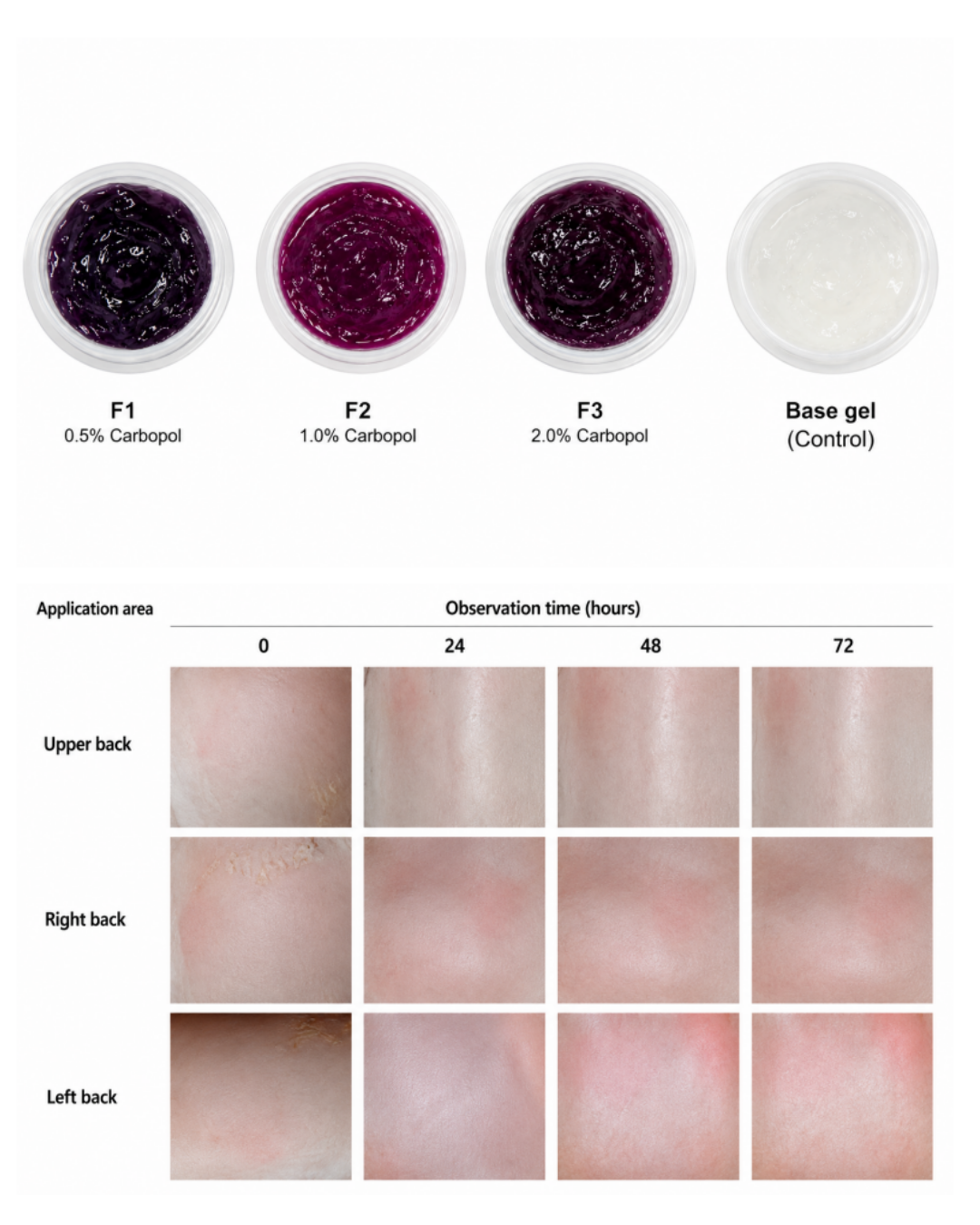
Acne is associated with the proliferation of acne-related bacteria, particularly Propionibacterium acnes and Staphylococcus epidermidis. This study evaluated the antibacterial activity, physical stability, microbiological quality, and skin irritation potential of an Antidesma bunius extract gel. The extract was tested against both bacterial species using an agar diffusion method, and a gel containing 2.5% extract was prepared with different Carbopol concentrations. The extract produced inhibition zones of 13.31–23.64 mm, whereas the gel formulations produced inhibition zones of 17.51–19.69 mm. The formulations remained homogeneous and showed acceptable organoleptic properties, pH, viscosity, spreadability, and adhesion after stability testing. Total plate and yeast and mold counts met the applicable microbiological limits. No erythema or edema was observed in albino rabbits. These findings indicated that A. bunius extract gel has potential as a topical anti-acne formulation.
Full text article
References
Ansong, J. A., Asante, E., Johnson, R., Boakye-Gyasi, M. E., Kuntworbe, N., Owusu, F. W. A., & Ofori-Kwakye, K. (2023). Formulation and evaluation of herbal-based antiacne gel preparations. BioMed Research International, 2023, Article 7838299. https://doi.org/10.1155/2023/7838299
Dabo, D. A., Zechariah, K. I., Pauline, G., Naomi, M. N., Dawal, S. P., & Vwamkat, A. S. (2024). Assessment of microbial contamination of solid herbal medicine sold in Makurdi metropolis. World Journal of Advanced Research and Reviews, 21(2), 496–505. https://doi.org/10.30574/wjarr.2024.21.2.0433
Darkwah, S., Agbettor, D., Codjoe, F., & Donkor, E. (2022). Microbial contamination of herbal preparations on the Ghanaian market, Accra. Microbiology Insights, 15. https://doi.org/10.1177/11786361221139602
Ermawati, D. E., & Ramadhani, C. I. (2020). Formulation of anti-acne gel of Moringa oleifera L. ethanolic extract and antibacterial test on Staphylococcus epidermidis. Majalah Farmaseutik, 16(2), 154–162. https://doi.org/10.22146/farmaseutik.v16i2.50319
Ferreira, A., Vecino, X., Ferreira, D., Cruz, J., Moldes, A., & Rodrigues, L. (2017). Novel cosmetic formulations containing a biosurfactant from Lactobacillus paracasei. Colloids and Surfaces B: Biointerfaces, 155, 522–529. https://doi.org/10.1016/j.colsurfb.2017.04.026
Geronimo, A., Bancual, M., Ko, K., Soliba, L., Ildefonso, J., Soriano, A., & Domantay, J. (2020). Free radical scavenging and in vitro cytotoxic activity of Bugnay (Antidesma bunius) leaves extract against A549 human lung adenocarcinoma and HCT-116 human colorectal cancer cell lines. Indonesian Journal of Cancer Chemoprevention, 11(3), 124–133. https://doi.org/10.14499/indonesianjcanchemoprev11iss3pp124-133
Gupta, B., Chopra, N., Dubey, S., Kohli, P., Zaidi, M. I., & Chauhan, A. (2023). Formulation of anti-acne of Moringa oliefera leaves powder ethanolic extract as an inhibititor of bacteria. Current Research in Pharmaceutical Sciences, 13(2), 102–107. https://doi.org/10.24092/CRPS.2023.130203
Jairoun, A., Al-Hemyari, S., Shahwan, M., & Zyoud, S. (2020). An investigation into incidences of microbial contamination in cosmeceuticals in the UAE: Imbalances between preservation and microbial contamination. Cosmetics, 7(4), Article 92. https://doi.org/10.3390/cosmetics7040092
Jung, Y., Jeong, H., Cho, Y., Lee, E., Jang, H., Kim, J., & Lim, K. (2019). Lysates of a probiotic, Lactobacillus rhamnosus, can improve skin barrier function in a reconstructed human epidermis model. International Journal of Molecular Sciences, 20(17), Article 4289. https://doi.org/10.3390/ijms20174289
Kanďárová, H., Willoughby, J., de Jong, W., Letašiová, S., Milasová, T., Bachelor, M., & Coleman, K. (2018). Pre-validation of an in vitro skin irritation test for medical devices using the reconstructed human tissue model EpiDerm™. Toxicology in Vitro, 50, 407–417. https://doi.org/10.1016/j.tiv.2018.02.007
Kanto, H., Washizaki, K., Itō, M., Matsunaga, K., Akamatsu, H., Kawai, K., & Mori, F. (2013). Optimal patch application time in the evaluation of skin irritation. The Journal of Dermatology, 40(5), 363–369. https://doi.org/10.1111/1346-8138.12004
Kaushik, V., Ganashalingam, Y., Schesny, R., Raab, C., Sengupta, S., & Keck, C. (2021). Influence of massage and skin hydration on dermal penetration efficacy of Nile red from petroleum jelly—An unexpected outcome. Pharmaceutics, 13(12), Article 2190. https://doi.org/10.3390/pharmaceutics13122190
Lubda, M., Pelzer, I., Salazar, A., & Hagen, J. (2023). Topically applied active ingredients establish an equilibrium dependent on their physico-chemical properties and a skin layer specific tissue capacity. Clinical & Experimental Dermatology and Therapies, 8(2). https://doi.org/10.29011/2575-8268.100209
Maurício, E., Rosado, C., Duarte, M., Veríssimo, J., Bom, S., & Vasconcelos, L. (2017). Efficiency of nisin as preservative in cosmetics and topical products. Cosmetics, 4(4), Article 41. https://doi.org/10.3390/cosmetics4040041
Merdana, I., Arjana, A., Widyastuti, S., Tetrania, T., Budiasa, K., Sudimartini, L., & Sudira, I. (2020). Assessment of the dermal acute irritation potential of natural veterinary medicine Minyak Rajas in albino rabbits. Journal of Pharmaceutical Research International, 32(10), 17–24. https://doi.org/10.9734/jpri/2020/v32i1030489
Ngamlerst, C., Udomkasemsab, A., Kongkachuichai, R., Kwanbunjan, K., Chupeerach, C., & Prangthip, P. (2019). The potential of antioxidant-rich Maoberry (Antidesma bunius) extract on fat metabolism in liver tissues of rats fed a high-fat diet. BMC Complementary and Alternative Medicine, 19(1). https://doi.org/10.1186/s12906-019-2716-0
Papa, C., Suciu, A., Dopcea, I., Ené, N., Singh, S., & Vamanu, E. (2023). Exploring the efficacy of extracts for cosmetic creams: In vivo and in vitro assessments. Nutraceuticals, 3(3), 306–314. https://doi.org/10.3390/nutraceuticals3030024
Phrompanya, P., Buncharoen, W., Tragoolpua, Y., & Saenphet, K. (2024). Antioxidant, anti-inflammatory, and antibacterial activities against acne-causing bacteria of Miliusa velutina (A. DC.) Hook. f. & Thomson extracts. Journal of Pharmacy & Pharmacognosy Research, 12(2), 243–254. https://doi.org/10.56499/jppres23.1704_12.2.243
Putri, A. N., Laila, N., & Forestryana, D. (2019). Formula optimization of Annona muricata folium ethanolic extract of anti acne gel formulation using factorial design method. Borneo Journal of Pharmacy, 2(2), 63–70. https://doi.org/10.33084/bjop.v2i2.981
Silalahi, M., Purba, E., Sawitri, I., Wahyuningtyas, R., & Sitepu, N. (2022). Antidesma bunius (L.) Spreng. (Foodstuffs and its bioactivity). Journal of Tropical Ethnobiology, 5(1), 19–29. https://doi.org/10.46359/jte.v5i1.104
Sonia, Z., Islam, M., Koly, S., Faisal, T., & Rakib, K. (2018). Evaluation of cytotoxicity and antibacterial activities of methanolic extract of Antidesma bunius (Linn.) (Family Euphorbiaceae) leaf. Journal of Advances in Medical and Pharmaceutical Sciences, 16(2), 1–7. https://doi.org/10.9734/jamps/2018/40004
Tahar, N., Wahyuni, D., Adawiyah, R., Khaerani, & Wahyuddin, M. (2023). Formulation and antibacterial activity of porang (Amorphophallus muelleri Blume) extract gel against Propionibacterium acne. Ad-Dawaa’ Journal of Pharmaceutical Sciences, 6(1), 83–92. https://doi.org/10.24252/djps.v6i1.38744
Thote, S., Dhoble, N., & Baheti, J. (2023). Development and evaluation of anti-acne gel containing Luffa acutangulaseeds extract. International Journal of Herbal Medicine, 11(4), 58–64. https://doi.org/10.22271/flora.2023.v11.i4a.881
Vora, J., Srivastava, A., & Modi, H. (2018). Antibacterial and antioxidant strategies for acne treatment through plant extracts. Informatics in Medicine Unlocked, 13, 128–132. https://doi.org/10.1016/j.imu.2017.10.005
Yasser, M., Rafi, M., Wahyuni, W., Widiyanti, S., & Asfar, A. (2020). Total phenolic content and antioxidant activities of buni fruit (Antidesma bunius L.) in Moncongloe Maros District extracted using ultrasound-assisted extraction. Rasayan Journal of Chemistry, 13(1), 684–689. https://doi.org/10.31788/rjc.2020.1315584
Authors
This work is licensed under a Creative Commons Attribution-NonCommercial-ShareAlike 4.0 International License. Copyright is retained by the authors.