
Antibacterial Activity of Esterified Trigona laeviceps Hive Waste Extract against Skin-Associated Bacteria

Article Sidebar
-
Antibacterial activity, Esterification, Hive waste, Propionibacterium acnes, Staphylococcus aureus
Abstract
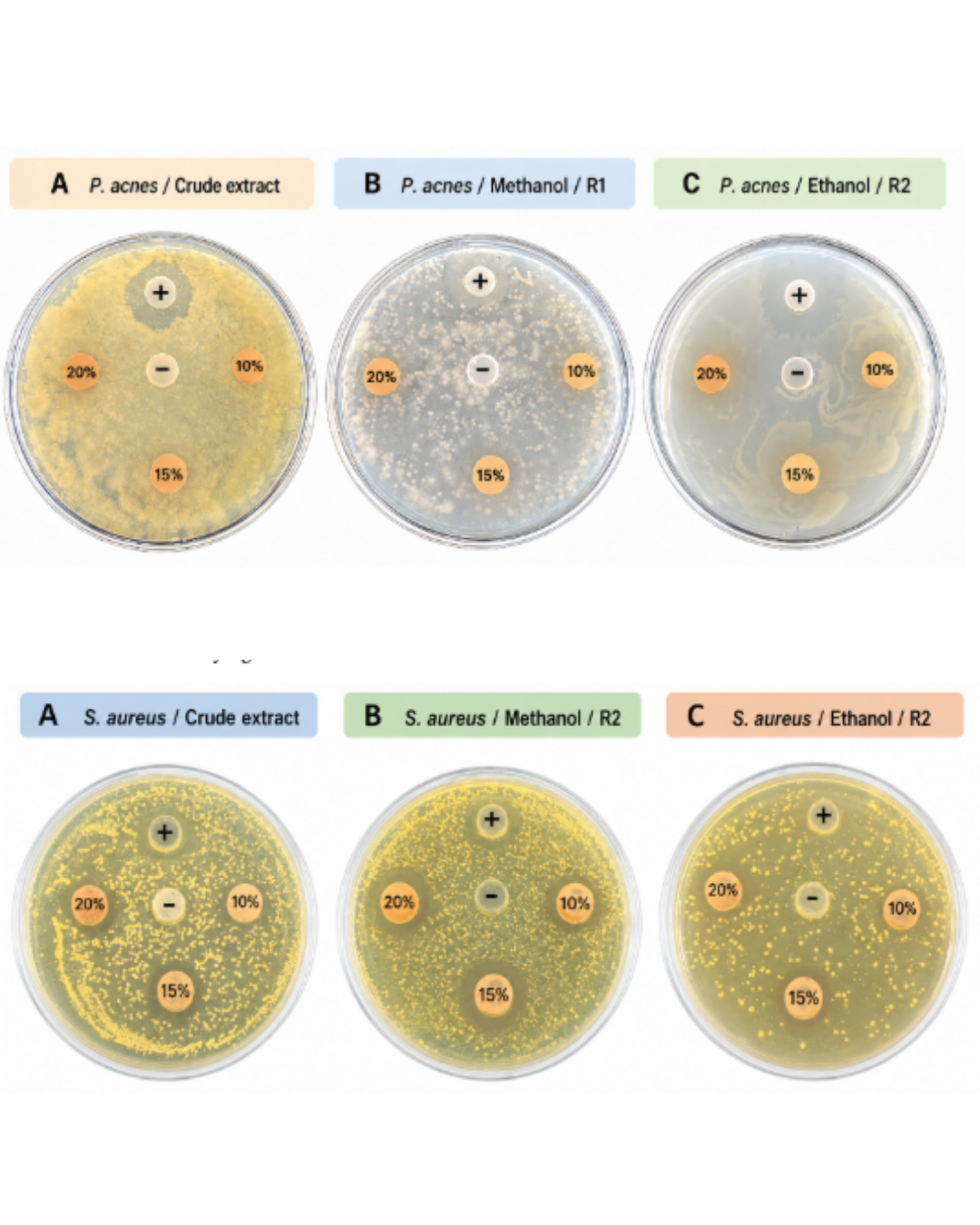
Stingless bee (Trigona laeviceps) hive waste contains bioactive compounds, including flavonoids, phenolics, terpenoids, and organic acids, with potential antibacterial activity. This study aimed to enhance its antibacterial activity through esterification using methanol and ethanol. The extract was obtained by sonochemical extraction with 96% ethanol and reacted with methanol or ethanol using H₂SO₄ as a catalyst. Esterification products were characterized by FTIR and GC–MS. Antibacterial activity against Staphylococcus aureus and Propionibacterium acnes was evaluated at 10%, 15%, and 20% using the agar well-diffusion method. Alcohol variation affected the chemical profile and antibacterial activity. The ethanol ester showed the largest inhibition zones at 20%, measuring 1.97 ± 0.24 mm against S. aureus and 1.90 ± 0.10 mm against P. acnes. These findings suggest that esterification may improve the value of stingless bee hive waste as a natural antibacterial candidate.
Full text article
References
Ananda, S., Batubara, I., & Raffiudin, R. (2020). Antioxidant and antibacterial activity of selected Indonesian honey against bacteria of acne. Jurnal Kimia Sains dan Aplikasi, 23(8), 267–275. https://doi.org/10.14710/jksa.23.8.267-275 DOI: https://doi.org/10.14710/jksa.23.8.267-275
Balouiri, M., Sadiki, M., & Ibnsouda, S. K. (2016). Methods for in vitro evaluating antimicrobial activity: A review. Journal of Pharmaceutical Analysis, 6(2), 71–79. https://doi.org/10.1016/j.jpha.2015.11.005 DOI: https://doi.org/10.1016/j.jpha.2015.11.005
Belay, W. Y., Getachew, M., Tegegne, B. A., Teffera, Z. H., Dagne, A., Zeleke, T. K., Abebe, R. B., Gedif, A. A., Fenta, A., Yirdaw, G., Tilahun, A., & Aschale, Y. (2024). Mechanism of antibacterial resistance, strategies and next-generation antimicrobials to contain antimicrobial resistance: A review. Frontiers in Pharmacology, 15, 1444781. https://doi.org/10.3389/fphar.2024.1444781 DOI: https://doi.org/10.3389/fphar.2024.1444781
Chemat, F., Rombaut, N., Sicaire, A. G., Meullemiestre, A., Fabiano-Tixier, A. S., & Abert-Vian, M. (2017). Ultrasound-assisted extraction of food and natural products: Mechanisms, techniques, combinations, protocols, and applications. A review. Ultrasonics Sonochemistry, 34, 540–560. https://doi.org/10.1016/j.ultsonch.2016.06.035 DOI: https://doi.org/10.1016/j.ultsonch.2016.06.035
Dąbrowska-Maś, E. (2017). Insights on fatty acids in lipophilic prodrug strategy. International Research Journal of Pure and Applied Chemistry, 14(4), 1–10. https://doi.org/10.9734/IRJPAC/2017/35859 DOI: https://doi.org/10.9734/IRJPAC/2017/35859
Davoodbasha, M., Edachery, B., Nooruddin, T., Lee, S.-Y., & Kim, J.-W. (2018). An evidence of C16 fatty acid methyl esters extracted from microalga for effective antimicrobial and antioxidant property. Microbial Pathogenesis, 115, 233–238. https://doi.org/10.1016/j.micpath.2017.12.049 DOI: https://doi.org/10.1016/j.micpath.2017.12.049
Echeverría, J., Opazo, J., Mendoza, L., Urzúa, A., & Wilkens, M. (2017). Structure–activity and lipophilicity relationships of selected antibacterial natural flavones and flavanones of Chilean flora. Molecules, 22(4), Article 608. https://doi.org/10.3390/molecules22040608 DOI: https://doi.org/10.3390/molecules22040608
Echeverría, J., Urzúa, A., Sanhueza, L., & Wilkens, M. (2017). Enhanced antibacterial activity of ent-labdane derivatives of salvic acid (7α-hydroxy-8(17)-ent-labden-15-oic acid): Effect of lipophilicity and the hydrogen bonding role in bacterial membrane interaction. Molecules, 22(7), Article 1039. https://doi.org/10.3390/molecules22071039 DOI: https://doi.org/10.3390/molecules22071039
Gambo, S. B., Ali, M., Diso, S. U., & Abubakar, N. S. (2018). Antibacterial activity of honey against Staphylococcus aureus and Pseudomonas aeruginosa isolated from infected wound. Archives of Pharmacy & Pharmacology Research, 1(2), 1–6. https://doi.org/10.33552/APPR.2018.01.000506 DOI: https://doi.org/10.33552/APPR.2018.01.000506
Gori, A., Boucherle, B., Rey, A., Rome, M., Fuzzati, N., & Peuchmaur, M. (2021). Development of an innovative maceration technique to optimize extraction and phase partition of natural products. Fitoterapia, 148, Article 104798. https://doi.org/10.1016/j.fitote.2020.104798 DOI: https://doi.org/10.1016/j.fitote.2020.104798
Ju, J., Li, X., Shen, Q., Guo, H., Quan, Z., & Yin, X. (2025). Advances in structural modification of natural products with antimicrobial activity. Fitoterapia, 186, Article 106815. https://doi.org/10.1016/j.fitote.2025.106815 DOI: https://doi.org/10.1016/j.fitote.2025.106815
Julianti, E., Rajah, K. K., & Fidrianny, I. (2017). Antibacterial activity of ethanolic extract of cinnamon bark, honey, and their combination effects against acne-causing bacteria. Scientia Pharmaceutica, 85(2), Article 19. https://doi.org/10.3390/scipharm85020019 DOI: https://doi.org/10.3390/scipharm85020019
Kamairudin, N., Hoong, S. S., Abdullah, L. C., Ariffin, H., & Biak, D. R. A. (2021). Optimisation of epoxide ring-opening reaction for the synthesis of bio-polyol from palm oil derivative using response surface methodology. Molecules, 26(3), Article 648. https://doi.org/10.3390/molecules26030648 DOI: https://doi.org/10.3390/molecules26030648
Kumar, B., Pathak, R., Mary, P. B., Jha, D., Sardana, K., & Gautam, H. K. (2016). New insights into acne pathogenesis: Exploring the role of acne-associated microbial populations. Dermatologica Sinica, 34(2), 67–73. https://doi.org/10.1016/j.dsi.2015.12.004 DOI: https://doi.org/10.1016/j.dsi.2015.12.004
Li, Q., Yang, S., Li, Y., Xue, X., Huang, Y., Luo, H., Zhang, Y., & Lu, Z. (2018). Comparative evaluation of soluble and insoluble-bound phenolics and antioxidant activity of two Chinese mistletoes. Molecules, 23(2), Article 359. https://doi.org/10.3390/molecules23020359 DOI: https://doi.org/10.3390/molecules23020359
Lobiuc, A., Pavăl, N.-E., Mangalagiu, I. I., Gheorghiță, R., Teliban, G.-C., Amăriucăi-Mantu, D., & Stoleru, V. (2023). Future antimicrobials: Natural and functionalized phenolics. Molecules, 28(3), Article 1114. https://doi.org/10.3390/molecules28031114 DOI: https://doi.org/10.3390/molecules28031114
Lozano-Grande, M. A., Gorinstein, S., Espitia-Rangel, E., Dávila-Ortiz, G., & Martínez-Ayala, A. L. (2018). Plant sources, extraction methods, and uses of squalene. International Journal of Agronomy, 2018, Article 1829160. https://doi.org/10.1155/2018/1829160 DOI: https://doi.org/10.1155/2018/1829160
Maddikeri, G. L., Pandit, A. B., & Gogate, P. R. (2012). Intensification approaches for biodiesel synthesis from waste cooking oil: A review. Industrial & Engineering Chemistry Research, 51(45), 14610–14628. https://doi.org/10.1021/ie301675j DOI: https://doi.org/10.1021/ie301675j
Marwah, F., Julyani, S., Rasfayanah, A., Abdi, D. A., & Sodiqah, Y. (2022). Uji sensitivitas madu lebah hutan (Apis dorsata) terhadap bakteri Propionibacterium acnes penyebab acne vulgaris. Fakumi Medical Journal: Jurnal Mahasiswa Kedokteran, 2(8), 578–584. https://doi.org/10.33096/fmj.v2i8.110 DOI: https://doi.org/10.33096/fmj.v2i8.110
Mason, T. J., Chemat, F., & Vinatoru, M. (2011). The extraction of natural products using ultrasound or microwaves. Current Organic Chemistry, 15(2), 237–247. https://doi.org/10.2174/138527211793979871 DOI: https://doi.org/10.2174/138527211793979871
McGaw, L. J., Jäger, A. K., & Van Staden, J. (2002). Antibacterial effects of fatty acids and related compounds from plants. South African Journal of Botany, 68(4), 417–423. https://doi.org/10.1016/S0254-6299(15)30367-7 DOI: https://doi.org/10.1016/S0254-6299(15)30367-7
Mehta, N., Jeyapriya, S., Kumar, P., Verma, A. K., Umaraw, P., Khatkar, S. K., Khatkar, A. B., Pathak, D., & Kaka, U. (2022). Ultrasound-assisted extraction and the encapsulation of bioactive components for food applications. Foods, 11(19), Article 2973. https://doi.org/10.3390/foods11192973 DOI: https://doi.org/10.3390/foods11192973
Nayak, A., & Bhushan, B. (2019). An overview of the recent trends on the waste valorization techniques for food wastes. Journal of Environmental Management, 233, 352–370. https://doi.org/10.1016/j.jenvman.2018.12.041 DOI: https://doi.org/10.1016/j.jenvman.2018.12.041
Nazemi, M., Motallebi, A., Abbasi, E., Khaledi, M., & Zare, M. (2022). Antibacterial, antifungal, and cytotoxic activity of the fraction contains squalene in the acetone extract of a sea cucumber, Stichopus hermanni. Iranian Journal of Fisheries Sciences, 21(6), 1495–1507. https://doi.org/10.22092/ijfs.2023.128416
Ng, W. J., Matejczuk, K., Ee, K. Y., Boutrou, I., Hew, P. S., Szweda, P., & Mossialos, D. (2025). Honey bee and stingless bee products: Effects on microbial virulence factors and pathogenicity mechanisms. Journal of Functional Foods, 132, Article 106967. https://doi.org/10.1016/j.jff.2025.106967 DOI: https://doi.org/10.1016/j.jff.2025.106967
Nweze, J. A., Okafor, J. I., Nweze, E. I., & Nweze, J. E. (2016). Comparison of antimicrobial potential of honey samples from Apis mellifera and two stingless bees from Nsukka, Nigeria. Journal of Pharmacognosy & Natural Products, 2(4), Article 124. https://doi.org/10.4172/2472-0992.1000124 DOI: https://doi.org/10.4172/2472-0992.1000124
Pujirahayu, N., Suzuki, T., & Katayama, T. (2019). Cycloartane-type triterpenes and botanical origin of propolis of stingless Indonesian bee Tetragonula sapiens. Plants, 8(3), Article 57. https://doi.org/10.3390/plants8030057 DOI: https://doi.org/10.3390/plants8030057
Sati, S. C., & Joshi, S. (2011). Antibacterial activities of Ginkgo biloba L. leaf extracts. The Scientific World Journal, 2011, Article 545421. https://doi.org/10.1100/2011/545421 DOI: https://doi.org/10.1100/2011/545421
Smith, B. C. (2011). Fundamentals of Fourier transform infrared spectroscopy (2nd ed.). CRC Press. DOI: https://doi.org/10.1201/b10777
Suslick, K. S., & Price, G. J. (1999). Applications of ultrasound to materials chemistry. Annual Review of Materials Science, 29, 295–326. https://doi.org/10.1146/annurev.matsci.29.1.295 DOI: https://doi.org/10.1146/annurev.matsci.29.1.295
Tong, S. Y. C., Davis, J. S., Eichenberger, E., Holland, T. L., & Fowler, V. G., Jr. (2015). Staphylococcus aureus infections: Epidemiology, pathophysiology, clinical manifestations, and management. Clinical Microbiology Reviews, 28(3), 603–661. https://doi.org/10.1128/CMR.00134-14 DOI: https://doi.org/10.1128/CMR.00134-14
Totsingan, F., Liu, F., & Gross, R. A. (2021). Structure–activity relationship assessment of sophorolipid ester derivatives against model bacteria strains. Molecules, 26(10), Article 3021. https://doi.org/10.3390/molecules26103021 DOI: https://doi.org/10.3390/molecules26103021
Tuksitha, L., Chen, Y. L. S., Chen, Y. L., Wong, K. Y., & Peng, C. C. (2018). Antioxidant and antibacterial capacity of stingless bee honey from Borneo (Sarawak). Journal of Asia-Pacific Entomology, 21(2), 563–570. https://doi.org/10.1016/j.aspen.2018.03.007 DOI: https://doi.org/10.1016/j.aspen.2018.03.007
Wang, Y., Liu, T., Li, M. F., Yang, Y. S., Li, R., Tan, J., Tang, S. H., & Jiang, Z. T. (2019). Composition, cytotoxicity and antioxidant activities of polyphenols in the leaves of star anise (Illicium verum Hook. f.). ScienceAsia, 45(6), 532–537. https://doi.org/10.2306/scienceasia1513-1874.2019.45.532 DOI: https://doi.org/10.2306/scienceasia1513-1874.2019.45.532
Zabolotneva, A. A., Shatova, O. P., Sadova, A. A., Shestopalov, A. V., & Roumiantsev, S. A. (2022). An overview of alkylresorcinols biological properties and effects. Oxidative Medicine and Cellular Longevity, 2022, Article 4667607. https://doi.org/10.1155/2022/4667607 DOI: https://doi.org/10.1155/2022/4667607
Authors
Copyright (c) 2026 Jurnal Jamu Indonesia

This work is licensed under a Creative Commons Attribution-NonCommercial-ShareAlike 4.0 International License.
This work is licensed under a Creative Commons Attribution-NonCommercial-ShareAlike 4.0 International License. Copyright is retained by the authors.