
Development and Evaluation of Topical Gel Containing Rosa spp. Extract for Anti-Acne and Anti-Aging Properties

Article Sidebar
-
Antibacterial activity, Cutibacterium acnes, Physicochemical evaluation, Rosa spp., Topical gel
Abstract
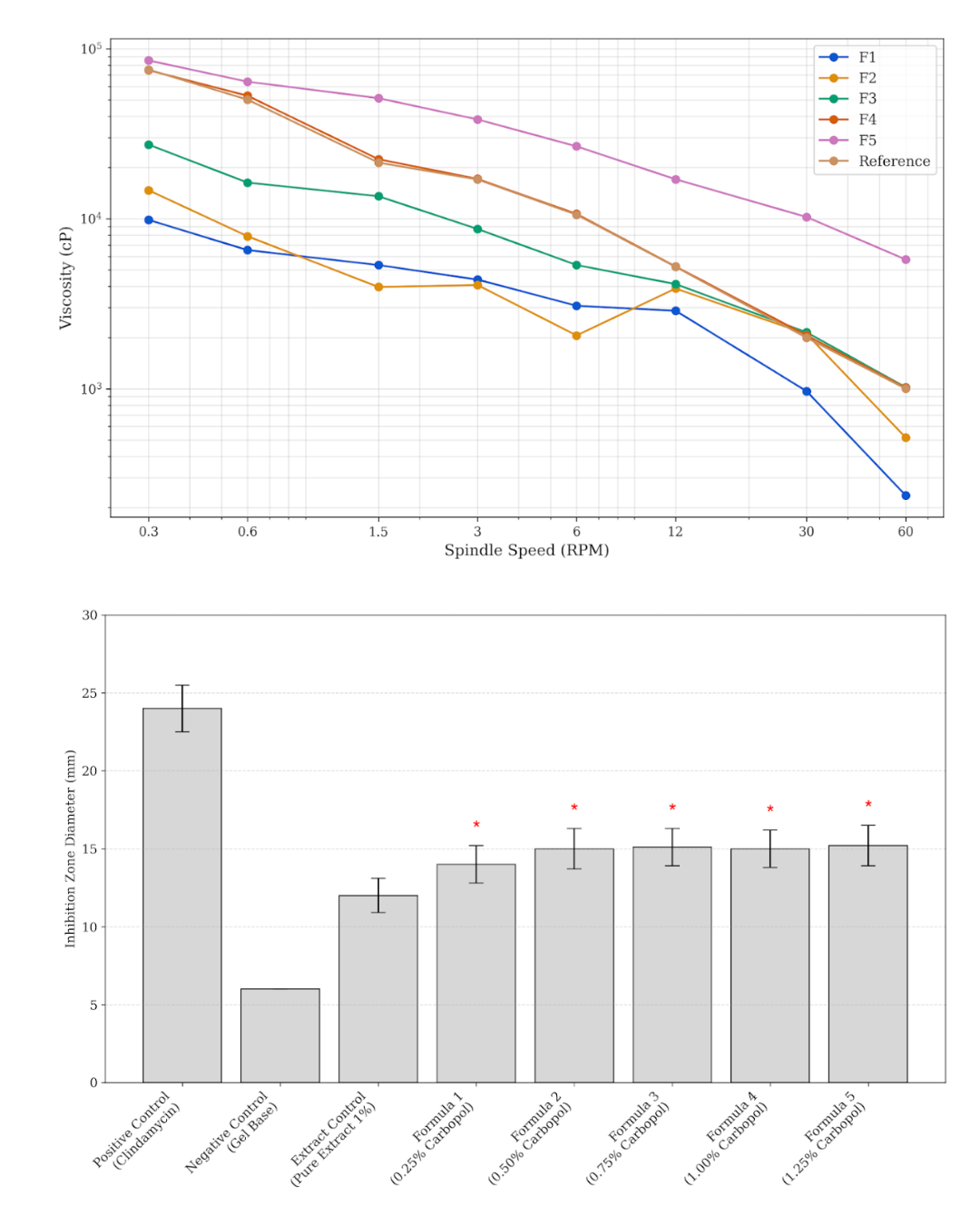
The present study aimed to develop and evaluate a topical gel containing ethanolic red rose flower extract as a potential natural anti-acne and anti-aging preparation. The extract was screened for phytochemicals, and the gel was formulated with varying concentrations of Carbopol 940 (0.25-1.25%). The gels were characterized for their organoleptic properties, pH, viscosity, spreadability, and in vitro antibacterial activity against Cutibacterium acnes. Phytochemical screening revealed the presence of alkaloids, flavonoids, quinones, tannins, saponins, triterpenoids, and anthocyanins in the extract. Organoleptic evaluation showed that Formulas 2 (0.5% Carbopol) and 3 (0.75% Carbopol) had the most suitable characteristics for a cosmetic gel, with moderate viscosity, non-greasiness, rapid absorption, and user comfort. Viscosity testing confirmed pseudoplastic flow behavior, with Formulas 2 and 3 exhibiting an optimal balance between physical stability and ease of application. Spreadability and adhesiveness tests further supported the suitability of these formulas. The pH of all formulas ranged from 7.02 to 7.08, requiring further optimization to match the skin's physiological pH. Antibacterial testing revealed that all gel formulas containing 1% extract showed strong inhibition against C. acnes (inhibition zones of 15.0 ± 1.2–1.3 mm), attributed to the presence of flavonoids, tannins, and other bioactive compounds. The results suggest that the red rose flower extract gel, particularly Formulas 2 and 3, has promising potential as a natural anti-acne and anti-aging preparation, offering a balance of physical stability, user comfort, and antibacterial activity.
Full text article
References
Ansong, J. A., Asante, E., Johnson, R., Boakye-Gyasi, M. E., Kuntworbe, N., Owusu, F. W. A., & Ofori-Kwakye, K. (2023). Formulation and evaluation of herbal‐based antiacne gel preparations. BioMed Research International, 2023, Article 7838299. https://doi.org/10.1155/2023/7838299
Chandimali, N., Bak, S. G., Park, E. H., Lim, H. J., Won, Y. S., Kim, E. K., Park, S. I., & Lee, S. J. (2025). Free radicals and their impact on health and antioxidant defenses: A review. Cell Death Discovery, 11(1). https://doi.org/10.1038/s41420-024-02278-8
Elfitriani, E., Raif, A., Ginting, C. N., & Ikhtiari, R. (2020). Evaluation of antioxidant and anti-collagenase activity of Rosa damascena L. flower petal and receptacle extract. F1000Research, 9, Article 716. https://doi.org/10.12688/f1000research.24772.1
El-Shiekh, R. A., Merghany, R. M., Fayez, N., Hassan, M., Bakr, A. F., Eid, O., Ali, D. E., & Sweilam, S. H. (2025). Phytochemicals as emerging therapeutics for acne vulgaris: A comprehensive review. Future Journal of Pharmaceutical Sciences, 11(1), Article 91. https://doi.org/10.1186/s43094-025-00842-2
Jafari-Sales, A., Jafari, B., Khaneshpour, H., & Pashazadeh, M. (2020). Antibacterial effect of methanolic extract of Rosa damascena on standard bacteria Staphylococcus aureus, Bacillus cereus, Escherichia coli and Pseudomonas aeruginosa in vitro. International Journal of Nature and Life Sciences, 4(1), 40–46. https://doi.org/10.47947/ijnls.728286
Kim, J.-E., Han, H., Xu, Y., Lee, M.-H., & Lee, H.-J. (2023). Efficacy of FRO on acne vulgaris pathogenesis. Pharmaceutics, 15(7), Article 1885. https://doi.org/10.3390/pharmaceutics15071885
Lee, M., Nam, T. G., Lee, I., Shin, E. J., Han, A., Lee, P., Lee, S., & Lim, T. (2018). Skin anti-inflammatory activity of rose petal extract (Rosa gallica) through reduction of MAPK signaling pathway. Food Science & Nutrition, 6(8), 2560–2567. https://doi.org/10.1002/fsn3.870
Pasril, Y., & Okasari, D. (2020). Pengaruh daya antibakteri ekstrak bunga mawar merah (Rosa damascena Mill) terhadap pertumbuhan Enterococcus faecalis. Insisiva Dental Journal: Majalah Kedokteran Gigi Insisiva, 9(1), 26–30. https://doi.org/10.18196/di.9114
Putri, A. N., Laila, N., & Forestryana, D. (2019). Formula optimization of Annona muricata folium ethanolic extract of anti acne gel formulation using factorial design method. Borneo Journal of Pharmacy, 2(2), 63–70. https://doi.org/10.33084/bjop.v2i2.981
Sahoo, S. K., Parida, P., Mishra, S., & Padhy, R. N. (2023). Influence of carbomer concentration on gel rheology and topical drug release. International Journal of Pharmaceutics, 634, Article 122694. https://doi.org/10.1016/j.ijpharm.2023.122694
Song, Y.-R., Lim, W.-C., Han, A., Lee, M., Shin, E. J., Lee, K.-M., Nam, T.-G., & Lim, T.-G. (2020). Rose petal extract (Rosa gallica) exerts skin whitening and anti-skin wrinkle effects. Journal of Medicinal Food, 23(8), 870–878. https://doi.org/10.1089/jmf.2020.4705
Sopharadee, S., Kittipitchakul, J., Srisawas, N., Neimkhum, W., Yawootti, A., Rades, T., & Chaiyana, W. (2025). Green approach for Rosa damascena Mill. petal extract: Insights into phytochemical composition, anti-aging potential, and stability. Antioxidants, 14(5), Article 541. https://doi.org/10.3390/antiox14050541
Thomas, N. A., Tungadi, R., Latif, M. S., & Sukmawati, M. E. (2023). Pengaruh konsentrasi carbopol 940 sebagai gelling agent terhadap stabilitas fisik sediaan gel lidah buaya (Aloe vera). Indonesian Journal of Pharmaceutical Education, 3(2), 316–324. https://doi.org/10.37311/ijpe.v3i2.18050
Vasam, M., Korutla, S., & Bohara, R. A. (2023). Acne vulgaris: A review of the pathophysiology, treatment, and recent nanotechnology based advances. Biochemistry and Biophysics Reports, 36, Article 101578. https://doi.org/10.1016/j.bbrep.2023.101578
Zaelani, D., Pratama, R., Sodik, J. J., & Restu, A. H. (2024). Uji aktivitas antioksidan ekstrak buah mahkota dewa (Phaleria macrocarpa (Scheff.) Boerl.) yang diformulasikan ke dalam sediaan masker gel. Jurnal Farmasi Galenika, 11(1), Article 330. https://doi.org/10.70410/jfg.v11i1.330
Zhao, X., Jiang, Y., Qiao, M., Lin, F., & Miao, B. (2025). Recent advances in bioactive compounds, health functions, and utilization of rose (Rosa spp.). Molecules, 30(19), Article 3869. https://doi.org/10.3390/molecules30193869
Authors

This work is licensed under a Creative Commons Attribution-NonCommercial-ShareAlike 4.0 International License. Copyright @2017. This is an open-access article distributed under the terms of the Creative Commons Attribution-NonCommercial-ShareAlike 4.0 International License (http://creativecommons.org/licenses/by-nc-sa/4.0/) which permits unrestricted non-commercial used, distribution and reproduction in any medium