
Formulation and Antibacterial Evaluation of Ethanolic Garlic Peel Emulgel Against Staphylococcus aureus and Propionibacterium acnes

Article Sidebar
-
emulgel, garlic peel extract, antibacterial activity, Staphylococcus aureus, Propionibacterium acnes
Abstract
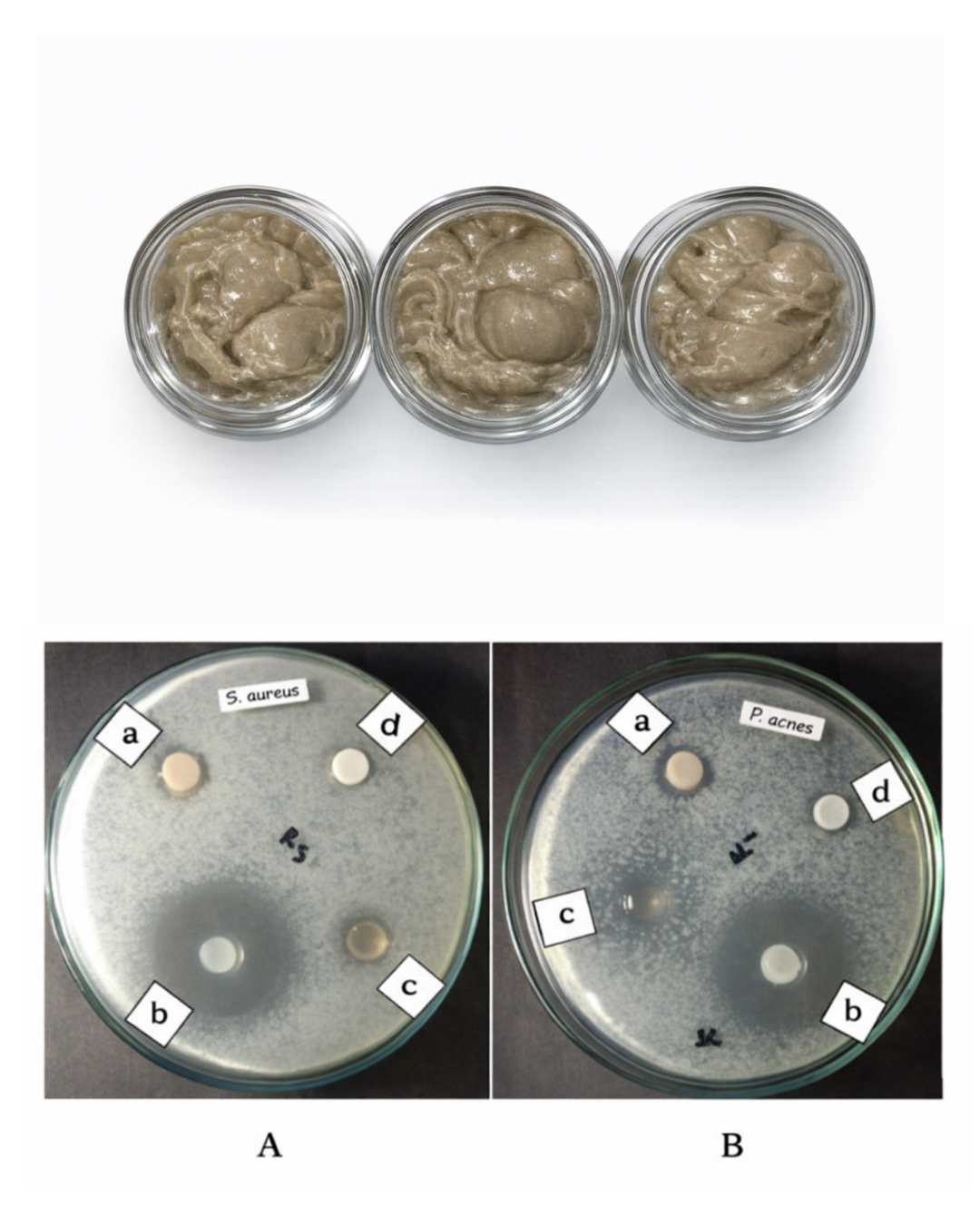
Garlic peel (Allium sativum L.) is a household waste that contains bioactive compounds with potential antibacterial activity. This study aimed to formulate an emulgel containing ethanolic garlic peel extract and evaluate its physical characteristics and antibacterial activity against Staphylococcus aureus and Propionibacterium acnes. The emulgel was evaluated for organoleptic properties, homogeneity, pH, and viscosity. Antibacterial activity was tested using the agar diffusion method. The formulation showed acceptable physical characteristics for topical use. The emulgel inhibited the growth of both bacteria, with inhibition zones of 12.16 mm against S. aureus and 11.02 mm against P. acnes. The antibacterial activity may be related to the presence of flavonoids, saponins, phenolic compounds, and allicin in garlic peel extract. These results suggest that garlic peel extract can be formulated into an emulgel with potential antibacterial activity.
Full text article
References
Erwiyani, A. R., Ayu, S. M., Ningtyas, W. A., & Vifta, R. L. (2022). Formulation and evaluation of pumpkin fruit (Cucurbita maxima L.) emulgel. Jurnal Ilmiah Farmasi, 68–78. https://doi.org/10.20885/jif.specialissue2022.art9
Gultom, E., Hestina, H., & Tafonao, I. S. (2024). Pemanfaatan limbah kulit bawang putih (Allium sativum) sebagai pengendali hama kutu kebul pada tanaman cabai. CHEDS: Journal of Chemistry, Education, and Science, 8(1), 128–135. https://doi.org/10.30743/cheds.v8i1.9408
Inayah, N., Pratama, K. J., & Permata, B. R. (2024). Formulasi dan uji aktivitas antibakteri sediaan gel anti jerawat ekstrak kulit buah kakao (Theobroma cacao L.) terhadap bakteri Propionibacterium acnes ATCC 11827. Jurnal Kajian Ilmiah Multidisipliner, 8(9), 105–114.
Jufri, M., Rachmadiva, M., Gozan, M., & Suyono, E. A. (2018). Formulation, stability test, and in vitro penetration test of emulgel from tobacco leaves extract. Journal of Young Pharmacists, 10(2), S69–S72. https://doi.org/10.5530/jyp.2018.2s.13
Khan, B. A., Ullah, S., Khan, M. K., Alshahrani, S. M., & Braga, V. A. (2020). Formulation and evaluation of Ocimum basilicum-based emulgel for wound healing using an animal model. Saudi Pharmaceutical Journal, 28(12), 1842–1850. https://doi.org/10.1016/j.jsps.2020.11.011
Mardiana, A. D., Ibrahim, M., & Lisdiana, L. (2015). Potency of Sansevieria trifasciata leaves filtrate on the bacteria growth inhibition of Staphylococcus aureus and Escherichia coli. LenteraBio, 4, 6–12.
Muliasari, H., Almira, D., & Subaidah, W. A. (2022). Formulation and evaluation of anti-inflammatory emulgel of Brucea javanica (L.) Merr seed extracts. Jurnal Kimia Riset, 7(1), 66–73. https://doi.org/10.20473/jkr.v7i1.36010
Ningrat, A. W. S. (2024). Formulation and testing of emulgel preparations from purified fraction of papaya (Carica papaya L.) leaves as anti-acne. Jurnal Ilmiah Farmasi Akademi Farmasi Jember, 7(1), 36–43. https://doi.org/10.53864/jifakfar.v7i1.166
Nisa, M., Lastri, W. S., & Hendrarti, W. (2021). Formulasi dan uji antibakteri gel ekstrak etanol kulit bawang putih (Allium sativum L.) terhadap bakteri Staphylococcus aureus. Pharmacoscript, 4(1), 109–116. https://doi.org/10.36423/pharmacoscript.v4i1.618
Nugrahani, A. P., Rahmadina, S. A., Lestari, N. D., & Mulyani, S. (2022). Inovasi sunscreen dari ekstrak kulit bawang putih dan bawang merah sebagai anti-kusam, anti-jerawat, dan anti-aging. Seminar Nasional Kimia dan Pendidikan Kimia (SN-KPK), 13(1), 153–165.
Ogedengbe, O. T., & Kolawole, O. M. (2024). Formulation and evaluation of fluconazole emulgels for potential treatment of vaginal candidiasis. Heliyon, 10(6), e28206. https://doi.org/10.1016/j.heliyon.2024.e28206
Safitri, G. L., Wibowo, M. A., & Idiawati, N. (2017). Uji aktivitas antibakteri ekstrak kasar buah asam paya (Eleiodoxa conferta (Griff.) Buret) terhadap bakteri Staphylococcus aureus dan Salmonella typhi. Jurnal Kimia Khatulistiwa, 6(1), 17–20.
Suci, P. R., Raharjeng, S. W., Fitriyany, E., Nur, C. I., Calya, F., & Sari, S. (2023). Pemanfaatan limbah kulit bawang putih (Allium sativum L.) sebagai bahan aktif pembuatan sabun cair. Jurnal Riset Kefarmasian Indonesia, 5(3), 427–438. https://doi.org/10.33759/jrki.v5i3.392
Yati, K., Jufri, M., Gozan, M., & Dwita, L. P. (2018). Pengaruh variasi konsentrasi hydroxypropyl methyl cellulose (HPMC) terhadap stabilitas fisik gel ekstrak tembakau (Nicotiana tabacum L.) dan aktivitasnya terhadap Streptococcus mutans. Pharmaceutical Sciences and Research, 5(3), 133–141. https://doi.org/10.7454/psr.v5i3.4146
Zahrah, H., Mustika, A., & Debora, K. (2019). Aktivitas antibakteri dan perubahan morfologi dari Propionibacterium acnes setelah pemberian ekstrak Curcuma xanthorrhiza. Jurnal Biosains Pascasarjana, 20(3), 160. https://doi.org/10.20473/jbp.v20i3.2018.160-169
Authors

This work is licensed under a Creative Commons Attribution-NonCommercial-ShareAlike 4.0 International License. Copyright @2017. This is an open-access article distributed under the terms of the Creative Commons Attribution-NonCommercial-ShareAlike 4.0 International License (http://creativecommons.org/licenses/by-nc-sa/4.0/) which permits unrestricted non-commercial used, distribution and reproduction in any medium