
Indonesian Medicinal Plants Investigated for Cancer-Related Activity: A Review of Ethnobotanical, Phytochemical, and Preclinical Evidence

Article Sidebar
-
Cytotoxicity, Ethnobotany, Evidence level, Indonesian medicinal plants, Phytochemistry
Abstract
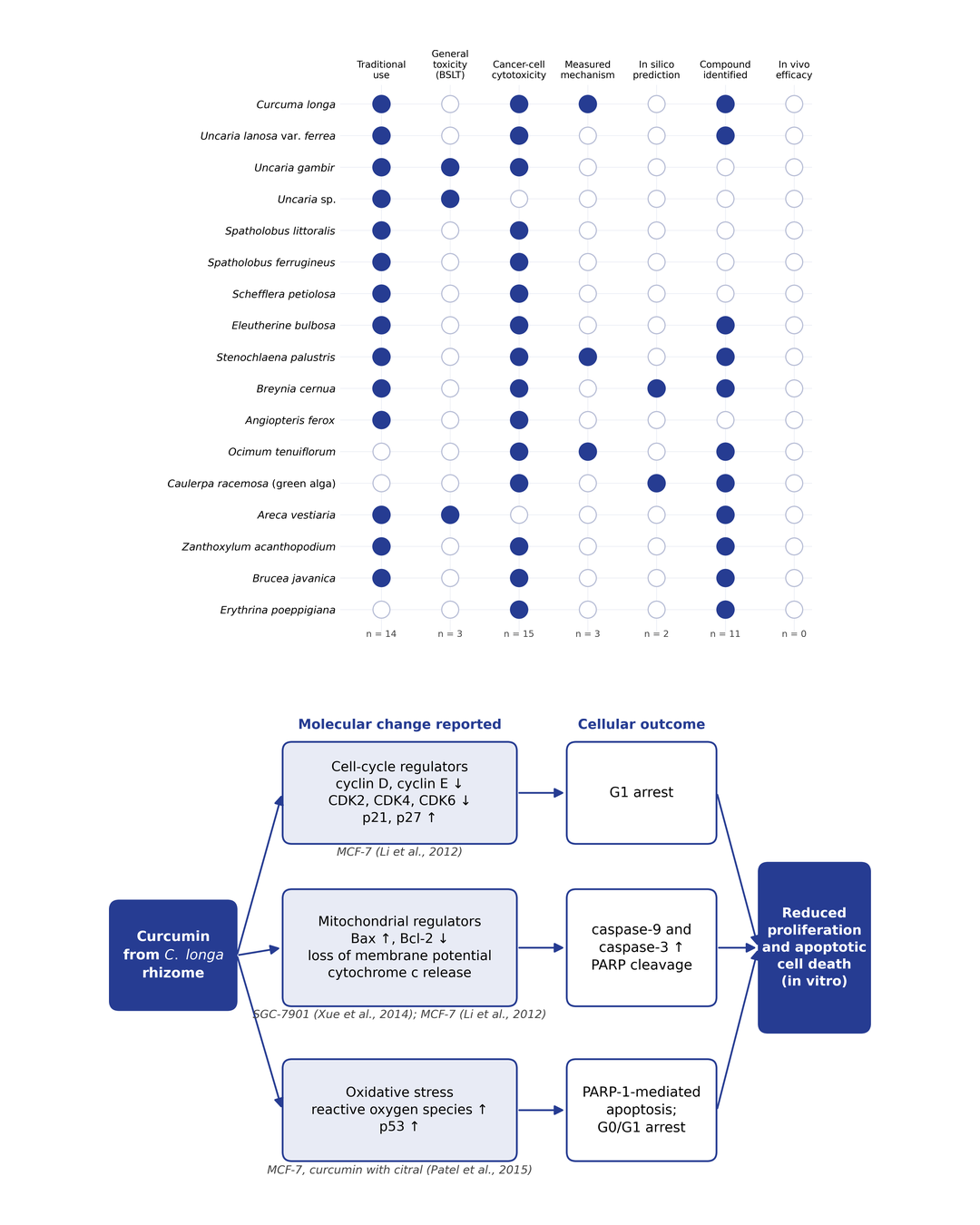
Medicinal plants are widely used by Indonesian cancer patients, but the evidence behind this use differs in kind and strength. This review classified 24 studies from Google Scholar, ScienceDirect and PubMed, plus ten further primary studies, by evidence level: traditional use, general toxicity, cancer-cell cytotoxicity, measured mechanism, in silico prediction and compound identification. Cancer-cell data existed for 15 of 17 taxa, almost all as crude extracts, and normal-cell controls were rare. The lowest IC50 values were 23.7 µg/mL (Caulerpa racemosa hexane extract, MCF-7) and 54.48 µg/mL (Zanthoxylum acanthopodium fruit ethanol extract, 4T1). The name bajakah covered species of three genera. Mechanisms were measured only for curcumin, Stenochlaena palustris and Ocimum tenuiflorum, and no in vivo efficacy study was found. Botanical authentication, selectivity testing, compound isolation and animal studies should precede therapeutic claims.
Full text article
References
Adrian, Syahputra, R. A., Juwita, N. A., Astyka, R., & Lubis, M. F. (2023). Andaliman (Zanthoxylum acanthopodium DC.) a herbal medicine from North Sumatera, Indonesia: Phytochemical and pharmacological review. Heliyon, 9(5), e16159. https://doi.org/10.1016/j.heliyon.2023.e16159 DOI: https://doi.org/10.1016/j.heliyon.2023.e16159
Aisyah, A. N., Nur, S., Lukitaningsih, E., Rumiyati, R., Burhan, A., Adjara, S. M., & Rahim, K. (2020). Efek sitotoksik ekstrak dan fraksi umbi paku atai merah (Angiopteris ferox Copel) terhadap sel kanker payudara T47D [Cytotoxic effects of paku atai merah (Angiopteris ferox Copel) tuber extract and fractions against T47D breast cancer cells]. Jurnal Farmasi Galenika, 6(2). https://doi.org/10.22487/j24428744.2020.v6.i2.15255 DOI: https://doi.org/10.22487/j24428744.2020.v6.i2.15255
Alamsyah Lubis, I., Ichwan, M. F., Mustofa, M., & Satria, D. (2018). Anticancer activity of Eleutherine bulbosa (Mill.) Urb. extract on WiDr cell line in vitro. In Proceedings of the 2nd Public Health International Conference (PHICo 2017) (pp. 167–171). Atlantis Press. https://doi.org/10.2991/phico-17.2018.25 DOI: https://doi.org/10.2991/phico-17.2018.25
Alfani, N. R., Febrianti, R., & Amananti, W. (2023). Analysis of total flavonoid content in the extract of bajakah kalalawit root (Uncaria gambir Roxb) infunded results. Indonesian Journal of Chemical Science and Technology, 6(1), 65–75. https://doi.org/10.24114/ijcst.v6i1.43184 DOI: https://doi.org/10.24114/ijcst.v6i1.43184
Aliviyanti, R. U. Y., Sudibyo, R. S., & Murwanti, R. (2021). Efek sitotoksik beberapa akar bajakah Kalimantan terhadap sel kanker payudara T47D [Cytotoxic effects of several Kalimantan bajakah roots on T47D breast cancer cells]. Jurnal Penelitian Saintek, 26(2). https://doi.org/10.21831/jps.v26i2.41211 DOI: https://doi.org/10.21831/jps.v26i2.41211
Ambardhani, N., Herlina, T., & Supratman, U. (2019). Cytotoxic activity of α-erythroidine from the stem bark of Erythrina poeppigiana against MCF-7 breast cancer cell line. International Research Journal of Pharmacy, 10(9), 55–58. https://doi.org/10.7897/2230-8407.1009262 DOI: https://doi.org/10.7897/2230-8407.1009262
Az-Zahra, F. R., Sari, N. L. W., Saputry, R., Nugroho, G. D., Pribadi, T., Sunarto, S., & Setyawan, A. D. (2021). Review: Traditional knowledge of the Dayak tribes (Borneo) in the use of medicinal plants. Biodiversitas Journal of Biological Diversity, 22(10), 4633–4647. https://doi.org/10.13057/biodiv/d221057 DOI: https://doi.org/10.13057/biodiv/d221057
Bray, F., Laversanne, M., Sung, H., Ferlay, J., Siegel, R. L., Soerjomataram, I., & Jemal, A. (2024). Global cancer statistics 2022: GLOBOCAN estimates of incidence and mortality worldwide for 36 cancers in 185 countries. CA: A Cancer Journal for Clinicians, 74(3), 229–263. https://doi.org/10.3322/caac.21834 DOI: https://doi.org/10.3322/caac.21834
Choi, S., Karki Kunwor, S., Im, H., Choi, D., Hwang, J., Ahmed, M., & Han, D. (2024). Traditional and complementary medicine use among cancer patients in Asian countries: A systematic review and meta-analysis. Cancers, 16(18), 3130. https://doi.org/10.3390/cancers16183130 DOI: https://doi.org/10.3390/cancers16183130
Dirgantara, S., Tanjung, R. H. R., Maury, H. K., & Meiyanto, E. (2018). Cytotoxic activity and phytochemical analysis of Breynia cernua from Papua. Indonesian Journal of Pharmaceutical Science and Technology, Suppl. 1(1), 31–36. https://jurnal.unpad.ac.id/ijpst/article/view/16121
Domlur Thyagaraj, V., Koshy, R., Kachroo, M., Mayachari, A. S., Sawant, L. P., & Balasubramanium, M. (2013). A validated RP-HPLC-UV/DAD method for simultaneous quantitative determination of rosmarinic acid and eugenol in Ocimum sanctum L. Pharmaceutical Methods, 4(1), 1–5. https://doi.org/10.1016/j.phme.2013.08.003 DOI: https://doi.org/10.1016/j.phme.2013.08.003
Elfahmi, Woerdenbag, H. J., & Kayser, O. (2014). Jamu: Indonesian traditional herbal medicine towards rational phytopharmacological use. Journal of Herbal Medicine, 4(2), 51–73. https://doi.org/10.1016/j.hermed.2014.01.002 DOI: https://doi.org/10.1016/j.hermed.2014.01.002
Fatmawati, F., Fauzana, N. A., Aisiah, S., Rini, R. K., Olga, O., Tanod, W. A., & Riyadi, P. H. (2022). Chemicals profile of kelakai leaves extracts (Stenochlaena palustris) with antioxidant and antibacterial activity against Aeromonas hydrophila. Sains Malaysiana, 51(8), 2531–2546. https://doi.org/10.17576/jsm-2022-5108-14 DOI: https://doi.org/10.17576/jsm-2022-5108-14
Hasan, A. E. Z., Julistiono, H., Bermawie, N., Riyanti, E. I., & Arifni, F. R. (2022). Soursop leaves (Annona muricata L.) endophytic fungi anticancer activity against HeLa cells. Saudi Journal of Biological Sciences, 29(8), 103354. https://doi.org/10.1016/j.sjbs.2022.103354 DOI: https://doi.org/10.1016/j.sjbs.2022.103354
Husodo, S. B., Budiarso, E., Kusuma, I. W., & Arung, E. T. (2021). The potential of katuk hutan (Phylanthus reticulus) as a medicinal plant. In Advances in Biological Sciences Research (Vol. 11, pp. 348–355). Atlantis Press. https://doi.org/10.2991/absr.k.210408.058 DOI: https://doi.org/10.2991/absr.k.210408.058
Hutapea, D. B., Susilawati, Y., Muhaimin, M., Amalia, R., Mulyani, A. T., & Chaerunisaa, A. Y. (2025). The potential of Zanthoxylum acanthopodium DC. as immunomodulators: Formulation, activity testing, and extract profiling. Pharmaceuticals, 18(7), 1001. https://doi.org/10.3390/ph18071001 DOI: https://doi.org/10.3390/ph18071001
Katta, B., Vijayakumar, C., Dutta, S., Dubashi, B., & Nelamangala Ramakrishnaiah, V. P. (2023). The incidence and severity of patient-reported side effects of chemotherapy in routine clinical care: A prospective observational study. Cureus, 15(4), e38301. https://doi.org/10.7759/cureus.38301 DOI: https://doi.org/10.7759/cureus.38301
Li, H.-Q., Jin, L.-J., Wu, F.-F., Li, X.-Y., You, J.-S., Cao, Z.-H., Li, D., & Xu, Y.-P. (2012). Effect of curcumin on proliferation, cell cycle, and caspases and MCF-7 cells. African Journal of Pharmacy and Pharmacology, 6(12), 864–870. https://doi.org/10.5897/ajpp11.418 DOI: https://doi.org/10.5897/AJPP11.418
Mahfudh, N., Utami, D., Nashihah, S., Ahda, M., Andika, A., & Sabilla, G. A. (2024). Variability and pharmacological potential of bajakah (Spatholobus sp.) as an indigenous medicinal plant: A review. International Journal of Public Health Science, 13(3), 1470–1479. https://doi.org/10.11591/ijphs.v13i3.23791 DOI: https://doi.org/10.11591/ijphs.v13i3.23791
Mee, T., Kirkby, N. F., Defourny, N. N., Kirkby, K. J., & Burnet, N. G. (2023). The use of radiotherapy, surgery and chemotherapy in the curative treatment of cancer: Results from the FORTY (Favourable Outcomes from RadioTherapY) project. The British Journal of Radiology, 96(1152), 20230334. https://doi.org/10.1259/bjr.20230334 DOI: https://doi.org/10.1259/bjr.20230334
Meiyanto, E., & Larasati, Y. A. (2019). The chemopreventive activity of Indonesia medicinal plants targeting on hallmarks of cancer. Advanced Pharmaceutical Bulletin, 9(2), 219–230. https://doi.org/10.15171/apb.2019.025 DOI: https://doi.org/10.15171/apb.2019.025
Munn, Z., Peters, M. D. J., Stern, C., Tufanaru, C., McArthur, A., & Aromataris, E. (2018). Systematic review or scoping review? Guidance for authors when choosing between a systematic or scoping review approach. BMC Medical Research Methodology, 18(1), 143. https://doi.org/10.1186/s12874-018-0611-x DOI: https://doi.org/10.1186/s12874-018-0611-x
Muti’ah, R., Listiyana, A., Nafisa, B. B., & Suryadinata, A. (2020). Kajian efek ekstrak umbi bawang Dayak (Eleutherine palmifolia (L.) Merr) sebagai antikanker [Study of the anticancer effect of Dayak onion (Eleutherine palmifolia (L.) Merr) bulb extract]. Journal of Islamic Pharmacy, 5(2), 14–25. https://doi.org/10.18860/jip.v5i2.9778 DOI: https://doi.org/10.18860/jip.v5i2.9778
Nurmilatina, N. (2017). Analisis komposisi kimia daun kelakai (Stenochlaena palustris Bedd.) dengan berbagai pelarut menggunakan GCMS [Chemical composition analysis of Stenochlaena palustris Bedd. leaves using various solvents on GCMS]. Jurnal Riset Industri Hasil Hutan, 9(1), 9–16. https://doi.org/10.24111/jrihh.v9i1.2952 DOI: https://doi.org/10.24111/jrihh.v9i1.2952
Olver, I., Carey, M., Boyes, A., Hall, A., Noble, N., Bryant, J., Walsh, J., & Sanson-Fisher, R. (2018). The timeliness of patients reporting the side effects of chemotherapy. Supportive Care in Cancer, 26(10), 3579–3586. https://doi.org/10.1007/s00520-018-4225-y DOI: https://doi.org/10.1007/s00520-018-4225-y
Page, M. J., McKenzie, J. E., Bossuyt, P. M., Boutron, I., Hoffmann, T. C., Mulrow, C. D., Shamseer, L., Tetzlaff, J. M., Akl, E. A., Brennan, S. E., Chou, R., Glanville, J., Grimshaw, J. M., Hróbjartsson, A., Lalu, M. M., Li, T., Loder, E. W., Mayo-Wilson, E., McDonald, S., … Moher, D. (2021). The PRISMA 2020 statement: An updated guideline for reporting systematic reviews. BMJ, 372, n71. https://doi.org/10.1136/bmj.n71 DOI: https://doi.org/10.1136/bmj.n71
Patel, P. B., Thakkar, V. R., & Patel, J. S. (2015). Cellular effect of curcumin and citral combination on breast cancer cells: Induction of apoptosis and cell cycle arrest. Journal of Breast Cancer, 18(3), 225–234. https://doi.org/10.4048/jbc.2015.18.3.225 DOI: https://doi.org/10.4048/jbc.2015.18.3.225
Pengpid, S., & Peltzer, K. (2018). Utilization of traditional and complementary medicine in Indonesia: Results of a national survey in 2014–15. Complementary Therapies in Clinical Practice, 33, 156–163. https://doi.org/10.1016/j.ctcp.2018.10.006 DOI: https://doi.org/10.1016/j.ctcp.2018.10.006
Permatasanti, A., & Hidayat, W. (2023). Potential of Indonesian herbal as an anti-cancer therapy: A systemic review of in vitro studies. Cancer Management and Research, 15, 837–850. https://doi.org/10.2147/cmar.s414457 DOI: https://doi.org/10.2147/CMAR.S414457
Permatasari, D. A. I., Sari, P. S. K., Permata, B. R., & Septiarini, A. D. (2023). Uji toksisitas fraksi n-heksan, etil asetat, air batang bajakah kalalawit (Uncaria gambir Roxb) menggunakan metode BSLT (brine shrimp lethality test) [Toxicity of n-hexane, ethyl acetate and water fractions of bajakah kalalawit (Uncaria gambir Roxb) stem by the brine shrimp lethality test]. Parapemikir: Jurnal Ilmiah Farmasi, 12(3), 380–386. https://doi.org/10.30591/pjif.v12i3.5762 DOI: https://doi.org/10.30591/pjif.v12i3.5762
Plants of the World Online. (2026). Plants of the World Online. Royal Botanic Gardens, Kew. Retrieved 28 September 2026, from https://powo.science.kew.org/
Putri, I. Y., Indra, R. L., & Lita, L. (2022). Description of the factors behind the choice of alternative medicine in breast cancer patient. Jurnal Kesehatan Samodra Ilmu, 13(1), 29–33. https://doi.org/10.55426/jksi.v13i1.192 DOI: https://doi.org/10.55426/jksi.v13i1.192
Rahayuwati, L., Ibrahim, K., & Komariah, M. (2017). Pilihan pengobatan pasien kanker payudara masa kemoterapi: Studi kasus [Treatment choices of breast cancer patients during chemotherapy: A case study]. Jurnal Keperawatan Indonesia, 20(2), 118–127. https://doi.org/10.7454/jki.v20i2.478 DOI: https://doi.org/10.7454/jki.v20i2.478
Rani, D. M., Wongso, H., Purwoko, R. Y., Winarto, N. B., Shalas, A. F., Triatmoko, B., Pratama, A. N. W., Keller, P. A., & Nugraha, A. S. (2023). Anti-cancer bioprospecting on medicinal plants from Indonesia: A review. Phytochemistry, 216, 113881. https://doi.org/10.1016/j.phytochem.2023.113881 DOI: https://doi.org/10.1016/j.phytochem.2023.113881
Rani, V. S. (2018). Isolation of a compound from the bulbs of Eleutherine bulbosa (Miller) Urban (Iridaceae). Asian Journal of Pharmaceutical and Clinical Research, 11(6), 406–410. https://doi.org/10.22159/ajpcr.2018.v11i6.25059 DOI: https://doi.org/10.22159/ajpcr.2018.v11i6.25059
Rerung, F., Anam, S., & Khumaidi, A. (2017). Isolasi senyawa flavonoid ekstrak biji pinang merah (Areca vestiaria Giseke) dan uji sitotoksiknya melalui uji brine shrimp lethality test (BSLT) [Isolation of flavonoid compounds of red pinang (Areca vestiaria Giseke) seed extract and cytotoxic test by brine shrimp lethality test]. Jurnal Farmasi Galenika, 3(1), 18–26. https://doi.org/10.22487/j24428744.2017.v3.i1.8135 DOI: https://doi.org/10.22487/j24428744.2017.v3.i1.8135
Rosidah, R., Hasibuan, P. A. Z., Haro, G., & Satria, D. (2019). Cytotoxicity activity of ethanol extract of andaliman fruits (Zanthoxylum acanthopodium DC.) towards 4T1 breast cancer cells. Indonesian Journal of Pharmaceutical and Clinical Research, 2(2), 31–35. https://doi.org/10.32734/idjpcr.v2i2.3220 DOI: https://doi.org/10.32734/idjpcr.v2i2.3220
Safitri, R. A., Saptarini, O., & Sunarni, T. (2021). Uji aktivitas sitotoksik, ekspresi p53, dan Bcl-2 dari ekstrak fraksi herba kelakai (Stenochleana palustris (Burm.F.) Bedd.) terhadap sel kanker payudara T47D [Cytotoxic activity and p53 and Bcl-2 expression of kelakai herb extract fractions on T47D breast cancer cells]. Jurnal Biotek Medisiana Indonesia, 9(2), 113–127. https://doi.org/10.22435/jbmi.v9i2.4415 DOI: https://doi.org/10.22435/jbmi.v9i2.4415
Sanger, G., Wonggo, D., Taher, N., Dotulong, V., Setiawan, A. A., Permatasari, H. K., Maulana, S., Nurkolis, F., Tsopmo, A., & Kim, B. (2023). Green seaweed Caulerpa racemosa: Chemical constituents, cytotoxicity in breast cancer cells and molecular docking simulation. Journal of Agriculture and Food Research, 12, 100621. https://doi.org/10.1016/j.jafr.2023.100621 DOI: https://doi.org/10.1016/j.jafr.2023.100621
Santoso, H., Chalidyanto, D., & Laksono, A. D. (2021). The prevalence of cancer in Indonesia: An ecological analysis. Indian Journal of Forensic Medicine & Toxicology, 15(3), 3170–3176. https://doi.org/10.37506/ijfmt.v15i3.15791 DOI: https://doi.org/10.37506/ijfmt.v15i3.15791
Satolom, C. C. (2015). Isolasi senyawa flavonoid pada biji pinang yaki (Areca vestiaria Giseke) [Isolation of flavonoid compounds from pinang yaki (Areca vestiaria Giseke) seeds]. Jurnal MIPA, 4(1), 40–45. https://doi.org/10.35799/jm.4.1.2015.6903 DOI: https://doi.org/10.35799/jm.4.1.2015.6903
Sharma, R. A., Gescher, A. J., & Steward, W. P. (2005). Curcumin: The story so far. European Journal of Cancer, 41(13), 1955–1968. https://doi.org/10.1016/j.ejca.2005.05.009 DOI: https://doi.org/10.1016/j.ejca.2005.05.009
Simbala, H. E. I., Nurkolis, F., Mayulu, N., & Rotty, L. W. A. (2022). Metabolites of pinang yaki (Areca vestiaria) fruit extract: A metabolite profiling study. F1000Research, 10, 1021. https://doi.org/10.12688/f1000research.73758.3 DOI: https://doi.org/10.12688/f1000research.73758.3
Subeki, & Muhartono. (2015). Senyawa brusein-A dari buah makasar (Brucea javanica (L.) Merr.) sebagai antiproliferasi terhadap sel kanker payudara T47D [Bruceine A from makasar fruit (Brucea javanica (L.) Merr.) as an antiproliferative agent against T47D breast cancer cells]. Majalah Kedokteran Bandung, 47(1), 22–28. https://doi.org/10.15395/mkb.v47n1.394 DOI: https://doi.org/10.15395/mkb.v47n1.394
Tala, Z. Z., & Siregar, G. A. (2022). Effect of andaliman (Zanthoxylum acanthopodium) fruit extract on anticancer activity of HepG2 liver cancer cell lines. Open Access Macedonian Journal of Medical Sciences, 10(A), 361–365. https://doi.org/10.3889/oamjms.2022.8136 DOI: https://doi.org/10.3889/oamjms.2022.8136
Utispan, K., Koontongkaew, S., Niyomtham, N., & Yingyongnarongkul, B.-E. (2023). Ethanolic extract of Ocimum sanctum leaf modulates oxidative stress, cell cycle and apoptosis in head and neck cancer cell lines. Heliyon, 9(4), e15518. https://doi.org/10.1016/j.heliyon.2023.e15518 DOI: https://doi.org/10.1016/j.heliyon.2023.e15518
Weerapreeyakul, N., Nonpunya, A., Barusrux, S., Thitimetharoch, T., & Sripanidkulchai, B. (2012). Evaluation of the anticancer potential of six herbs against a hepatoma cell line. Chinese Medicine, 7(1), 15. https://doi.org/10.1186/1749-8546-7-15 DOI: https://doi.org/10.1186/1749-8546-7-15
Wihadmadyatami, H., Karnati, S., Hening, P., Tjahjono, Y., Rizal, Maharjanti, F., Kusindarta, D. L., Triyono, T., & Supriatno. (2019). Ethanolic extract Ocimum sanctum Linn. induces an apoptosis in human lung adenocarcinoma (A549) cells. Heliyon, 5(11), e02772. https://doi.org/10.1016/j.heliyon.2019.e02772 DOI: https://doi.org/10.1016/j.heliyon.2019.e02772
Wiraswati, H. L., Fauziah, N., Pradini, G. W., Kurnia, D., Kodir, R. A., Berbudi, A., Arimdayu, A. R., Laelalugina, A., Supandi, & Ma’ruf, I. F. (2023). Breynia cernua: Chemical profiling of volatile compounds in the stem extract and its antioxidant, antibacterial, antiplasmodial and anticancer activity in vitro and in silico. Metabolites, 13(2), 281. https://doi.org/10.3390/metabo13020281 DOI: https://doi.org/10.3390/metabo13020281
Xue, X., Yu, J.-L., Sun, D.-Q., Kong, F., Qu, X.-J., Zou, W., Wu, J., & Wang, R.-M. (2014). Curcumin induces apoptosis in SGC-7901 gastric adenocarcinoma cells via regulation of mitochondrial signaling pathways. Asian Pacific Journal of Cancer Prevention, 15(9), 3987–3992. https://doi.org/10.7314/apjcp.2014.15.9.3987 DOI: https://doi.org/10.7314/APJCP.2014.15.9.3987
Yang, P., Liu, D.-Q., Liang, T.-J., Li, J., Zhang, H.-Y., Liu, A.-H., Guo, Y.-W., & Mao, S.-C. (2015). Bioactive constituents from the green alga Caulerpa racemosa. Bioorganic & Medicinal Chemistry, 23(1), 38–45. https://doi.org/10.1016/j.bmc.2014.11.031 DOI: https://doi.org/10.1016/j.bmc.2014.11.031
Yanti, M. N., Rahmawati, I., & Herdwiani, W. (2021). Uji aktivitas sitotoksik herba kelakai (Stenochlaena palustris (Burm.F.) Bedd.) terhadap sel kanker hati HepG2 [Cytotoxic activity of herbaceous kelakai (Stenochlaena palustris (Burm.F.) Bedd.) against HepG2 liver cancer cells]. Jurnal Bioteknologi & Biosains Indonesia, 8(2), 255–266. https://ejournal.brin.go.id/JBBI/article/view/1805
Yuliastuti, F., Andayani, T. M., Endarti, D., & Kristina, S. A. (2023). Breast, cervical, and lung cancer: A comparison of real healthcare costs and INA-CBGs rates in the era of national health insurance. Pharmacy Practice, 21(1), 2768. https://doi.org/10.18549/pharmpract.2023.1.2768 DOI: https://doi.org/10.18549/PharmPract.2023.1.2768
Yusuf, M., Muhaimin, M., Amalia, R., & Iskandar, Y. (2023). Cytotoxic activity and phytochemical screening of ethanol extract of bajakah tampala (Uncaria lanosa var. ferrea (Blume) Ridsdale) stem on breast cancer cell lines MCF-7. International Journal of Applied Pharmaceutics, 15(Special Issue 2), 44–47. https://doi.org/10.22159/ijap.2023.v15s2.08 DOI: https://doi.org/10.22159/ijap.2023.v15s2.08
Yusuf, M., Muhaimin, M., Amalia, R., & Iskandar, Y. (2026). Metabolite profiling and cytotoxicity of bajakah tampala (Uncaria lanosa var. ferrea) stem fractions against breast cancer cells. Jurnal Jamu Indonesia, 11(3), 217–223. https://doi.org/10.29244/jji.v11i3.498 DOI: https://doi.org/10.29244/jji.v11i3.498
Zein, M. F. F., Hazar, S., & Suwendar. (2022). Uji sitotoksik fraksi dan ekstrak batang kayu bajakah (Uncaria sp.) menggunakan metode brine shrimp lethality test (BSLT) [Cytotoxicity of fractions and extract of bajakah (Uncaria sp.) stem wood by the brine shrimp lethality test]. Bandung Conference Series: Pharmacy, 2(2). https://doi.org/10.29313/bcsp.v2i2.4567 DOI: https://doi.org/10.29313/bcsp.v2i2.4567
Authors
Copyright (c) 2026 Mashuri Yusuf, Muhaimin Muhaimin, Yoppi Iskandar, Riezki Amalia, Syuhada Syuhada

This work is licensed under a Creative Commons Attribution-NonCommercial-ShareAlike 4.0 International License.
This work is licensed under a Creative Commons Attribution-NonCommercial-ShareAlike 4.0 International License. Copyright is retained by the authors.