
Traditional Medicine Use and Pharmacist Involvement Among Patients with Diabetes and Hypertension in Semarang, Indonesia: A Cross-sectional Study

Article Sidebar
-
diabetes mellitus, herb–drug interaction, hypertension, pharmacist, traditional medicine
Abstract
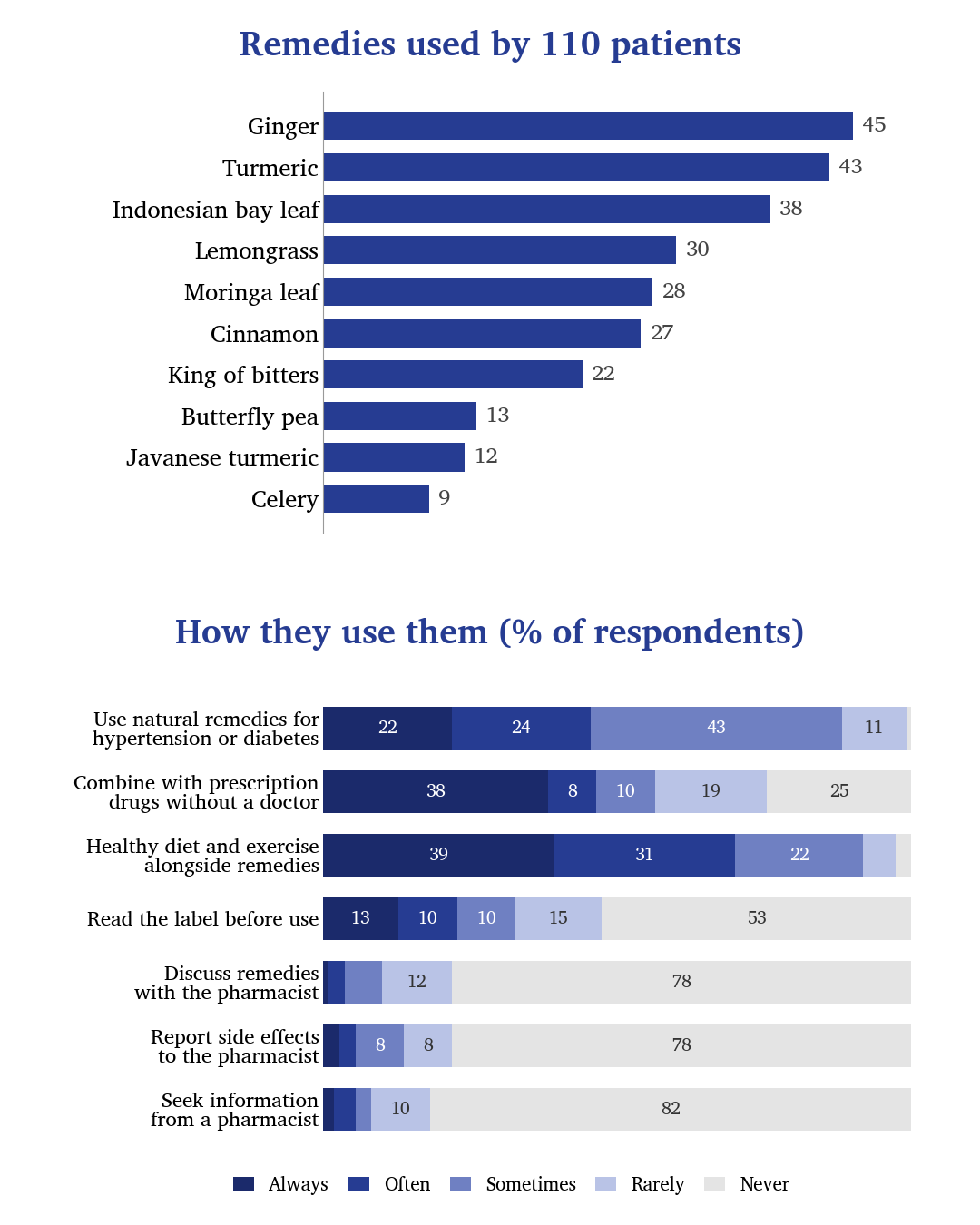
Patients with diabetes or hypertension often take traditional medicine alongside prescribed drugs, yet little is known about how they involve pharmacists in that use. This descriptive cross-sectional study enrolled 110 adult users of traditional medicine, recruited by purposive sampling at a community health centre and a private clinic in Semarang, Indonesia, and surveyed them with a structured questionnaire. Their mean age was 59.5 ± 10.3 years, 77.3% were women and 73.6% had diabetes. Ginger (40.9%), turmeric (39.1%) and Indonesian bay leaf (34.5%) were the remedies named most often. Pharmacists were seldom involved: 78.2% of respondents had never discussed their remedies with a pharmacist, 81.8% had never asked a pharmacist for information about them and 78.2% had never reported a side effect to one. Meanwhile, 46.4% always or often combined remedies with prescribed drugs without consulting a doctor. Community pharmacists are well placed to close this counselling gap.
Full text article
References
Alqathama, A., Alluhiabi, G., Baghdadi, H., Aljahani, L., Khan, O., Jabal, S., Makkawi, S., & Alhomoud, F. (2020). Herbal medicine from the perspective of type II diabetic patients and physicians: What is the relationship? BMC Complementary Medicine and Therapies, 20(1), 65. https://doi.org/10.1186/s12906-020-2854-4 DOI: https://doi.org/10.1186/s12906-020-2854-4
Alzahrani, A. S., Price, M. J., Greenfield, S. M., & Paudyal, V. (2021). Global prevalence and types of complementary and alternative medicines use amongst adults with diabetes: Systematic review and meta-analysis. European Journal of Clinical Pharmacology, 77(9), 1259–1274. https://doi.org/10.1007/s00228-021-03097-x DOI: https://doi.org/10.1007/s00228-021-03097-x
Arifah, F. H., Nugroho, A. E., Rohman, A., & Sujarwo, W. (2022). A review of medicinal plants for the treatment of diabetes mellitus: The case of Indonesia. South African Journal of Botany, 149, 537–558. https://doi.org/10.1016/j.sajb.2022.06.042 DOI: https://doi.org/10.1016/j.sajb.2022.06.042
Başaran, N., Paslı, D., & Başaran, A. A. (2022). Unpredictable adverse effects of herbal products. Food and Chemical Toxicology, 159, 112762. https://doi.org/10.1016/j.fct.2021.112762 DOI: https://doi.org/10.1016/j.fct.2021.112762
Dewijanti, I. D., Mangunwardoyo, W., Artanti, N., & Hanafi, M. (2019). Bioactivities of salam leaf (Syzygium polyanthum (Wight) Walp). AIP Conference Proceedings, 2168, 020072. https://doi.org/10.1063/1.5132499 DOI: https://doi.org/10.1063/1.5132499
Ekor, M. (2014). The growing use of herbal medicines: Issues relating to adverse reactions and challenges in monitoring safety. Frontiers in Pharmacology, 4, 177. https://doi.org/10.3389/fphar.2013.00177 DOI: https://doi.org/10.3389/fphar.2013.00177
El-Dahiyat, F., Rashrash, M., Abuhamdah, S., Abu Farha, R., & Babar, Z.-U.-D. (2020). Herbal medicines: A cross-sectional study to evaluate the prevalence and predictors of use among Jordanian adults. Journal of Pharmaceutical Policy and Practice, 13, 2. https://doi.org/10.1186/s40545-019-0200-3 DOI: https://doi.org/10.1186/s40545-019-0200-3
Fahmy, S. A., Abdu, S., & Abuelkhair, M. (2010). Pharmacists’ attitude, perceptions and knowledge towards the use of herbal products in Abu Dhabi, United Arab Emirates. Pharmacy Practice, 8(2), 109–115. https://doi.org/10.4321/S1886-36552010000200005 DOI: https://doi.org/10.4321/S1886-36552010000200005
Fatiha, C. N., & Kittisopee, T. (2025). Factors affecting Indonesian community pharmacists to advise patient about herbal medicine. The Thai Journal of Pharmaceutical Sciences, 43(4), Article 10. https://doi.org/10.56808/3027-7922.3060 DOI: https://doi.org/10.56808/3027-7922.3060
Ghorbani, Z., Hekmatdoost, A., & Mirmiran, P. (2014). Anti-hyperglycemic and insulin sensitizer effects of turmeric and its principle constituent curcumin. International Journal of Endocrinology and Metabolism, 12(4), e18081. https://doi.org/10.5812/ijem.18081 DOI: https://doi.org/10.5812/ijem.18081
Hasani, H., Arab, A., Hadi, A., Pourmasoumi, M., Ghavami, A., & Miraghajani, M. (2019). Does ginger supplementation lower blood pressure? A systematic review and meta-analysis of clinical trials. Phytotherapy Research, 33(6), 1639–1647. https://doi.org/10.1002/ptr.6362 DOI: https://doi.org/10.1002/ptr.6362
Huang, F., Deng, T., Meng, L., & Ma, X. (2019). Dietary ginger as a traditional therapy for blood sugar control in patients with type 2 diabetes mellitus. Medicine, 98(13), e15054. https://doi.org/10.1097/MD.0000000000015054 DOI: https://doi.org/10.1097/MD.0000000000015054
Irmawati, S., Rosdianah, R., Wahyuningsih, T. Y., & Yunus, M. (2024). Decoction of bay leaf (Syzygium polyanthum) against the reduction of high blood pressure in 3-month injectable birth control receptors. Jurnal Ilmiah Kesehatan Sandi Husada, 13(2), 257–264. https://doi.org/10.35816/jiskh.v13i2.1212 DOI: https://doi.org/10.35816/jiskh.v13i2.1212
Kalhori, A., Rafraf, M., Navekar, R., Ghaffari, A., & Jafarabadi, M. A. (2022). Effect of turmeric supplementation on blood pressure and serum levels of sirtuin 1 and adiponectin in patients with nonalcoholic fatty liver disease: A double-blind, randomized, placebo-controlled trial. Preventive Nutrition and Food Science, 27(1), 37–44. https://doi.org/10.3746/pnf.2022.27.1.37 DOI: https://doi.org/10.3746/pnf.2022.27.1.37
Karimi, A., Moini Jazani, A., Darzi, M., Doost Azgomi, R. N., & Vajdi, M. (2023). Effects of curcumin on blood pressure: A systematic review and dose-response meta-analysis. Nutrition, Metabolism and Cardiovascular Diseases, 33(11), 2089–2101. https://doi.org/10.1016/j.numecd.2023.07.003 DOI: https://doi.org/10.1016/j.numecd.2023.07.003
Kasole, R., Martin, H. D., & Kimiywe, J. (2019). Traditional medicine and its role in the management of diabetes mellitus: “Patients’ and herbalists’ perspectives”. Evidence-Based Complementary and Alternative Medicine, 2019, 2835691. https://doi.org/10.1155/2019/2835691 DOI: https://doi.org/10.1155/2019/2835691
Khoshnoud, M. J., Hajian, A., & Asemani, O. (2025). Drug counseling for herbal medicines: Patients’ perspectives on the professional performance of pharmacists in urban pharmacies. BMC Complementary Medicine and Therapies, 25, 335. https://doi.org/10.1186/s12906-025-05079-3 DOI: https://doi.org/10.1186/s12906-025-05079-3
Marton, L. T., Pescinini-e-Salzedas, L. M., Camargo, M. E. C., Barbalho, S. M., Haber, J. F. dos S., Sinatora, R. V., Detregiachi, C. R. P., Girio, R. J. S., Buchaim, D. V., & Cincotto dos Santos Bueno, P. (2021). The effects of curcumin on diabetes mellitus: A systematic review. Frontiers in Endocrinology, 12, 669448. https://doi.org/10.3389/fendo.2021.669448 DOI: https://doi.org/10.3389/fendo.2021.669448
NCD Risk Factor Collaboration (NCD-RisC). (2021). Worldwide trends in hypertension prevalence and progress in treatment and control from 1990 to 2019: A pooled analysis of 1201 population-representative studies with 104 million participants. The Lancet, 398(10304), 957–980. https://doi.org/10.1016/S0140-6736(21)01330-1 DOI: https://doi.org/10.1016/S0140-6736(21)01330-1
Ng, J. Y., Tahir, U., & Dhaliwal, S. (2021). Barriers, knowledge, and training related to pharmacists’ counselling on dietary and herbal supplements: A systematic review of qualitative studies. BMC Health Services Research, 21(1), 499. https://doi.org/10.1186/s12913-021-06502-4 DOI: https://doi.org/10.1186/s12913-021-06502-4
Niriayo, Y. L., Demoz, G. T., Asgedom, S. W., Kahsay, G. G., & Gidey, K. (2025). Effect of self-care activities on blood pressure control among patients with hypertension. BioMed Research International, 2025, 6623871. https://doi.org/10.1155/bmri/6623871 DOI: https://doi.org/10.1155/bmri/6623871
Nyirenda, K. K., Mponda, J., Chikowe, I., Kawonga, E., Gomani Phiri, N. T., Msukwa, M., Phiri, C., Roe, A. L., Paine, M. F., Gurley, B., Oketch-Rabah, H., Gafner, S., Krzykwa, J., Mitchell, C. A., Embry, M. R., Pettit, S., & Smith, D. J. (2025). An exploratory evaluation of the interaction risk between herbal products and pharmaceutical medicines used concurrently for disease management in Blantyre, Malawi. Pharmaceutical Biology, 63(1), 877–895. https://doi.org/10.1080/13880209.2025.2586351 DOI: https://doi.org/10.1080/13880209.2025.2586351
Posadzki, P., Watson, L. K., & Ernst, E. (2013). Adverse effects of herbal medicines: An overview of systematic reviews. Clinical Medicine, 13(1), 7–12. https://doi.org/10.7861/clinmedicine.13-1-7 DOI: https://doi.org/10.7861/clinmedicine.13-1-7
Prasad, S., & Aggarwal, B. B. (2011). Turmeric, the golden spice: From traditional medicine to modern medicine. In I. F. F. Benzie & S. Wachtel-Galor (Eds.), Herbal medicine: Biomolecular and clinical aspects (2nd ed.). CRC Press/Taylor & Francis. https://www.ncbi.nlm.nih.gov/books/NBK92752/ DOI: https://doi.org/10.1201/b10787-14
Prasetya, F., Noviani, L., Kuncoro, H., Indriyanti, N., Tjen, D., & Suprana, J. (2025). A comparative review of modern pharmacy and jamu through the Djampi Oesodo triad philosophy. Journal of Tropical Pharmacy and Chemistry, 9(2), 175–185. https://doi.org/10.30872/jtpc.v9i2.312 DOI: https://doi.org/10.30872/jtpc.v9i2.312
Pratama, A. A. (2024). Literature review: Antidiabetic activity of bay leaf infusion (Syzygium polyanthum). Jurnal EduHealth, 15(3), 322–329.
Santanello, C., & Carr, A. (2019). Pharmacists’ knowledge, perceptions, and practices regarding herbal medicine. Innovations in Pharmacy, 10(3), 15. https://doi.org/10.24926/iip.v10i3.2059 DOI: https://doi.org/10.24926/iip.v10i3.2059
Sasongko, S. S. (2025). Development and validation of a questionnaire on knowledge, attitudes, and practices regarding the use of natural medicine in diabetes mellitus. Media Farmasi Indonesia, 20(1), 87–98. https://doi.org/10.53359/mfi.v20i1.318 DOI: https://doi.org/10.53359/mfi.v20i1.318
Setiawati, M. C. N., Munisih, S., Advistasari, Y. D., & Emwatika, A. (2024). Hubungan karakteristik dengan pengetahuan dan sikap swamedikasi obat tradisional pada mahasiswa STIFAR Yayasan Pharmasi Semarang. Parapemikir: Jurnal Ilmiah Farmasi, 13(2), 188–194. https://doi.org/10.30591/pjif.v13i1.6085 DOI: https://doi.org/10.30591/pjif.v13i1.6085
Sun, H., Saeedi, P., Karuranga, S., Pinkepank, M., Ogurtsova, K., Duncan, B. B., Stein, C., Basit, A., Chan, J. C. N., Mbanya, J. C., Pavkov, M. E., Ramachandaran, A., Wild, S. H., James, S., Herman, W. H., Zhang, P., Bommer, C., Kuo, S., Boyko, E. J., & Magliano, D. J. (2022). IDF Diabetes Atlas: Global, regional and country-level diabetes prevalence estimates for 2021 and projections for 2045. Diabetes Research and Clinical Practice, 183, 109119. https://doi.org/10.1016/j.diabres.2021.109119 DOI: https://doi.org/10.1016/j.diabres.2021.109119
Thikekar, A. K., Thomas, A. B., & Chitlange, S. S. (2021). Herb–drug interactions in diabetes mellitus: A review based on pre-clinical and clinical data. Phytotherapy Research, 35(9), 4763–4781. https://doi.org/10.1002/ptr.7108 DOI: https://doi.org/10.1002/ptr.7108
Thin, S. M., Thet, D., Li, J. Y., Nakpun, T., Nitadpakorn, S., Phanudulkitti, C., Sorofman, B. A., Watcharadamrongkun, S., & Kittisopee, T. (2022). A systematic review of community pharmacist practices in complementary medicine. Pharmacy Practice, 20(3), 2697. https://doi.org/10.18549/PharmPract.2022.3.2697 DOI: https://doi.org/10.18549/PharmPract.2022.3.2697
Ung, C. O. L., Kbar, N., Aslani, P., Smith, L., Gelissen, I. C., & Harnett, J. E. (2023). Pharmacy education in traditional and complementary medicines—A systematic review. Research in Social and Administrative Pharmacy, 19(10), 1331–1353. https://doi.org/10.1016/j.sapharm.2023.07.007 DOI: https://doi.org/10.1016/j.sapharm.2023.07.007
Wang, Y., Yu, H., Zhang, X., Feng, Q., Guo, X., Li, S., Li, R., Chu, D., & Ma, Y. (2017). Evaluation of daily ginger consumption for the prevention of chronic diseases in adults: A cross-sectional study. Nutrition, 36, 79–84. https://doi.org/10.1016/j.nut.2016.05.009 DOI: https://doi.org/10.1016/j.nut.2016.05.009
Welz, A. N., Emberger-Klein, A., & Menrad, K. (2018). Why people use herbal medicine: Insights from a focus-group study in Germany. BMC Complementary and Alternative Medicine, 18(1), 92. https://doi.org/10.1186/s12906-018-2160-6 DOI: https://doi.org/10.1186/s12906-018-2160-6
Widayati, A., Hadning, I., & Wulandari, E. T. (2025). Factors associated with herbal usage among hypertensive and diabetic patients in Yogyakarta, Indonesia: A cross-sectional study. Scientific Reports, 16, 2218. https://doi.org/10.1038/s41598-025-31978-z DOI: https://doi.org/10.1038/s41598-025-31978-z
Widodo, W. D. P., Parisa, N., Tamzil, N. S., Lusiana, E., Ardita, N., Putri, A. A. A., Permata, S. B., & Ditamor, A. F. (2023). The potential of bay leaf (Syzygium polyanthum) as an anti-diabetic agent. International Journal of Islamic and Complementary Medicine, 4(2), 63–70. https://doi.org/10.55116/ijicm.v4i2.60 DOI: https://doi.org/10.55116/IJICM.V4I2.60
Authors
Copyright (c) 2026 Maria Caecilia Nanny Setiawati, Siti Munisih, Klara Konsita da Rato

This work is licensed under a Creative Commons Attribution-NonCommercial-ShareAlike 4.0 International License.
This work is licensed under a Creative Commons Attribution-NonCommercial-ShareAlike 4.0 International License. Copyright is retained by the authors.