
Quantitative Ethnopharmacological Prioritization of Sundanese Medicinal Plants in Cisarua, West Java

Article Sidebar
-
Ethnopharmacology, Herbal prioritization, Medicinal plants, Sundanese knowledge, Wound care
Abstract
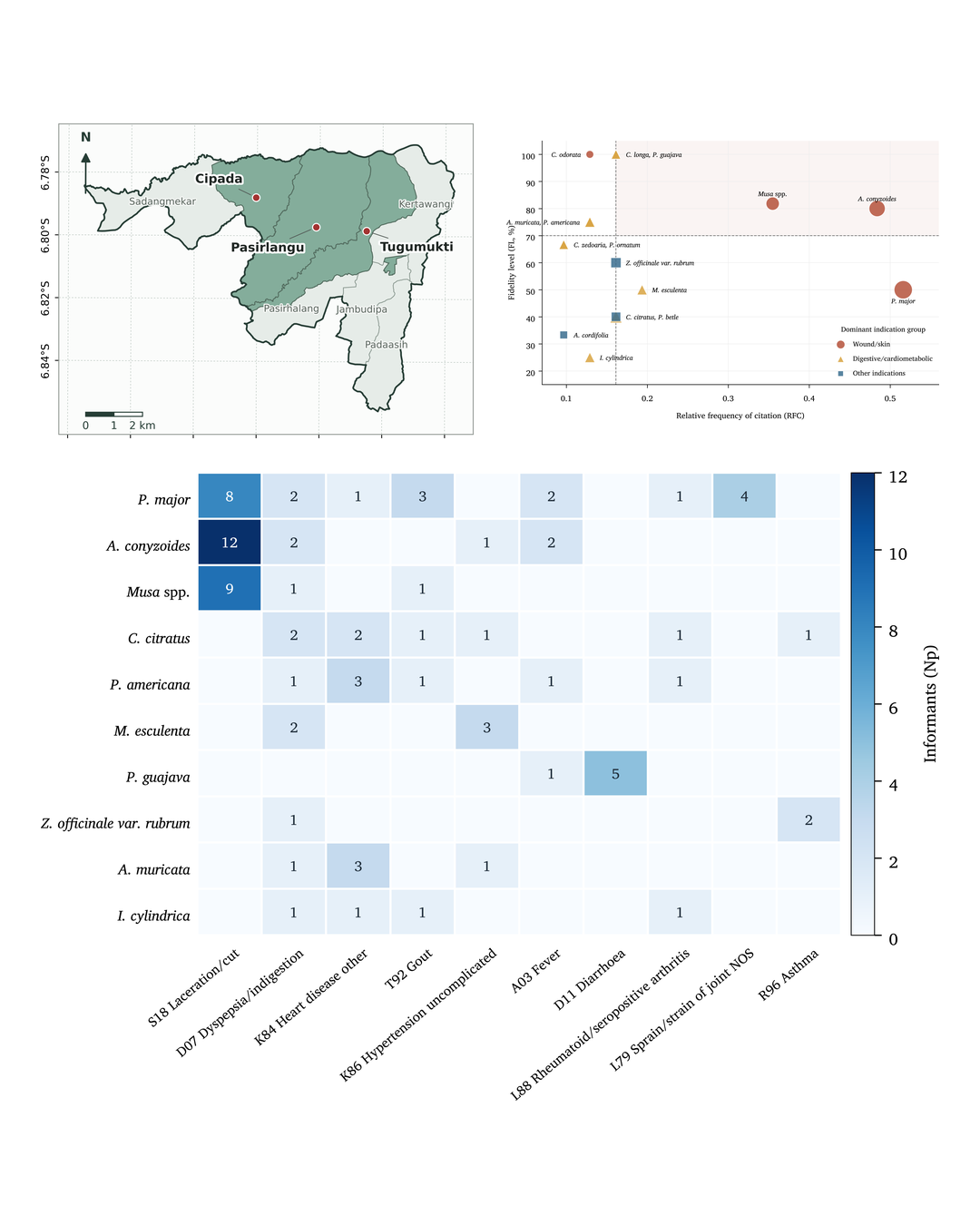
Ethnomedicinal knowledge can guide the selection of herbal candidates, but quantitative evidence from West Java is limited. This cross-sectional survey documented medicinal plant use among 31 Sundanese informants in three villages of Cisarua. Semi-structured interviews yielded 224 therapeutic use reports covering 66 taxa from 30 families, from which use-report, citation, fidelity, consensus, family-use, and Jaccard indices were calculated. Knowledge varied widely between informants (median four taxa; range 1–22). Leaves (60.3%), decoction (62.9%), and oral administration (72.8%) predominated. Plantago major L. had the highest use-report count (23), use value (0.742), and relative frequency of citation (0.516), whereas Ageratum conyzoides L. and Musa spp. showed high fidelity for lacerations (80.0% and 81.8%, respectively). Lacerations/cuts formed the largest indication category (39 reports; ICF = 0.789). Taken together, salience, specificity, and report volume identified wound-related taxa as priorities for authentication, standardized extraction, pharmacological validation, and safety assessment.
Full text article
References
Albar, H., Juhriah, & Santosa, S. (2025). Ethnobotany of medicinal plants by the community in Langgudu Sub-district, Bima District, West Nusa Tenggara, Indonesia. Biodiversitas, 26(1), 315–325. https://doi.org/10.13057/biodiv/d260131 DOI: https://doi.org/10.13057/biodiv/d260131
Andrade-Cetto, A., & Heinrich, M. (2011). From the field into the lab: Useful approaches to selecting species based on local knowledge. Frontiers in Pharmacology, 2, Article 20. https://doi.org/10.3389/fphar.2011.00020 DOI: https://doi.org/10.3389/fphar.2011.00020
Badan Penelitian dan Pengembangan Kesehatan. (2011). Pedoman umum panen dan pascapanen tanaman obat. Kementerian Kesehatan Republik Indonesia.
Badan Pusat Statistik Kabupaten Bandung Barat. (2020). Kecamatan Cisarua dalam angka 2020. BPS Kabupaten Bandung Barat.
Budi, H. S., Anitasari, S., Ulfa, N. M., Juliastuti, W. S., Aljunaid, M., Ramadan, D. E., Muzari, K., & Shen, Y.-K. (2022). Topical medicine potency of Musa paradisiaca var. sapientum (L.) Kuntze as oral gel for wound healing: An in vitro, in vivo study. European Journal of Dentistry, 16(4), 848–855. https://doi.org/10.1055/s-0041-1740226 DOI: https://doi.org/10.1055/s-0041-1740226
Bunga, C. D., Rianawati, L., Nurkhayati, N., Azizah, B. R., Yuliastuti, F., Lutfiyati, H., & Azzahra, A. L. (2025). Studi etnomedisin: Analisa potensi pemanfaatan tumbuhan obat tradisional di Desa Tempurejo. Jurnal Mandala Pharmacon Indonesia, 11(1), 91–109. https://doi.org/10.35311/jmpi.v11i1.760 DOI: https://doi.org/10.35311/jmpi.v11i1.760
Chahal, R., Nanda, A., Akkol, E. K., Sobarzo-Sánchez, E., Arya, A., Kaushik, D., Dutt, R., Bhardwaj, R., Rahman, M. H., & Mittal, V. (2021). Ageratum conyzoides L. and its secondary metabolites in the management of different fungal pathogens. Molecules, 26(10), 2933. https://doi.org/10.3390/molecules26102933 DOI: https://doi.org/10.3390/molecules26102933
Cheng, Y.-Z., Liu, I.-M., Cheng, J.-T., Lin, B.-S., & Liu, F. (2024). Wound healing is promoted by Musa paradisiaca (banana) extract in diabetic rats. Archives of Medical Science, 20(2), 632–640. https://doi.org/10.5114/aoms.2020.92344 DOI: https://doi.org/10.5114/aoms.2020.92344
Ekor, M. (2014). The growing use of herbal medicines: Issues relating to adverse reactions and challenges in monitoring safety. Frontiers in Pharmacology, 4, Article 177. https://doi.org/10.3389/fphar.2013.00177 DOI: https://doi.org/10.3389/fphar.2013.00177
Fabricant, D. S., & Farnsworth, N. R. (2001). The value of plants used in traditional medicine for drug discovery. Environmental Health Perspectives, 109(Suppl. 1), 69–75. https://doi.org/10.1289/ehp.01109s169 DOI: https://doi.org/10.1289/ehp.01109s169
Faruque, M. O., Uddin, S. B., Barlow, J. W., Hu, S., Dong, S., Cai, Q., Li, X., & Hu, X. (2018). Quantitative ethnobotany of medicinal plants used by indigenous communities in the Bandarban District of Bangladesh. Frontiers in Pharmacology, 9, 40. https://doi.org/10.3389/fphar.2018.00040 DOI: https://doi.org/10.3389/fphar.2018.00040
Febriyanti, R. M., Ramadhania, Z. M., Tjitraresmi, A., Indradi, R. B., Maisyarah, I. T., Maundu, P. M., Muhaimin, & Sujarwo, W. (2026). A systematic review of ethnobotanical studies in Indonesia: Diversity and cultural patterns of medicinal plant use. Journal of Ethnobiology and Ethnomedicine, 22(1), 42. https://doi.org/10.1186/s13002-026-00879-4 DOI: https://doi.org/10.1186/s13002-026-00879-4
Ghanadian, M., Soltani, R., Homayouni, A., Khorvash, F., Mohammadi Jouabadi, S., & Abdollahzadeh, M. (2024). The effect of Plantago major hydroalcoholic extract on the healing of diabetic foot and pressure ulcers: A randomized open-label controlled clinical trial. International Journal of Lower Extremity Wounds, 23(3), 475–481. https://doi.org/10.1177/15347346211070723 DOI: https://doi.org/10.1177/15347346211070723
Heinrich, M., Appendino, G., Efferth, T., Fürst, R., Izzo, A. A., Kayser, O., Pezzuto, J. M., & Viljoen, A. (2020). Best practice in research – Overcoming common challenges in phytopharmacological research. Journal of Ethnopharmacology, 246, Article 112230. https://doi.org/10.1016/j.jep.2019.112230 DOI: https://doi.org/10.1016/j.jep.2019.112230
Iskandar, B. S., Suryana, Y., Mulyanto, D., Iskandar, J., & Gunawan, R. (2023). Ethnomedicinal aspects of Sundanese traditional homegarden: A case study in rural Sumedang, West Java, Indonesia. Journal of Tropical Ethnobiology, 6(1), 57–78. https://doi.org/10.46359/jte.v6i1.167 DOI: https://doi.org/10.46359/jte.v6i1.167
Jadid, N., Kurniawan, E., Himayani, C. E. S., Andriyani, Prasetyowati, I., Purwani, K. I., Muslihatin, W., Hidayati, D., & Tjahjaningrum, I. T. D. (2020). An ethnobotanical study of medicinal plants used by the Tengger tribe in Ngadisari Village, Indonesia. PLOS ONE, 15(7), e0235886. https://doi.org/10.1371/journal.pone.0235886 DOI: https://doi.org/10.1371/journal.pone.0235886
Kodir, R. A., Moektiwardoyo, M., & Iskandar, Y. (2017). Etnofarmasi dan ulasan bioprospektif tumbuhan obat liar dalam pengobatan tradisional Kampung Adat Cikondang, Kecamatan Pangalengan, Kabupaten Bandung, Jawa Barat. Farmaka, 15(1), 26–44. https://jurnal.unpad.ac.id/farmaka/article/view/11487
Moreira, D. L., Teixeira, S. S., Monteiro, M. H. D. A., De-Oliveira, A. C. A. X., & Paumgartten, F. J. R. (2014). Traditional use and safety of herbal medicines. Revista Brasileira de Farmacognosia, 24(2), 248–257. https://doi.org/10.1016/j.bjp.2014.03.006 DOI: https://doi.org/10.1016/j.bjp.2014.03.006
Mulyani, Y., Hasimun, P., & Sumarna, R. (2020). Kajian etnofarmakologi pemanfaatan tanaman obat oleh masyarakat di Kecamatan Dawuan, Kabupaten Subang, Provinsi Jawa Barat. Jurnal Farmasi Galenika (Galenika Journal of Pharmacy), 6(1), 37–54. https://doi.org/10.22487/j24428744.2020.v6.i1.13572 DOI: https://doi.org/10.22487/j24428744.2020.v6.i1.13572
Najafian, Y., Hamedi, S. S., Kaboli Farshchi, M., & Feyzabadi, Z. (2018). Plantago major in Traditional Persian Medicine and modern phytotherapy: A narrative review. Electronic Physician, 10(2), 6390–6399. https://doi.org/10.19082/6390 DOI: https://doi.org/10.19082/6390
Ojha, K., Chandrabala, & Ponnusamy, K. (2025). The intersection of traditional medicine and wetland conservation: An ethnobotanical study of Surha Tal, India. Natural Resources for Human Health, 5(4), 532–548. https://doi.org/10.53365/nrfhh/204974 DOI: https://doi.org/10.53365/nrfhh/204974
Raihandhany, R., Dwiartama, A., & Ratnasih, R. (2023). A short note on Asteraceae as traditional food and medicinal plants in Cihanjawar Village, Purwakarta Regency, West Java. 3BIO: Journal of Biological Science, Technology and Management, 5(1), 162–167. https://doi.org/10.5614/3bio.2023.5.1.5 DOI: https://doi.org/10.5614/3bio.2023.5.1.5
Reang, M., Banik, B., Debbarma, S., & Datta, B. K. (2023). Quantitative assessment of ethnobotanical resources and medicinal plants utilization patterns in Tripura, India. Journal of Bioresources, 10(1), 14–24. https://doi.org/10.5281/zenodo.10513730
Riany, A., Permatasari, A. P., Salsabila, N., Nurlena, Rahayu, S. E., & Marcelina, M. (2024). Ethnobotanical study of medicinal plants in Bangbayang Village, Sumedang, West Java. Journal of Tropical Biodiversity, 4(2), 89–111. https://doi.org/10.59689/bio.v4i2.213 DOI: https://doi.org/10.59689/bio.v4i2.213
Royal Botanic Gardens, Kew. (2026). Plants of the World Online. Retrieved July 12, 2026, from https://powo.science.kew.org/
Shanmugam, S., Rajagopal, V., Balamurugan, S., Muthupandi, C. P., Eswaran, V. M., Raveendraretnam, K., & Rajendran, K. (2021). Ethnobotanical indices on wound healing medicinal plants in the Arjuna River of Virudhunagar District in Tamil Nadu, Southern India. Asian Journal of Ethnobiology, 4(1), 31–36. https://doi.org/10.13057/asianjethnobiol/y040103 DOI: https://doi.org/10.13057/asianjethnobiol/y040103
Soemarwoto, R., & Iskandar, J. (2021). Plant knowledge richness in the Sundanese upland village: A case study in Sindangsari, West Java, Indonesia. Biodiversitas, 22(9), 3722–3735. https://doi.org/10.13057/biodiv/d220916 DOI: https://doi.org/10.13057/biodiv/d220916
Swastini, D. A., Martien, R., Fachiroh, J., & Nugroho, A. E. (2025). Ethnopharmacology and bioactive evidence of medicinal plants for wound healing in Indonesia: A scoping review. Journal of Applied Pharmaceutical Science, 15(6), 10–30. https://doi.org/10.7324/JAPS.2025.211952 DOI: https://doi.org/10.7324/JAPS.2025.211952
Tangjang, M., Maletha, A., & Banerjee, K. (2025). Cultural roots of healing: Exploring traditional medicine practices of the Nocte tribe of Arunachal Pradesh. Indian Journal of Traditional Knowledge, 24(7), 665–676. https://or.niscpr.res.in/index.php/IJTK/article/download/18003/4556/91668
Weckerle, C. S., de Boer, H. J., Puri, R. K., van Andel, T., Bussmann, R. W., & Leonti, M. (2018). Recommended standards for conducting and reporting ethnopharmacological field studies. Journal of Ethnopharmacology, 210, 125–132. https://doi.org/10.1016/j.jep.2017.08.018 DOI: https://doi.org/10.1016/j.jep.2017.08.018
Widodo, R. C., Khuluq, M. H., & Handayani, E. W. (2024). Studi etnobotani penggunaan tanaman berkhasiat obat pada masyarakat di Kecamatan Mirit, Kabupaten Kebumen, Jawa Tengah. Jurnal Farmasi Klinik dan Sains, 4(2), 29–38. https://doi.org/10.26753/jfks.v4i2.1219 DOI: https://doi.org/10.26753/jfks.v4i2.1219
WONCA International Classification Committee. (2005). ICPC-2-R: International Classification of Primary Care (2nd ed., rev.). Oxford University Press.
Yudhantoro, L., Hidajat, N. N., Ismiarto, Y. D., & Ismono, D. (2019). Histopathological effects of Ageratum leaf extract (Ageratum conyzoides) on wound healing acceleration after acute excisional wound on epidermis in type 2 diabetes mellitus model of Sprague Dawley rats (Rattus norvegicus). Majalah Kedokteran Bandung, 51(3), 172–178. https://doi.org/10.15395/mkb.v51n3.1652 DOI: https://doi.org/10.15395/mkb.v51n3.1652
Zan, K., Li, Y.-L., Wang, Y., Wang, Z., Jin, H.-Y., Liu, L.-N., & Ma, S.-C. (2021). Risk assessment and determination of six main pyrrolizidine alkaloids in Agerati Conyzoidis Herba by UPLC-MS/MS. Chinese Journal of Pharmaceutical Analysis, 41(7), 1169–1175. https://doi.org/10.16155/j.0254-1793.2021.07.08
Zhakipbekov, K., Turgumbayeva, A., Issayeva, R., Kipchakbayeva, A., Kadyrbayeva, G., Tleubayeva, M., Akhayeva, T., Tastambek, K., Sainova, G., Serikbayeva, E., Tolenova, K., Makhatova, B., Anarbayeva, R., Shimirova, Z., & Tileuberdi, Y. (2023). Antimicrobial and other biomedical properties of extracts from Plantago major, Plantaginaceae. Pharmaceuticals, 16(8), 1092. https://doi.org/10.3390/ph16081092 DOI: https://doi.org/10.3390/ph16081092
Authors
Copyright (c) 2026 Raden Maya Febriyanti, Mahirah Mardiyah, Dwintha Lestari, Budi Irawan

This work is licensed under a Creative Commons Attribution-NonCommercial-ShareAlike 4.0 International License.
This work is licensed under a Creative Commons Attribution-NonCommercial-ShareAlike 4.0 International License. Copyright is retained by the authors.