
Effect of Red Galangal–Citronella Grass Decoction Ratios on Phenolic Content, Flavonoid Content, and Antioxidant Activity

Article Sidebar
-
ABTS, Alpinia purpurata, Cymbopogon nardus, Decoction
Abstract
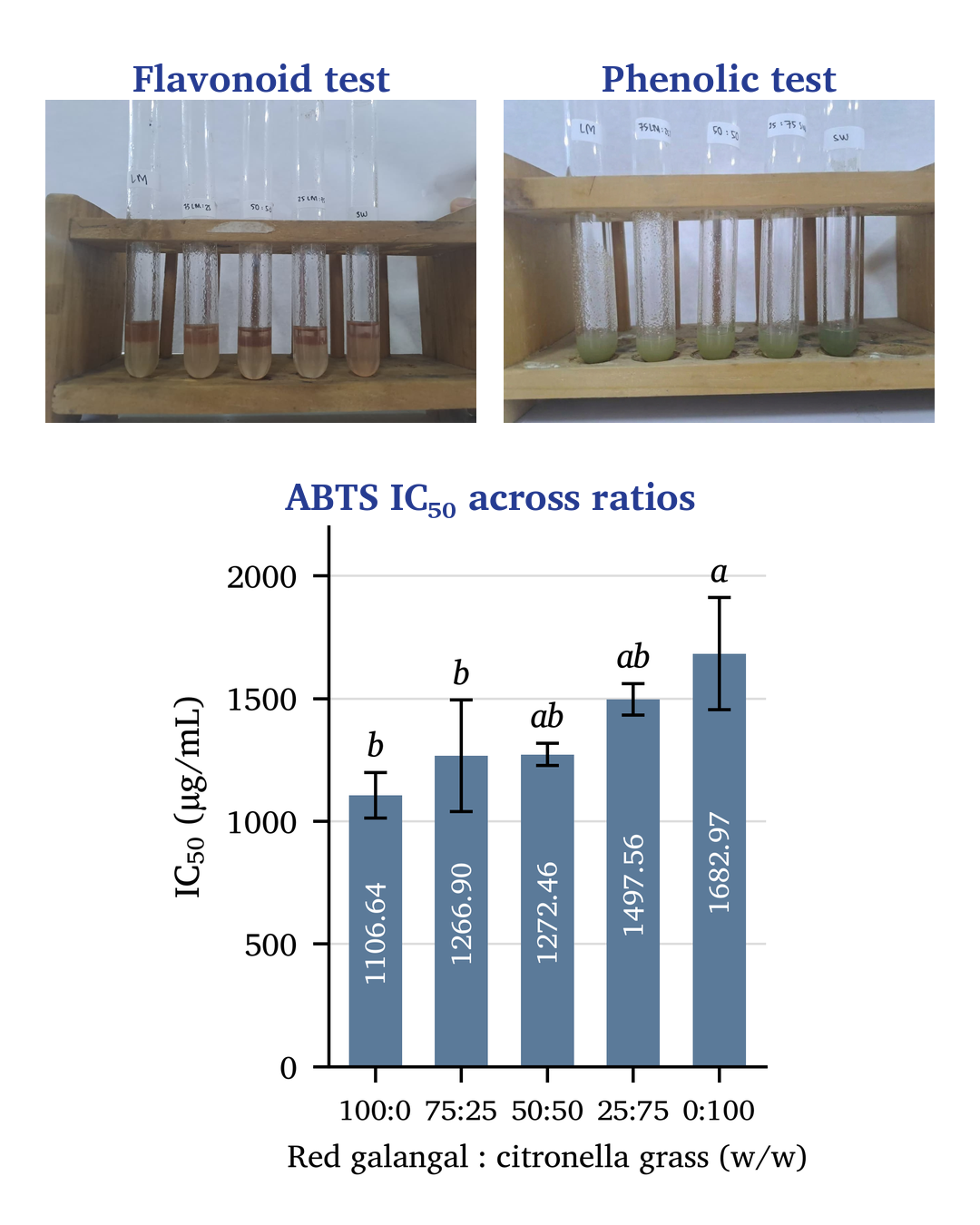
Whether the plants in polyherbal decoctions interact is rarely tested. Red galangal (Alpinia purpurata) and citronella grass (Cymbopogon nardus) were decocted at ratios of 100:0, 75:25, 50:50, 25:75, and 0:100 (w/w) and analysed for total phenolic content (TPC), total flavonoid content (TFC), and 2,2′-azino-bis(3-ethylbenzothiazoline-6-sulfonic acid) (ABTS) radical-scavenging activity; mixtures were compared with additive expectations. TPC decreased from 593.84 to 375.75 mg gallic acid equivalents/L as citronella grass increased, whereas TFC peaked at 25:75 (49.90 mg quercetin equivalents/L). The half-maximal inhibitory concentration (IC₅₀) ranged from 1106.64 µg/mL (red galangal) to 1682.97 µg/mL (citronella grass). Every mixture’s activity matched the additive prediction (observed/expected 0.96–1.05, p > 0.3), whereas TFC deviated strongly (0.74–1.41). Activity correlated with TPC (r = 0.97, p = 0.007) but not TFC. The ratio therefore adjusts antioxidant capacity proportionally, without synergy, and phenolics rather than flavonoids govern it.
Full text article
References
Akowuah, G. A., & Zhari, I. (2010). Effect of extraction temperature on stability of major polyphenols and antioxidant activity of Orthosiphon stamineus leaf. Journal of Herbs, Spices & Medicinal Plants, 16(3–4), 160–166. https://doi.org/10.1080/10496475.2010.509652 DOI: https://doi.org/10.1080/10496475.2010.509652
Anwar, K., Lokana, F. M., & Budiarti, A. (2022). Antioxidant activity of dewandaru leaf (Eugenia uniflora L.) ethanol extract and determination of total flavonoid and phenolic content. Jurnal Ilmiah Sains, 22(2), 161–171. https://doi.org/10.35799/jis.v22i2.43913 DOI: https://doi.org/10.35799/jis.v22i2.43913
Chairina, N., Permatasari, D. A. I., & Veranita, W. (2023). Uji aktivitas antioksidan ekstrak etanol batang serai wangi (Cymbopogon nardus L.) dengan metode DPPH (2,2-diphenyl-1-picrylhydrazyl) [Antioxidant activity of the ethanolic extract of citronella grass (Cymbopogon nardus L.) stems by the DPPH method]. Jurnal Farmasi dan Kesehatan Indonesia, 3(2), 65–74. https://doi.org/10.61179/jfki.v3i2.376 DOI: https://doi.org/10.61179/jfki.v3i2.376
Cui, W.-S., & Zhao, X.-H. (2020). Composition and activity changes of the soluble water and ethanol extracts from white mulberry (Morus alba L.) fruits in response to thermal treatment. Journal of Food Measurement and Characterization, 14(2), 838–848. https://doi.org/10.1007/s11694-019-00332-z DOI: https://doi.org/10.1007/s11694-019-00332-z
De Marino, S., Festa, C., Zollo, F., Nini, A., Antenucci, L., Raimo, G., & Iorizzi, M. (2014). Antioxidant activity and chemical components as potential anticancer agents in the olive leaf (Olea europaea L. cv Leccino.) decoction. Anti-Cancer Agents in Medicinal Chemistry, 14(10), 1376–1385. https://doi.org/10.2174/1871520614666140804153936 DOI: https://doi.org/10.2174/1871520614666140804153936
Djati, M., Naomi Azerlyn, D. R., Kusuma, K. H., Rosyadah, N., Sarah Kamila, F., Annisa, Y., Ika Christina, Y., Rizqi Dwijayanti, D., & Widodo, N. (2025). Antioxidant properties and quantification of phenolic and flavonoid compounds in Alpinia purpurata (Viell.) K. Schum ethanol extract. Biotropika: Journal of Tropical Biology, 13(1), 11–15. https://doi.org/10.21776/ub.biotropika.2025.013.01.02 DOI: https://doi.org/10.21776/ub.biotropika.2025.013.01.02
Elfrida, E., Tarigan, N. S., & Suwardi, A. B. (2021). Ethnobotanical study of medicinal plants used by community in Jambur Labu Village, East Aceh, Indonesia. Biodiversitas Journal of Biological Diversity, 22(7), 2893–2900. https://doi.org/10.13057/biodiv/d220741 DOI: https://doi.org/10.13057/biodiv/d220741
Fotakis, C., Tsigrimani, D., Tsiaka, T., Lantzouraki, D. Z., Strati, I. F., Makris, C., Tagkouli, D., Proestos, C., Sinanoglou, V. J., & Zoumpoulakis, P. (2016). Metabolic and antioxidant profiles of herbal infusions and decoctions. Food Chemistry, 211, 963–971. https://doi.org/10.1016/j.foodchem.2016.05.124 DOI: https://doi.org/10.1016/j.foodchem.2016.05.124
Harborne, J. B. (2006). Metode fitokimia: Penuntun cara modern menganalisis tumbuhan [Phytochemical methods: A guide to modern techniques of plant analysis] (K. Padmawinata & I. Soediro, Trans.). Penerbit ITB.
Harouak, H., Ibijbijen, J., & Nassiri, L. (2021). Chemical profile of Tetraclinis articulata (Vahl) Masters, and Juglans regia L. and Olea europaea L. var. sylvestris used against oral diseases: In vitro analysis between polyphenolic content and aqueous extraction optimization. Heliyon, 7(5), e07118. https://doi.org/10.1016/j.heliyon.2021.e07118 DOI: https://doi.org/10.1016/j.heliyon.2021.e07118
Hasan, H., Thomas, N. A., Hiola, F., Ramadhani, F. N., & Ibrahim, A. S. (2022). Skrining fitokimia dan uji aktivitas antioksidan kulit batang matoa (Pometia pinnata) dengan metode 1,1-diphenyl-2-picrylhydrazyl (DPPH) [Phytochemical screening and antioxidant activity of matoa (Pometia pinnata) stem bark by the DPPH method]. Indonesian Journal of Pharmaceutical Education, 2(1), 67–73. https://doi.org/10.37311/ijpe.v2i1.10995 DOI: https://doi.org/10.37311/ijpe.v2i1.10995
Hirose, Y., Washizu, T., Uchida, Y., & Matsugo, S. (2005). Structural determination and antioxidative activity of oxidation products of flavonoids with reactive oxygen species. In M. Hiramatsu, T. Yoshikawa, & L. Packer (Eds.), Molecular interventions in lifestyle-related diseases (pp. 333–337). CRC Press. https://doi.org/10.1201/9781420027174.ch27 DOI: https://doi.org/10.1201/9781420027174.ch27
Hossain, M. B., Ahmed, L., Martin-Diana, A. B., Brunton, N. P., & Barry-Ryan, C. (2023). Individual and combined antioxidant activity of spices and spice phenolics. Antioxidants, 12(2), 308. https://doi.org/10.3390/antiox12020308 DOI: https://doi.org/10.3390/antiox12020308
Jomova, K., Raptova, R., Alomar, S. Y., Alwasel, S. H., Nepovimova, E., Kuca, K., & Valko, M. (2023). Reactive oxygen species, toxicity, oxidative stress, and antioxidants: Chronic diseases and aging. Archives of Toxicology, 97(10), 2499–2574. https://doi.org/10.1007/s00204-023-03562-9 DOI: https://doi.org/10.1007/s00204-023-03562-9
Kurin, E., Hajská, M., Kostovčíková, E., Dokupilová, K., Mučaji, P., Nagy, M., Novotný, B., & Bittner Fialová, S. (2025). Unveiling synergistic antioxidant effects of green tea and peppermint: Role of polyphenol interactions and blend preparation. International Journal of Molecular Sciences, 26(13), 6257. https://doi.org/10.3390/ijms26136257 DOI: https://doi.org/10.3390/ijms26136257
Mardhiyyah, K., Ryandini, Y. I., & Hermawan, Y. (2021). Red and white galangal puree antioxidant activity and phytochemistry screening. Jurnal Jamu Indonesia, 6(1), 23–31. https://doi.org/10.29244/jji.v6i1.174 DOI: https://doi.org/10.29244/jji.v6i1.174
Molyneux, P. (2004). The use of the stable free radical diphenylpicrylhydrazyl (DPPH) for estimating antioxidant activity. Songklanakarin Journal of Science and Technology, 26(2), 211–219.
Muala, W. C. B., Desobgo, Z. S. C., & Jong, N. E. (2021). Optimization of extraction conditions of phenolic compounds from Cymbopogon citratus and evaluation of phenolics and aroma profiles of extract. Heliyon, 7(4), e06744. https://doi.org/10.1016/j.heliyon.2021.e06744 DOI: https://doi.org/10.1016/j.heliyon.2021.e06744
Mukarromah, M. L., Yulia, N., & Mardhiyah. (2024). Differences in antioxidant activity of butterfly pea flower infusion (Clitoria ternatea L.) with the addition of lemon and lime. Indonesian Journal of Pharmaceutical Education, 4(3), 473–486. https://doi.org/10.37311/ijpe.v4i3.29281 DOI: https://doi.org/10.37311/ijpe.v4i3.29281
Mulkiya Yuliawati, K., Salsabilla Yuniar, F., Febrina, E., Wilar, G., Febriyanti, R. M., Prayoga, D. K., Kuswandani, F., Sumiwi, S. A., Jiranusornkul, S., & Levita, J. (2026). Investigating the anti-inflammatory mechanism of Alpinia purpurata (Vieill.) K. Schum. rhizome extract: Metabolite profiling, network pharmacology, in vitro safety, and in vivo validation. Iranian Journal of Pharmaceutical Research, 25(1), e169725. https://doi.org/10.5812/ijpr-169725 DOI: https://doi.org/10.5812/ijpr-169725
Munteanu, I. G., & Apetrei, C. (2021). Analytical methods used in determining antioxidant activity: A review. International Journal of Molecular Sciences, 22(7), 3380. https://doi.org/10.3390/ijms22073380 DOI: https://doi.org/10.3390/ijms22073380
Olszowy, M., Dawidowicz, A. L., & Jóźwik-Dolęba, M. (2019). Are mutual interactions between antioxidants the only factors responsible for antagonistic antioxidant effect of their mixtures? Additive and antagonistic antioxidant effects in mixtures of gallic, ferulic and caffeic acids. European Food Research and Technology, 245(7), 1473–1485. https://doi.org/10.1007/s00217-019-03255-7 DOI: https://doi.org/10.1007/s00217-019-03255-7
Platzer, M., Kiese, S., Herfellner, T., Schweiggert-Weisz, U., & Eisner, P. (2021). How does the phenol structure influence the results of the Folin–Ciocalteu assay? Antioxidants, 10(5), 811. https://doi.org/10.3390/antiox10050811 DOI: https://doi.org/10.3390/antiox10050811
Predescu, N. C., Papuc, C., Nicorescu, V., Gajaila, I., Goran, G. V., Petcu, C. D., & Stefan, G. (2016). The influence of solid-to-solvent ratio and extraction method on total phenolic content, flavonoid content and antioxidant properties of some ethanolic plant extracts. Revista de Chimie, 67(10), 1922–1927.
Procházková, D., Boušová, I., & Wilhelmová, N. (2011). Antioxidant and prooxidant properties of flavonoids. Fitoterapia, 82(4), 513–523. https://doi.org/10.1016/j.fitote.2011.01.018 DOI: https://doi.org/10.1016/j.fitote.2011.01.018
Rahim, N. F. A., Muhammad, N., Abdullah, N., Talip, B. A., & Poh, K. H. (2020). The interaction effect and optimal formulation of selected polyherbal extracts towards antioxidant activity. Food Research, 4(6), 2042–2048. https://doi.org/10.26656/fr.2017.4(6).281 DOI: https://doi.org/10.26656/fr.2017.4(6).281
Rama, H., Ndaba, B., Maaza, M., Dhlamini, M. S., Cochrane, N., & Roopnarain, A. (2023). Effect of extraction methods on phytochemical constituents and antioxidant activity of de-kernelled Sclerocarya birrea seeds. Journal of the Science of Food and Agriculture, 103(15), 7757–7763. https://doi.org/10.1002/jsfa.12865 DOI: https://doi.org/10.1002/jsfa.12865
Rauf, A., Nawaz, H., & Shad, M. A. (2018). Effect of solvent polarity and extraction time on in vitro antioxidant properties of Brassica oleracea convar capitata var L. seeds. Pakistan Journal of Pharmaceutical Sciences, 31(5), 1889–1897.
Rohmawaty, E., Wiraswati, H. L., Zahra, T. A., Amalina, S. N., Ramadhanti, J., Rosdianto, A. M., Laelalugina, A., Nasution, G. T. D., & Kamisah, Y. (2025). Antioxidant and anti-inflammatory potential of Cymbopogon nardus ethanol extract on 3T3-L1 cells. Journal of Inflammation Research, 18, 2125–2136. https://doi.org/10.2147/JIR.S506189 DOI: https://doi.org/10.2147/JIR.S506189
Rudrapal, M., Khairnar, S. J., Khan, J., Dukhyil, A. B., Ansari, M. A., Alomary, M. N., Alshabrmi, F. M., Palai, S., Deb, P. K., & Devi, R. (2022). Dietary polyphenols and their role in oxidative stress-induced human diseases: Insights into protective effects, antioxidant potentials and mechanism(s) of action. Frontiers in Pharmacology, 13, 806470. https://doi.org/10.3389/fphar.2022.806470 DOI: https://doi.org/10.3389/fphar.2022.806470
Salim, R., Taslim, T., Selonni, F., Verawaty, & Dewi, I. P. (2025). Decoction of Cocos nucifera Linn.: Antioxidant activity, total phenolics, and flavonoids contents. Indonesian Journal of Pharmaceutical Science and Technology, 12(2), 129–136. https://doi.org/10.24198/ijpst.v12i2.45058 DOI: https://doi.org/10.24198/ijpst.v12i2.45058
Shraim, A. M., Ahmed, T. A., Rahman, M. M., & Hijji, Y. M. (2021). Determination of total flavonoid content by aluminum chloride assay: A critical evaluation. LWT, 150, 111932. https://doi.org/10.1016/j.lwt.2021.111932 DOI: https://doi.org/10.1016/j.lwt.2021.111932
Tibenda, J. J., Yi, Q., Wang, X., & Zhao, Q. (2022). Review of phytomedicine, phytochemistry, ethnopharmacology, toxicology, and pharmacological activities of Cymbopogon genus. Frontiers in Pharmacology, 13, 997918. https://doi.org/10.3389/fphar.2022.997918 DOI: https://doi.org/10.3389/fphar.2022.997918
Uduwana, S., Abeynayake, N., & Wickramasinghe, I. (2023). Synergistic, antagonistic, and additive effects on the resultant antioxidant activity in infusions of green tea with bee honey and Citrus limonum extract as additives. Journal of Agriculture and Food Research, 12, 100571. https://doi.org/10.1016/j.jafr.2023.100571 DOI: https://doi.org/10.1016/j.jafr.2023.100571
Wahyuni, D. K., Kharisma, V. D., Murtadlo, A. A. A., Rahmawati, C. T., Syukriya, A. J., Prasongsuk, S., Subramaniam, S., Wibowo, A. T., & Purnobasuki, H. (2024). The antioxidant and antimicrobial activity of ethanolic extract in roots, stems, and leaves of three commercial Cymbopogon species. BMC Complementary Medicine and Therapies, 24, 272. https://doi.org/10.1186/s12906-024-04573-4 DOI: https://doi.org/10.1186/s12906-024-04599-8
Wardani, T. K., Arianingsih, E., Syarifah, A., Hamad, A., & Hartanti, D. (2025). Crude drug standardization, formula optimization, and interaction effects of a five-component antioxidant polyherbal formulation. Jurnal Jamu Indonesia, 10(2), 93–101. https://doi.org/10.29244/jji.v10i2.353 DOI: https://doi.org/10.29244/jji.v10i2.353
Widyowati, R., Purwitasari, N., Ekasari, W., Agil, M., Sahu, R. K., Rohmah, M. N., & Sholikhah, I. (2024). An ethnomedicinal study: Joint pain therapy by traditional healers of Solo City. Traditional and Integrative Medicine, 9(1), 3–12. https://doi.org/10.18502/tim.v9i1.15084 DOI: https://doi.org/10.18502/tim.v9i1.15084
Yap, V. L., Tan, L. F., Rajagopal, M., Wiart, C., Selvaraja, M., Leong, M. Y., & Tan, P. L. (2023). Evaluation of phytochemicals and antioxidant potential of a new polyherbal formulation TC-16: Additive, synergistic or antagonistic? BMC Complementary Medicine and Therapies, 23, 93. https://doi.org/10.1186/s12906-023-03921-0 DOI: https://doi.org/10.1186/s12906-023-03921-0
Authors
Copyright (c) 2026 Dwi Endah Kusumawati, Davia Maulidda Suharno, Shenia Virdiyanti, Asih Puji Lestari, Ainun Fawaid

This work is licensed under a Creative Commons Attribution-NonCommercial-ShareAlike 4.0 International License.
This work is licensed under a Creative Commons Attribution-NonCommercial-ShareAlike 4.0 International License. Copyright is retained by the authors.