
Therapeutic Effects of Morus alba Leaf Extract on Fasting Blood Glucose and Pancreatic β-Cell Restoration in HFD–STZ-Induced Diabetic Rats

Article Sidebar
-
Diabetes mellitus, Metabolic syndrome, Morus alba, Pancreatic β-cells
Abstract
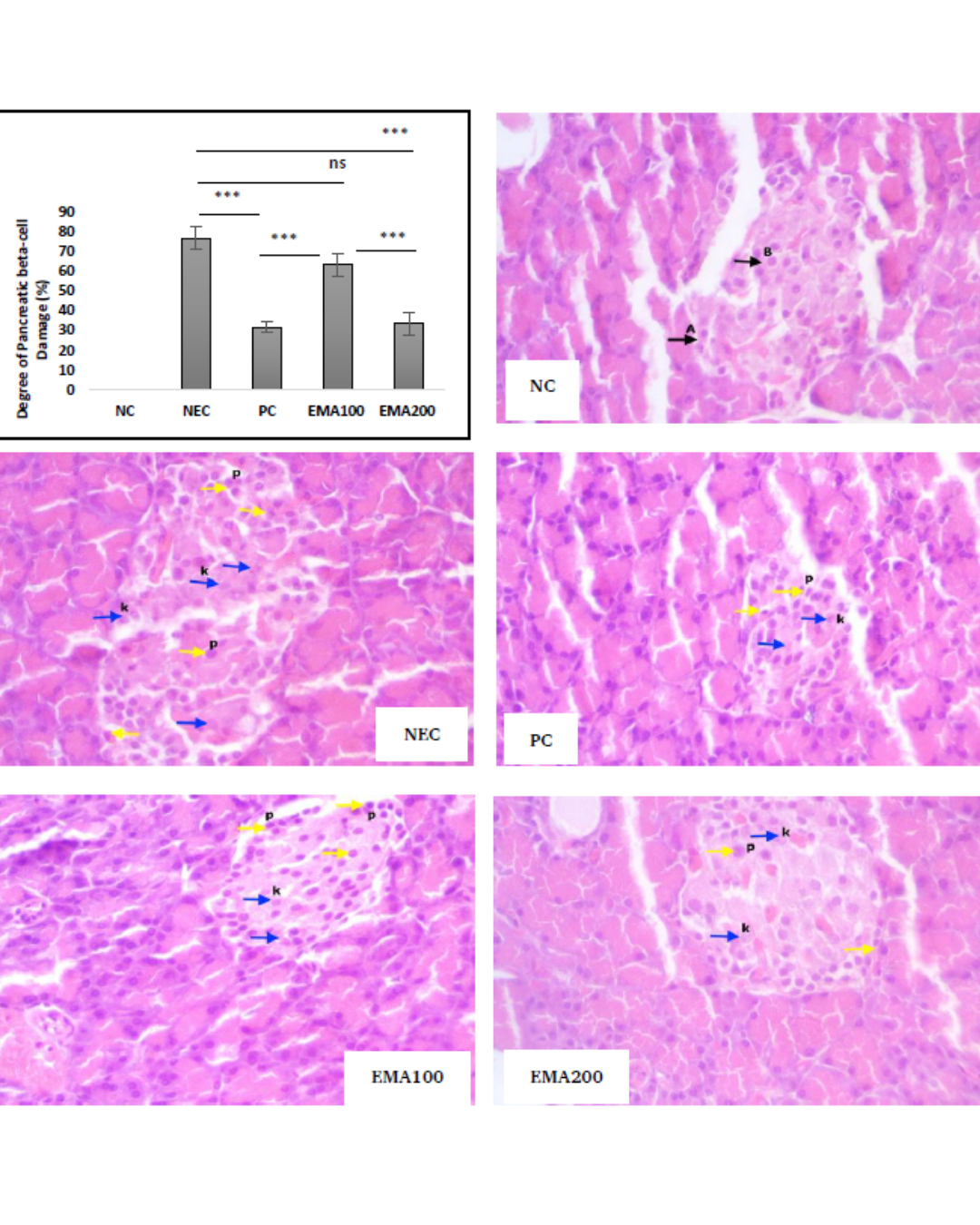
Type 2 diabetes mellitus (T2DM) is characterized by chronic hyperglycemia caused by insulin resistance and pancreatic β-cell dysfunction. Morus alba leaves contain bioactive compounds with potential antidiabetic activity. This study evaluated the hypoglycemic and β-cell protective effects of ethanolic M. alba leaf extract (EMA) in diabetic rats. The extract was obtained through maceration, yielding 12.14%. Wistar rats were divided into normal control, negative control, positive control, EMA100 (100 mg/kg BW), and EMA200 (200 mg/kg BW). Diabetes was induced using a high-fat diet, 2% sucrose solution, and low-dose streptozotocin. Fasting blood glucose (FBG) and pancreatic histopathology were analyzed. EMA significantly reduced FBG and improved pancreatic β-cell morphology, particularly at 200 mg/kg BW. These findings suggest that EMA has potential as a therapeutic candidate for T2DM by improving glycemic control and preserving pancreatic β-cell integrity.
Full text article
References
Abdalla, M. M. I. (2024). Advancing diabetes management: Exploring pancreatic beta-cell restoration’s potential and challenges. World Journal of Gastroenterology, 30(40), 4339–4353. https://doi.org/10.3748/wjg.v30.i40.4339
Sayem, M. A., Islam, H., Shil, R. C., Uddin, M. K. M., Hossen, A., Rahman, R., Hasan, M. M., Akter, T., Sultana, A., & Islam, S. (2025). Phytochemicals from anti-diabetic medicinal plants: A comprehensive review of glycemic control mechanisms. World Journal of Advanced Research and Reviews, 26(1), 3576–3590. https://doi.org/10.30574/wjarr.2025.26.1.1444
Banday, M. Z., Sameer, A. S., & Nissar, S. (2020). Pathophysiology of diabetes: An overview. Avicenna Journal of Medicine, 10(4), 174–188. https://doi.org/10.4103/ajm.ajm_53_20
Bitwell, C., Sen, S. I., Luke, C., & Kakoma, M. K. (2023). A review of modern and conventional extraction techniques and their applications for extracting phytochemicals from plants. Scientific African, 19, e01585. https://doi.org/10.1016/j.sciaf.2023.e01585
Brito, A. K. da S., Mendes, A. V. da S., Acha, B. T., Oliveira, A. S. da S., Macedo, J. L., Cruzio, A. S., Prianti, M. das G., Abreu, R. R. de, Lucarini, M., Durazzo, A., Martins, M. do C. de C. e, & Arcanjo, D. D. R. (2025). Experimental models of type 2 diabetes mellitus induced by combining hyperlipidemic diet (HFD) and streptozotocin administration in rats: An integrative review. Biomedicines, 13(5), 1158. https://doi.org/10.3390/biomedicines13051158
Chen, S., Xi, M., Gao, F., Li, M., Dong, T., Geng, Z., Liu, C., Huang, F., Wang, J., Li, X., Wei, P., & Miao, F. (2023). Evaluation of mulberry leaves’ hypoglycemic properties and hypoglycemic mechanisms. Frontiers in Pharmacology, 14, 1045309. https://doi.org/10.3389/fphar.2023.1045309
Coşkun, N., Sarıtaş, S., Jaouhari, Y., Bordiga, M., & Karav, S. (2024). The impact of freeze drying on bioactivity and physical properties of food products. Applied Sciences, 14(20), 9183. https://doi.org/10.3390/app14209183
Gieroba, B., Kryska, A., & Sroka-Bartnicka, A. (2025). Type 2 diabetes mellitus—Conventional therapies and future perspectives in innovative treatment. Biochemistry and Biophysics Reports, 42, 102037. https://doi.org/10.1016/j.bbrep.2025.102037
Hossain, M. J., Al-Mamun, M., & Islam, M. R. (2024). Diabetes mellitus, the fastest growing global public health concern: Early detection should be focused. Health Science Reports, 7(3), e2004. https://doi.org/10.1002/hsr2.2004
Huang, K.-C., Chuang, P.-Y., Yang, T.-Y., Tsai, Y.-H., Li, Y.-Y., & Chang, S.-F. (2024). Diabetic rats induced using a high-fat diet and low-dose streptozotocin treatment exhibit gut microbiota dysbiosis and osteoporotic bone pathologies. Nutrients, 16(8), 1220. https://doi.org/10.3390/nu16081220
Ji, S., Zhu, C., Gao, S., Shao, X., Chen, X., Zhang, H., & Tang, D. (2021). Morus alba leaves ethanol extract protects pancreatic islet cells against dysfunction and death by inducing autophagy in type 2 diabetes. Phytomedicine, 83, 153478. https://doi.org/10.1016/j.phymed.2021.153478
Lee, J.-E., Jayakody, J. T. M., Kim, J.-I., Jeong, J.-W., Choi, K.-M., Kim, T.-S., Seo, C., Azimi, I., Hyun, J., & Ryu, B. (2024). The influence of solvent choice on the extraction of bioactive compounds from Asteraceae: A comparative review. Foods, 13(19), 3151. https://doi.org/10.3390/foods13193151
Lv, Q., Lin, J., Wu, X., Pu, H., Guan, Y., Xiao, P., He, C., & Jiang, B. (2022). Novel active compounds and the anti-diabetic mechanism of mulberry leaves. Frontiers in Pharmacology, 13, 986931. https://doi.org/10.3389/fphar.2022.986931
Magliano, D. J., & Boyko, E. J. (Eds.). (2021). IDF diabetes atlas (10th ed.). International Diabetes Federation.
Ramos, J. G. M., Pairazamán, A. T. E., Willis, M. E. S. M., Santisteban, S. C., & Herrera, E. C. (2021). Medicinal properties of Morus alba for the control of type 2 diabetes mellitus: a systematic review. F1000Research, 10, 1022. https://doi.org/10.12688/f1000research.55573.1
Pereira, L., & Valado, A. (2023). Algae-derived natural products in diabetes and its complications: Current advances and future prospects. Life, 13(9), 1831. https://doi.org/10.3390/life13091831
Porasar, P., Gibo, R., Gogoi, B., Sharma, D., Bharadwaj, A., Gam, S., Hazarika, D., & Dutta, K. N. (2025). A systematic review on the phytochemistry, isolated compounds, nutritional benefits, pharmacology and toxicology of the plant species Morus alba L. Discover Plants, 2(1), 7. https://doi.org/10.1007/s44372-024-00043-w
Pratiwi, R. Y., Elya, B., Setiawan, H., Solawati, A., & Rosmalena. (2021). Alterations in body weight, blood glucose levels, and lipid profiles in high-fat diet–low dose streptozotocin-induced diabetic rats. Pharmacognosy Journal, 13(6), 1562–1567. https://doi.org/10.5530/pj.2021.13.199
Salampe, M., Rahimah, S., Nur, S., Mamada, S. S., Biring, F. S., Keyzia, K., Matandung, F. N., Payung, D., Rahman, A. A., Wahyuddin, N., & Ivone, V. P. (2025). Uji aktivitas antioksidan ekstrak daun murbei (Morus alba) menggunakan metode BCB, CUPRAC, dan FRAP. Jurnal Mandala Pharmacon Indonesia, 11(1), 149–157. https://doi.org/10.35311/jmpi.v11i1.723
Soeatmadji, D. W., Rosandi, R., Saraswati, M. R., Sibarani, R. P., & Tarigan, W. O. (2023). Clinicodemographic profile and outcomes of type 2 diabetes mellitus in the Indonesian cohort of DISCOVER: A 3-year prospective cohort study. Journal of the ASEAN Federation of Endocrine Societies, 38(1), 68–74. https://doi.org/10.15605/jafes.038.01.10
Strati, M., Moustaki, M., Psaltopoulou, T., Vryonidou, A., & Paschou, S. A. (2024). Early onset type 2 diabetes mellitus: An update. Endocrine, 85(3), 965–978. https://doi.org/10.1007/s12020-024-03772-w
Suthamwong, P., Minami, M., Okada, T., Shiwaku, N., Uesugi, M., Yokode, M., & Kamei, K. (2020). Administration of mulberry leaves maintains pancreatic β-cell mass in obese/type 2 diabetes mellitus mouse model. BMC Complementary Medicine and Therapies, 20(1), 136. https://doi.org/10.1186/s12906-020-02933-4
Taneera, J., & Saber-Ayad, M. M. (2024). Preservation of β-cells as a therapeutic strategy for diabetes. Hormone and Metabolic Research, 56(4), 261–271. https://doi.org/10.1055/a-2239-2668
Tran, N., Pham, B., & Le, L. (2020). Bioactive compounds in anti-diabetic plants: From herbal medicine to modern drug discovery. Biology, 9(9), 252. https://doi.org/10.3390/biology9090252
Tricase, A. F., Cavalluzzi, M. M., Catalano, A., De Bellis, M., De Palma, A., Basile, G., Sinicropi, M. S., & Lentini, G. (2025). Insights into the activities and usefulness of deoxynojirimycin and Morus alba: A comprehensive review. Molecules, 30(15), 3213. https://doi.org/10.3390/molecules30153213
Trimarco, V., Gallo, P., Ghazihosseini, S., Izzo, A., Rozza, P. I., Spinelli, A., Cristiano, S., De Rosa, C., Rozza, F., & Morisco, C. (2025). White mulberry plant extracts in cardiovascular prevention: An update. Nutrients, 17(14), 2262. https://doi.org/10.3390/nu17142262
Tsivileva, O. M., Koftin, O. V., & Evseeva, N. V. (2022). Coumarins as fungal metabolites with potential medicinal properties. Antibiotics, 11(9), 1156. https://doi.org/10.3390/antibiotics11091156
Wahidin, M., Achadi, A., Besral, B., Kosen, S., Nadjib, M., Nurwahyuni, A., Ronoatmodjo, S., Rahajeng, E., Pane, M., & Kusuma, D. (2024). Projection of diabetes morbidity and mortality till 2045 in Indonesia based on risk factors and NCD prevention and control programs. Scientific Reports, 14(1), 5424. https://doi.org/10.1038/s41598-024-54563-2
Wickramasinghe, A. S. D., Attanayake, A. P., Wijesiri, T. W., Peiris, H. H., & Mudduwa, L. K. B. (2024). Pancreatic and hepatic histopathology of high-fat diet fed streptozotocin-induced Wistar rat model of type 2 diabetes mellitus. Ceylon Journal of Science, 53(2), 235–242. https://doi.org/10.4038/cjs.v53i2.8274
Yameny, A. A. (2024). Diabetes mellitus overview 2024. Journal of Bioscience and Applied Research, 10(3), 641–645. https://doi.org/10.21608/jbaar.2024.382794
Authors

This work is licensed under a Creative Commons Attribution-NonCommercial-ShareAlike 4.0 International License. Copyright @2017. This is an open-access article distributed under the terms of the Creative Commons Attribution-NonCommercial-ShareAlike 4.0 International License (http://creativecommons.org/licenses/by-nc-sa/4.0/) which permits unrestricted non-commercial used, distribution and reproduction in any medium