
Jurnal Jamu Indonesia (JJI) is dedicated to the exchange of information and widespread scientific understanding regarding the development of the world of herbal medicine through the publication of scientific papers. The themes of scientific papers within the scope of JJI include the theme of herbal medicine research from upstream to downstream which is not limited to ethnobotanical research and local knowledge, exploration, conservation, domestication of biological resources related to herbal medicine, variety breeding, development of Good Agricultural and Collection Practices (GACP) for herbal medicine raw materials, development of standards for raw materials and herbal medicine products, development of herbal medicine products, identification of active compounds and their synthesis, working mechanisms for the bioactivity of herbal medicine formulas, social and economic aspects related to the development of herbal medicine.
Editorial Policiesee
- Focus and Scope
- Peer Review Process
- Publication Frequency
- Open Access Policy
- Publication Ethics
- Screening for Plagiarism
- Article Processing Charge
- Digital Archiving
- Review Guidelines
FOCUS AND SCOPE
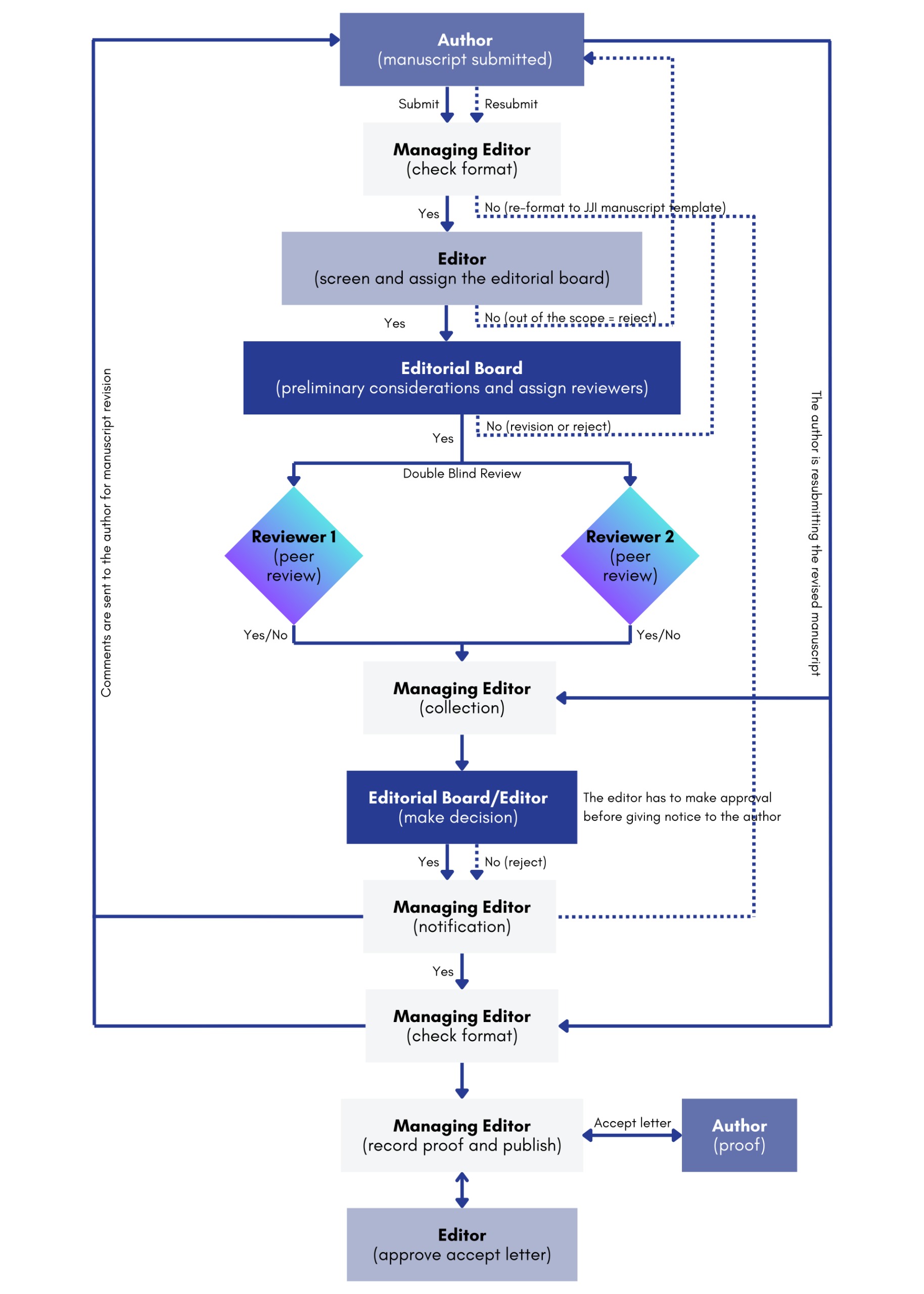
PEER REVIEW PROCESS
Overview: Jurnal Jamu Indonesia (JJI) publishes research articles, review articles, and short
communications. All submissions undergo a rigorous peer review process to ensure the highest
standards of academic quality. This process includes the following stages:
1. Screening: The editorial team initially screens all submitted articles to ensure they align with
the scope of JJI. This phase involves assessing the content, formatting, writing quality, and
language. Additionally, a plagiarism check is conducted using Turnitin. The screening process
typically takes 1–2 weeks. An article may be rejected during this stage for one or more of the
following reasons:
a) The content does not fall within the scope of JJI.
b) The plagiarism check reveals more than 25% content similarity.
c) The article lacks significant academic contribution.
d) The study offers no practical application or relevance.
e) The article is poorly formatted, presented, or written, making it difficult to understand.
2. Peer Review: If an article passes the screening stage, it is then subjected to peer review. The
editorial team selects two reviewers who are experts in the relevant field. These reviewers must
be from different institutions than the authors and from each other. JJI employs a single-blind
review process, where reviewers are aware of the authors' identities, but the authors do not know
the reviewers. The peer review process typically takes 2–3 months.
3. Notification of Peer Review Results: After the peer review process, the editorial team makes
the final decision based on the reviewers' feedback. Authors will be notified of one of the
following outcomes:
a) Accepted as is
b) Accepted with minor revisions
c) Requires extensive revision and reconsideration by the Associate Editor
d) Requires extensive revision and reconsideration by the original reviewers
e) Rejected
4. Revision: Authors whose articles require revision must address the reviewers' comments and
resubmit their work. The revised article is then evaluated by the editorial team or, in some cases,
by the original reviewers if they have requested to do so. Language editing services may be
offered if necessary. The revision process, from submission to the final decision, typically takes
up to 6 weeks.
5. Proofing: Accepted articles undergo proofreading, with proofs sent electronically to
corresponding authors for verification. Corrections are expected within 48 hours.
PUBLICATION FREQUENCY
Starting in 2026, Jurnal Jamu Indonesia will be published six times a year (February, April, June, August, October, and December)
OPEN ACCESS POLICY
Jurnal Jamu Indonesia provides immediate open access to its content on the principle that making research freely available to the public supports a greater global exchange of knowledge.
PUBLICATION ETHICS OF JJI
1. General Statement
Jurnal Jamu Indonesia (JJI) is dedicated to upholding the highest standards of publication ethics and takes all possible measures against any publication malpractice. The journal follows the guidelines of the Committee on Publication Ethics (COPE) and expects all parties involved — authors, reviewers, editors, and the publisher — to strictly adhere to these ethical standards.
Any form of unethical behavior, such as plagiarism, data fabrication, duplicate publication, or authorship manipulation, is strictly prohibited. Allegations of misconduct will be investigated thoroughly, and appropriate action — including retraction — will be taken when necessary.
2. Responsibilities of Authors
Authors submitting manuscripts to JJI must:
- Ensure Originality: Submit original work that has not been previously published or under consideration elsewhere. All sources and references must be properly cited.
- Avoid Redundant Publication: Submitting the same manuscript to more than one journal simultaneously is considered unethical.
- Declare Conflicts of Interest: All authors must disclose any financial or personal relationships that could inappropriately influence their work. If there is no conflict, a statement such as “The authors declare no conflict of interest.” must be included.
- Assign Proper Authorship: Authorship must be limited to individuals who have made significant contributions to the research. All listed authors must approve the final manuscript before submission.
- Acknowledge Funding and Support: All financial support and institutional contributions must be clearly acknowledged.
- Ensure Research Ethics for Human and Animal Subjects:
- Human studies must have received ethical approval from an accredited ethics committee.
- Informed consent must be obtained from all participants.
- Participant confidentiality and anonymity must be protected.
- Animal studies must comply with institutional and national ethical standards.
- Register Clinical Trials: Clinical trials must be registered in a publicly accessible registry (e.g., ClinicalTrials.gov or WHO ICTRP). The registration number must be clearly stated in the manuscript.
- Make Data Available: Authors are encouraged to provide access to raw data, when appropriate, and retain all research data for a reasonable period after publication.
3. Responsibilities of Editors
Editors are responsible for:
• Making unbiased editorial decisions based solely on the manuscript’s academic merit and relevance.
• Ensuring a fair, timely, and confidential peer review process.
• Taking appropriate action when ethical concerns or complaints arise.
• Avoiding conflicts of interest and withdrawing from editorial decisions where a conflict exists.
• Upholding academic integrity and transparency throughout the editorial process.
4. Responsibilities of Reviewers
Peer reviewers are expected to:
• Provide constructive, objective, and timely evaluations of submitted manuscripts.
• Maintain the confidentiality of all manuscript content.
• Declare any conflicts of interest.
• Report any ethical issues (e.g., plagiarism, duplicate submission, data falsification) to the editors.
5. Handling of Ethical Misconduct
JJI follows COPE procedures in handling allegations of misconduct. If ethical violations are confirmed, appropriate actions may include:
• Rejection or withdrawal of the manuscript
• Retraction of published articles
• Notification to authors’ institutions or funding bodies
All actions will be documented, and retractions or corrections will be issued transparently with detailed explanations.
6. Data Sharing and Transparency
Authors are encouraged to deposit their datasets in public repositories or provide access to underlying data supporting their findings. A Data Availability Statement must be included in the manuscript.
7. Publication Model and Licensing
JJI is an open access journal. All articles are published under the terms of the Creative Commons Attribution-NonCommercial-ShareAlike 4.0 International License (CC BY-NC-SA 4.0), allowing others to remix, adapt, and build upon the work non-commercially, as long as they credit the authors and license their new creations under the identical terms.
License link: https://creativecommons.org/licenses/by-nc-sa/4.0/
An Article Processing Charge (APC) applies to accepted articles. Details are available on the journal's website.
8. Principles of Transparency
JJI adheres to international standards for transparency in scholarly publishing. We provide clear and accessible information about:
• Editorial and peer review process
• Editorial board and institutional affiliation
• Article processing fees
• Licensing and copyright policy
• Ethical publishing practices
• Archiving and indexing
9. Reporting of Ethical Issues
If any concerns arise regarding ethical misconduct related to submitted or published articles, please contact the editorial office:
Email: jurnaljamuindonesia@apps.ipb.ac.id
All reports will be handled confidentially and reviewed in accordance with COPE guidelines.
10. Retraction and Correction Policy
Articles published in Jurnal Jamu Indonesia (JJI) will be considered for retraction or correction if:
1. There is clear evidence that the findings are unreliable, either as a result of scientific misconduct (e.g., data fabrication, falsification) or honest error (e.g., miscalculation or experimental error).
2. The findings have been previously published elsewhere without proper citation, permission, or justification (redundant or duplicate publication).
3. The article constitutes plagiarism.
4. The research is found to be unethical or violates recognized ethical standards.
Mechanism of Retraction
The retraction mechanism follows the Retraction Guidelines of the Committee on Publication Ethics (COPE), which can be accessed at: https://publicationethics.org/files/retraction%20guidelines.pdf
• A retraction notice will be issued and linked to the original article.
• The retraction notice will clearly state the reasons for retraction.
• Retracted articles will not be removed from the online archive but will be clearly marked as “Retracted” to ensure the integrity of the scholarly record.
Corrections
In cases where a small portion of an otherwise reliable article proves to be misleading (especially due to honest error), a correction (erratum or corrigendum) will be published promptly.
Article Processing Charge
Jurnal Jamu Indonesia (JJI) is an Open Access Journal. The publication fee (APC) for the Jurnal Jamu Indonesian is IDR 1,000,000. Additional charges may be billed for language improvement (IDR 500,000-1,000,000).
SCREENING FOR PLAGIARISM
The authors should ensure that they have written entirely original works, and if the authors have used the work and/or words of others, that this has been appropriately cited or quoted. Plagiarism takes many forms, from passing off another paper as the author's own to copying or paraphrasing substantial parts of another paper (without attribution) to claiming results from research conducted by others. Plagiarism in all its forms constitutes unethical publishing behavior and is unacceptable. Turnitin is at most 25% with the provisions of excluding bibliography and excluding less than 3% sources.
DIGITAL ARCHIVING
The Jurnal Jamu Indonesia (JJI) has implemented a robust digital preservation strategy by utilizing the PKP Preservation Network (PKP PN), guaranteeing uninterrupted access to its scholarly content. This commitment to preservation is detailed in the Publisher Manifest, ensuring that the valuable research published within JJI remains available to future scholars. Furthermore, the PKP PN serves as an essential safeguard for OJS journals, particularly those not included in other preservation services like CLOCKSS or Portico, thus playing a crucial role in maintaining the availability of academic literature for the long term.